Milk Literacy: Why Every Indian Family Should Know Their Dairy — Aryan Sharma
Milk is almost certainly the most repeated food decision in your home. You buy it every day, you pour it for children before school and for elders before bed, you cook with it, you set curd from it. And yet, if I stopped you outside a shop and asked three plain questions — which animal your milk came from, which farm, and whether it was quality checked — most people in this country could not answer even one. That is not your failing. It is the design of a system that never expected you to ask.
I am Aryan Sharma, and I started PYAAS because I believe that silence is the real problem in Indian dairy — not price, not fat percentage, not packaging. Families have been asked to trust milk they were never allowed to see. My answer to that is a phrase I keep coming back to: milk literacy. It simply means the ability of any family to know what is in the glass. This essay is my case for why milk literacy for families is a basic consumer right, and not a premium you should have to pay extra to unlock.
What milk literacy actually means
Milk literacy is not a science degree and it is not fear. I am not asking you to memorise casein proteins or to distrust every carton on the shelf. I am asking for something much smaller and much more powerful: that the answers to basic questions about your milk are visible to you, in plain language, before you buy.
A literate reader can look at a page and understand it. A milk-literate family can look at a pack and understand it too — where it came from, what is in it, and how to check. The information already exists somewhere in every supply chain. Milk literacy is just the decision to hand that information back to the person actually drinking it.
Why it is a right, not a premium
Somewhere along the way, transparency in dairy got sold back to us as luxury. Know your source, and you pay more. Want to see a test, pay more. See the farm, pay more. I find this quietly unfair. You do not pay a surcharge to read the ingredients on a biscuit packet or to see the expiry on a bottle of oil. Knowing what you eat is treated as the default there. Milk should be no different.
A family in India buying milk every morning is not asking for a favour when they ask where it came from. They are asking for the same honesty every other aisle already offers. At PYAAS we treat traceability as a baseline the customer is owed, not a feature we charge for. The premium, if there is one, is in the care of the milk itself — not in the right to know about it.
The four things a milk-literate family can ask
If milk literacy sounds abstract, it is really just four questions. Ask them of anyone who sells you milk, from a doorstep vendor to a national brand. The answers, or the silences, will tell you almost everything.
1. Which animal, and which breed
A2 is a genetic claim — it depends entirely on the cow — so a brand that cannot name the breed cannot honestly stand behind the word. Our A2 milk comes from the A2 cows within herds of Holstein Friesian and Sahiwal on our partner farms. If you want the plain science behind the term, read what A2 milk actually is.
2. Which farm, and which farmer
Most packaged milk is pooled from thousands of farms and mixed, which means no one can truthfully tell you where your litre began. Single-origin milk from a named farm is the only way a farm-level claim can hold up. Our milk will come from named farms in Gonda, Uttar Pradesh — Sri Radha Mohan Dairy Farm, where farmer Ram tends a herd of 76 cows, alongside Gonard Dairy and Ranjeet Singh Dairy Farm.
3. How fresh, and how far it travelled
Freshness is a number, not an adjective. Ask how many hours pass between milking and your door, and whether it stayed cold the whole way. A short, chilled journey is one of the biggest differences you can taste, and it is a fair thing to expect an answer to.
4. Was it quality checked
Purity is not a feeling either. A milk-literate family should be able to see a recent quality record for the batch they are actually drinking, not a certificate from a year ago. And you do not need a laboratory at home to stay alert — a few simple purity checks go a long way.
How we are building milk literacy at PYAAS
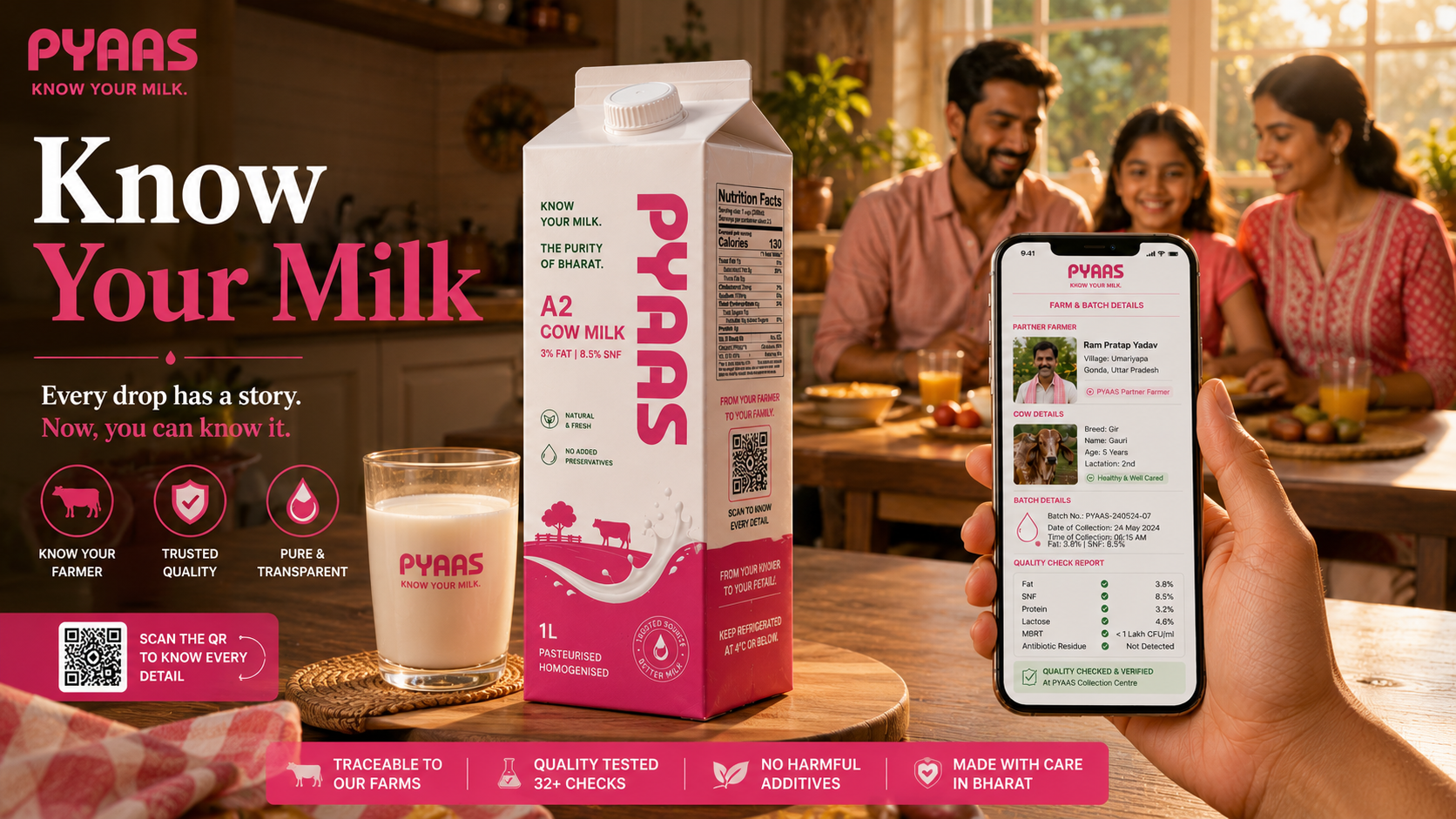
The whole promise of PYAAS is in our tagline: Know Your Milk. Every pack carries a QR code. Scan it and you see the exact farm, the farmer who milked the cows, and that batch's quality record. You do not have to take our word for any of it, which is precisely the point — milk literacy only counts if you can verify it yourself. You can meet the people and places behind every batch on the farms page.
To be honest about where we are today: our A2 Bilona cow ghee is live and shipping across India right now, made in small batches. Our fresh A2 cow milk is not out yet — it launches in Lucknow from August 2026 and will expand across Uttar Pradesh from there. I would rather tell you exactly what is ready and what is coming than blur the two. That, too, is part of milk literacy.
The literate kitchen is the future
I think we are heading toward a version of Indian dairy where asking where your milk came from feels as ordinary as checking a date on a packet — where no family has to pay extra to know, and no brand gets to stay silent. That is the standard we are building PYAAS toward, farm by farm and batch by batch.
You do not need to become an expert. You only need to expect answers. Ask the four questions the next time you buy milk for your family. The sellers worth keeping are the ones who can answer all four without flinching — and who hand you the proof before you ever have to ask.
Written by
Aryan Sharma
Aryan Sharma is the Founder & CEO of PYAAS, an independent, transparency-first dairy brand based in Gonda and Lucknow, Uttar Pradesh. Every PYAAS pack is traceable to its farm by QR — Know Your Milk.
More from Aryan SharmaCommon questions.
What is milk literacy?
Milk literacy is the plain ability of any family to know what they are drinking: which animal and breed the milk came from, which farm and farmer produced it, how fresh it is, and whether it was quality checked. It does not require any science background — only that a brand is willing to show you those answers instead of asking you to trust a word on the front of the pack.
Is knowing where my milk comes from really necessary, or just marketing?
It is necessary. Milk is the food most Indian families buy every single day, often for children and elders, so small differences in source and freshness repeat hundreds of times a year. Knowing the farm, the breed and the quality check is how you judge value honestly. When a brand cannot tell you where a litre came from, you are trusting a claim, not a source.
How can a family become more milk-literate without lab equipment at home?
Start by asking your seller five questions: which breed, which farm, how many hours from milking to your door, whether the batch is quality checked, and whether you can reach a real person. You can also run a few simple home checks. With PYAAS, every pack carries a QR code that opens the exact farm, the farmer and that batch's quality record, so the answers are handed to you rather than hidden.
Get the next one in your inbox.
The occasional note on milk, ghee, and how we work. Plain words, no hype, and you can leave any time.
Keep reading.
A2 Bilona Ghee in Gorakhpur: A Buyer's Guide
13 September 2026
A2 Bilona Ghee in Mathura and Vrindavan
13 September 2026
A2 Bilona Ghee in Mumbai, Delivered Across India
13 September 2026
A2 Bilona Ghee in Bengaluru, Delivered to Your Door
11 September 2026