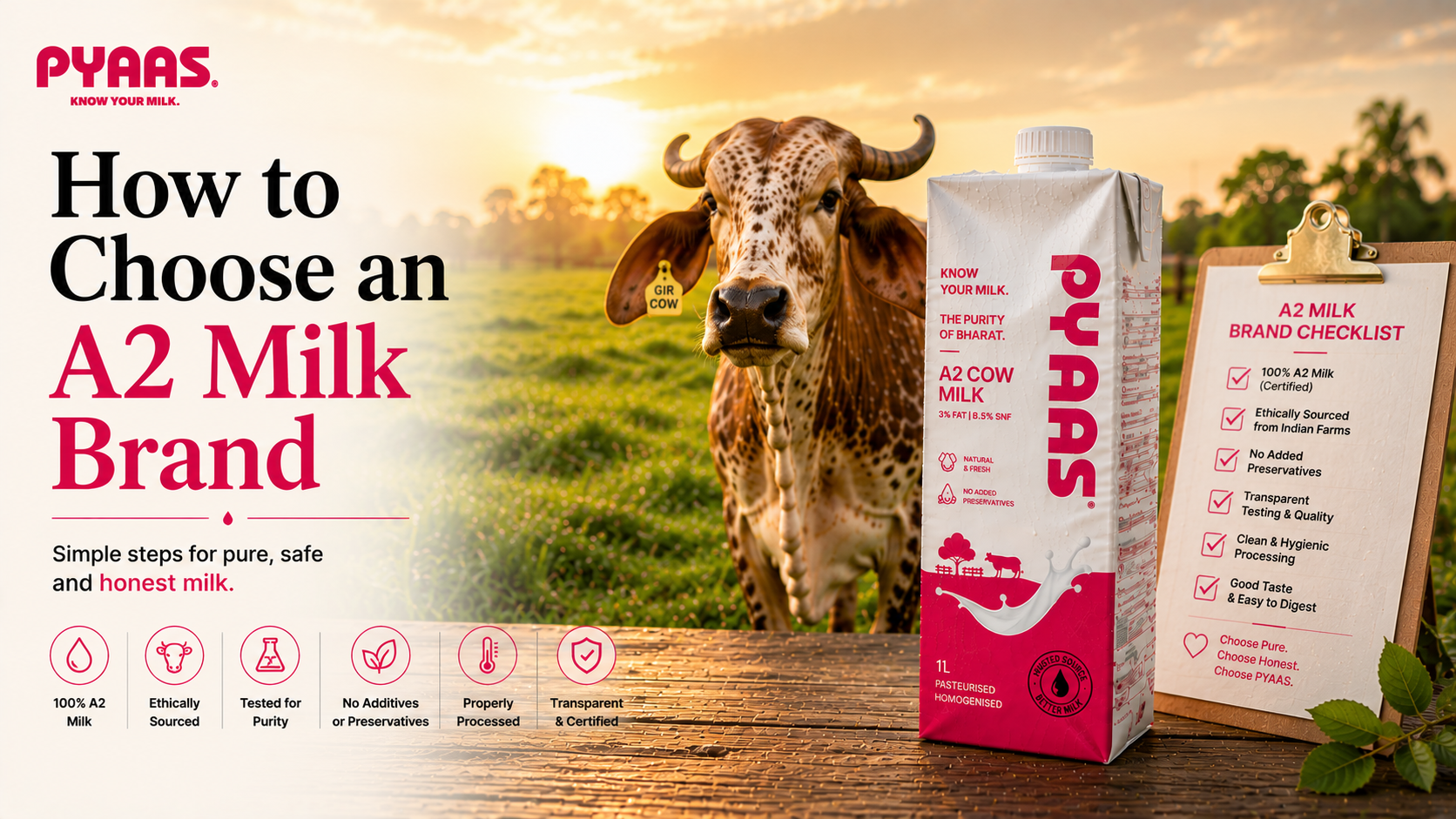
Why an A2 Claim Needs Proof, Not Just a Label
I build the traceability system at PYAAS, which means I spend my days on a single uncomfortable question: if we print "A2" on a pack, can I prove it? Not argue it, not vouch for it, but prove it to a stranger who has every reason to be skeptical. My name is Kushagra Shekhar Kaushik, and as the Founder & CTO of PYAAS I have come to believe that an A2 claim is only ever as good as the record standing behind it.
Walk past any dairy shelf and "A2" is everywhere now. It has become one of the most repeated words in Indian food, and one of the least verified. That gap, between how often the word is printed and how rarely it can be checked, is the problem I want to talk about.
A2 is a claim about genetics, not a flavour
A2 is not a taste, a grade, or a marketing tier. It is a statement about a cow's genetics. Milk carries a protein called beta-casein, and depending on the animal's genes it appears in an A1 or an A2 form. A2 milk comes from cows that produce only the A2 type. At PYAAS our herds in Gonda, Uttar Pradesh are Holstein Friesian and Sahiwal, and the A2 milk comes specifically from the A2 cows in those herds.
Read that last sentence again, because it is where most A2 marketing quietly falls apart. A2 is a property of an individual animal. If a brand cannot tell you which cows, on which farm, then "A2" on the front of the pack is a hope, not a fact. It is a genetic claim resting on genetics that no one can see.
The label is a promise; traceability is the proof
Here is the distinction I keep returning to as a technologist. A label is a promise. Traceability is the proof that the promise was kept. Anyone can print the promise. Almost no one, in this industry, can show the proof.
When milk is pooled, collected from thousands of unnamed farms and mixed in a single tank, the proof is destroyed at the source. Once your litre is blended with everyone else's, no honest person can tell you which cow it came from. The A2 word may still be true in aggregate, but it is unverifiable by design. And an unverifiable truth, to a customer paying a premium, is hard to distinguish from a story.
What we actually built at PYAAS
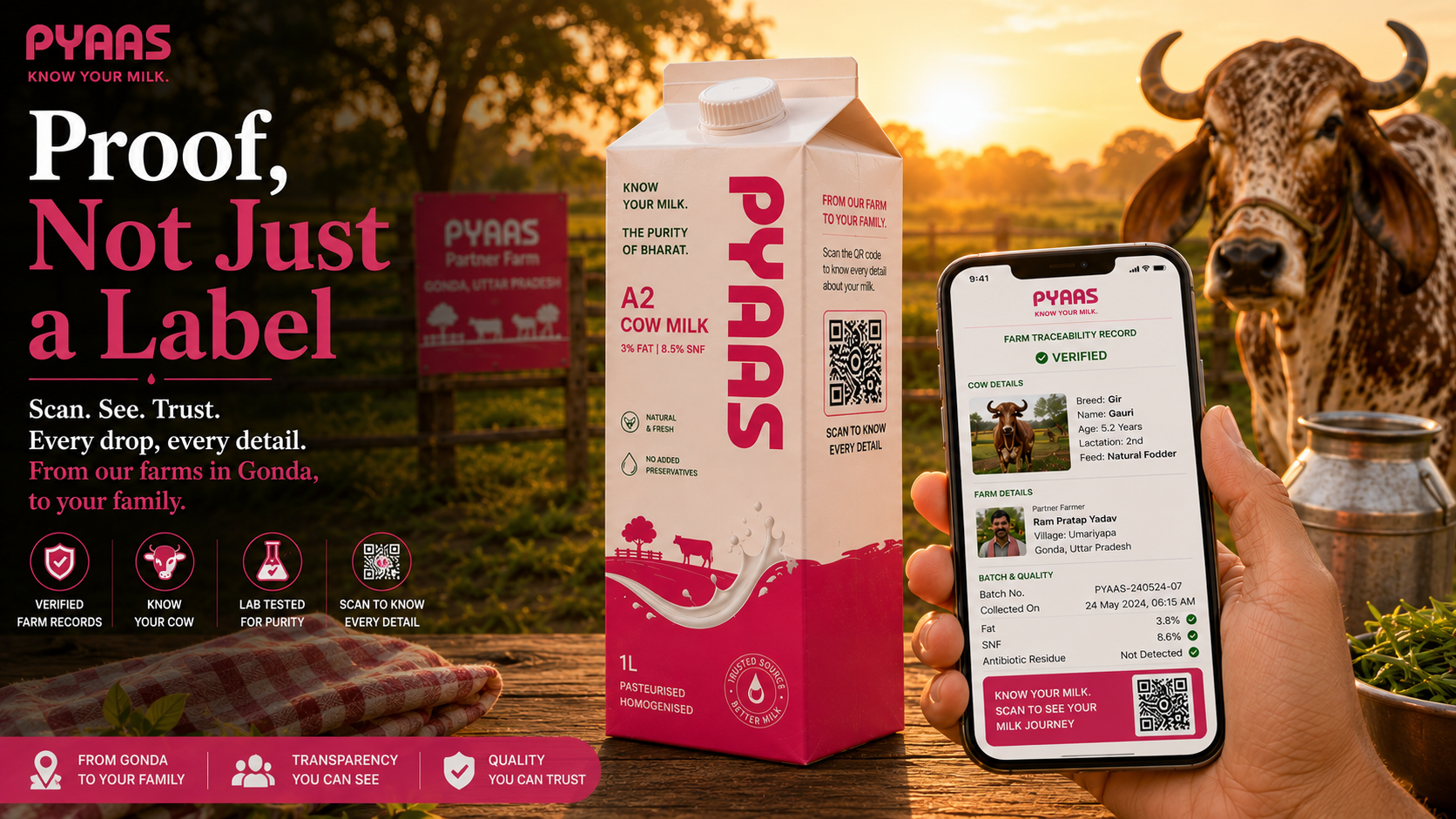
The traceability system I lead exists to close exactly that gap. Every PYAAS pack carries a QR code. Scan it and it opens the record for that specific batch: the named farm it came from, whether Sri Radha Mohan Dairy Farm, Gonard Dairy or Ranjeet Singh Dairy Farm, the farmer who milked the cows, and that batch's quality-checked record.
None of that is a brochure. It is a real entry tied to a real batch, a real farmer and a real day. When Ram at Sri Radha Mohan's 76-cow farm sends milk, or Harsh Singh at Gonard Dairy, or Ranjeet Singh at his own farm, that origin follows the milk all the way to your kitchen. The point of the technology is not to be clever. It is to make sure I never have to ask you to simply trust me.
Four questions that separate proof from packaging
- Which farm? A real A2 claim can name the farm, not just a region or a co-operative.
- Which breed, and which cows? A2 is genetic, so the herd should be nameable and the A2 animals identifiable.
- Single-origin or pooled? Pooled milk cannot carry a farm-level A2 claim honestly, however good it tastes.
- Can you see the batch's own record? Not a certificate from last year, but the quality-checked record for the pack in your hand.
Run any A2 milk through those four questions and the field narrows fast. That is not an accident. Proof is expensive to build and easy to leave out, which is exactly why so few brands offer it.
Where this is heading
Today PYAAS ships A2 Bilona cow ghee across India, and every jar already carries this traceability. Fresh A2 cow milk is next: we launch in Lucknow from August 2026 and expand across Uttar Pradesh from there, with the same QR-to-batch record on every pack from day one. We are building toward a ₹100 crore dairy brand, but the number is not the point, the standard is. If we cannot prove a claim, we would rather not make it.
My hope is that this becomes normal, and then boring. When "A2" on a label is expected to come with a record you can open in three seconds, the word finally means something again. Until then, treat every A2 claim the way I do when I sit down to design the system: assume it needs proof, and go looking for it. That is what Know Your Milk means to me, and you can meet the farms behind every batch whenever you like. — Kushagra Shekhar Kaushik
Written by
Kushagra Shekhar Kaushik
Kushagra Shekhar Kaushik is the Founder & CTO of PYAAS, an independent, transparency-first dairy brand based in Gonda and Lucknow, Uttar Pradesh, building the technology that makes every pack traceable to its farm by QR.
More from Kushagra Shekhar KaushikCommon questions.
What does 'A2 milk proof' actually mean?
It means being able to verify an A2 claim rather than just read it. Because A2 is about a cow's genetics, real proof is traceability: the ability to see which named farm and which cows the milk came from. At PYAAS, a QR code on every pack opens that batch's farm, farmer and quality-checked record.
How can I tell if an A2 milk brand is genuine?
Ask whether it can name the farm and the breed, whether the milk is single-origin or pooled from many suppliers, and whether you can see a record for the exact batch you are buying. If a brand cannot show you where the milk came from, treat the A2 claim with caution.
Is PYAAS A2 milk available now?
PYAAS A2 Bilona cow ghee ships across India today and already carries QR traceability. Fresh A2 cow milk is launching in Lucknow from August 2026 and will expand across Uttar Pradesh, with the same farm-to-batch record on every pack.
Get the next one in your inbox.
The occasional note on milk, ghee, and how we work. Plain words, no hype, and you can leave any time.
Keep reading.
Tharparkar Cow Milk: One of India's Hardy A2 Breeds
19 August 2026
What Is BCM-7 and Why It Matters in A2 Milk
18 August 2026
The A2 Cows in Our Gonda Herds, Explained
26 July 2026
A2 Milk vs Regular Milk: Is It Worth the Price?
22 July 2026