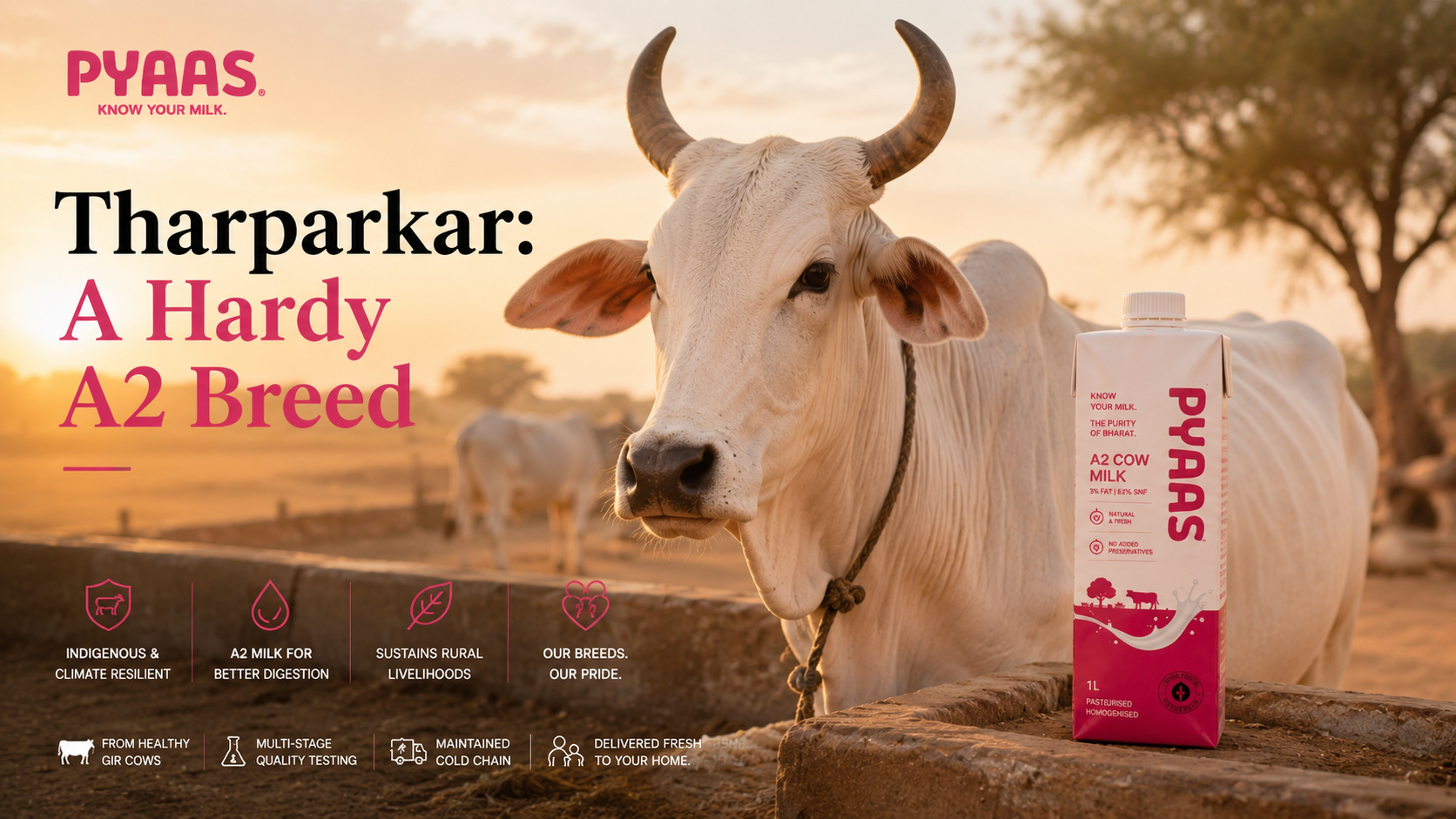
Tharparkar Cow Milk: One of India's Hardy A2 Breeds
In the parched stretches of western India, where summer turns the land to dust and water is a daily calculation, one cow keeps giving milk when others would falter. The Tharparkar cow is a desert survivor, and its milk carries a quiet reputation among people who value India's indigenous breeds. It is a story worth telling honestly, including a straight word about how it does and does not relate to PYAAS.
A breed shaped by the desert
The Tharparkar takes its name from the Thar desert region straddling parts of Rajasthan and neighbouring areas. This is not gentle dairy country. Feed is sparse, heat is punishing, and water is scarce. Over generations, the Tharparkar adapted into a remarkably hardy animal that can maintain a decent milk yield on modest resources that would leave a high-strung exotic breed struggling.
That resilience is the heart of its value. A cow that stays healthy and productive in harsh conditions, resists local diseases and tolerates heat is precious to farmers who cannot rely on climate control or rich fodder. The Tharparkar is usually white or light grey, medium to large in build, and known for a steady, sturdy temperament.
What Tharparkar milk is like
Tharparkar milk is typically rich and wholesome, well regarded for household use and traditional dairy preparations. Like other indigenous breeds such as the Sahiwal, the Tharparkar does not chase the enormous volumes of specialised exotic dairy cattle. Instead it offers a dependable, nourishing yield that suits the realities of its home region.
The A2 tendency, told honestly
Tharparkar milk usually comes up in the same breath as A2 milk, and there is a real reason for that. Many indigenous Indian cattle breeds tend to carry the A2 form of beta-casein more often than the exotic breeds developed in Europe. So on average, a Tharparkar cow is more likely to produce A2 milk.
But tendency is not certainty, and this is where honesty matters. Whether any individual cow produces A1 or A2 milk is decided by her genes, one animal at a time. A breed leaning towards A2 does not mean every Tharparkar is guaranteed A2. Claiming a whole breed is uniformly A2 would overstate the biology, and you deserve better than that. If you want the underlying protein science, our explainer on what A2 milk really is walks through it clearly.
- Hardy: thrives in heat and drought on modest feed.
- Reliable yield: rich milk without demanding intensive care.
- A2 tendency: more likely to carry A2, but per animal, not guaranteed.
- Indigenous heritage: a genuine part of India's desi cattle wealth.
A straight word about PYAAS
Because the Tharparkar is such an admired A2-leaning breed, it would be tempting for any dairy brand to wave its name around. We will not, because it would not be true. PYAAS does not partner with Tharparkar herds. Our partner farms in Gonda, Uttar Pradesh, run Holstein Friesian and Sahiwal cattle, and that is exactly what we say.
What we share with the Tharparkar story is the principle underneath it: A2 milk comes only from A2 cows, identified individually. Within our Sahiwal and Holstein Friesian herds we identify the A2 cows cow by cow and keep their milk separate. We never claim a whole herd, a breed or a tank is all A2. If you would like to see who actually raises our cows, our farms page introduces the real people behind the milk.
This matters because the appeal of indigenous breeds like the Tharparkar is sometimes used loosely in marketing, with brands implying a breed they do not use or an A2 guarantee they cannot make. A single, known source is worth far more than a borrowed reputation, which is the whole argument behind single-origin milk.
Why hardy indigenous breeds deserve attention
Beyond any one brand, the Tharparkar is a reminder of something valuable. India's indigenous cattle carry genetics suited to Indian conditions, resistance to local stresses, and an A2 tendency that has become newly interesting. Preserving and respecting these breeds is part of a healthier dairy future, even where high-yield exotic cattle dominate the numbers.
The honest takeaway
Tharparkar cow milk comes from one of India's toughest and most respected indigenous breeds, rich, dependable, and more likely than average to be A2, though never guaranteed by breed alone. PYAAS admires that heritage without pretending to be part of it: our herds are Holstein Friesian and Sahiwal, and our A2 milk is drawn only from identified A2 cows. That is the difference between telling a good story and telling the true one.
Written by
Naina Sharma
PYAAS is an honest, traceable Indian dairy brand from Gonda, Uttar Pradesh.
More from Naina SharmaCommon questions.
Is Tharparkar cow milk A2?
Tharparkar cows, like many indigenous Indian breeds, tend to carry the A2 form of beta-casein more often than exotic breeds. But A2 is a per-animal genetic trait, so it is not guaranteed by breed alone. Tharparkar cow milk leans A2 as a tendency, which is not the same as a certainty for every animal.
What makes the Tharparkar breed special?
The Tharparkar is prized for its hardiness. It originates in the arid Thar desert region and can produce a reasonable, rich yield of milk while withstanding heat, sparse feed and tough conditions. That resilience, along with its A2 tendency, makes it a valued indigenous dairy breed in India.
Does PYAAS use Tharparkar cows?
No, and we would rather be clear than imply otherwise. PYAAS partner herds in Gonda are Holstein Friesian and Sahiwal, not Tharparkar. We draw A2 milk only from the A2 cows within those herds, identified cow by cow, so we never borrow another breed's reputation to describe our own milk.
Get the next one in your inbox.
The occasional note on milk, ghee, and how we work. Plain words, no hype, and you can leave any time.
Keep reading.
What Is BCM-7 and Why It Matters in A2 Milk
18 August 2026
Why an A2 Claim Needs Proof, Not Just a Label
28 July 2026
The A2 Cows in Our Gonda Herds, Explained
26 July 2026
A2 Milk vs Regular Milk: Is It Worth the Price?
22 July 2026