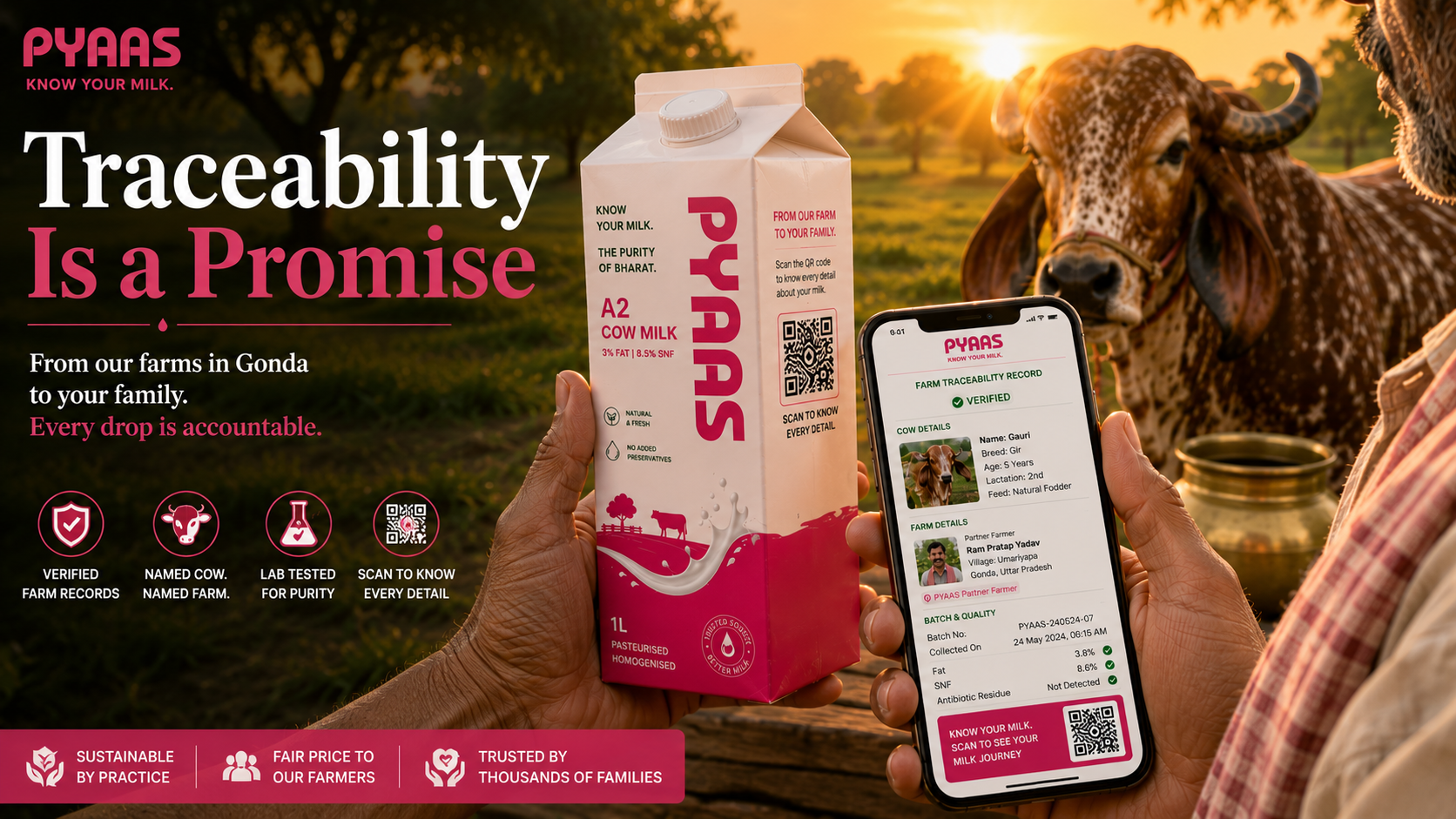
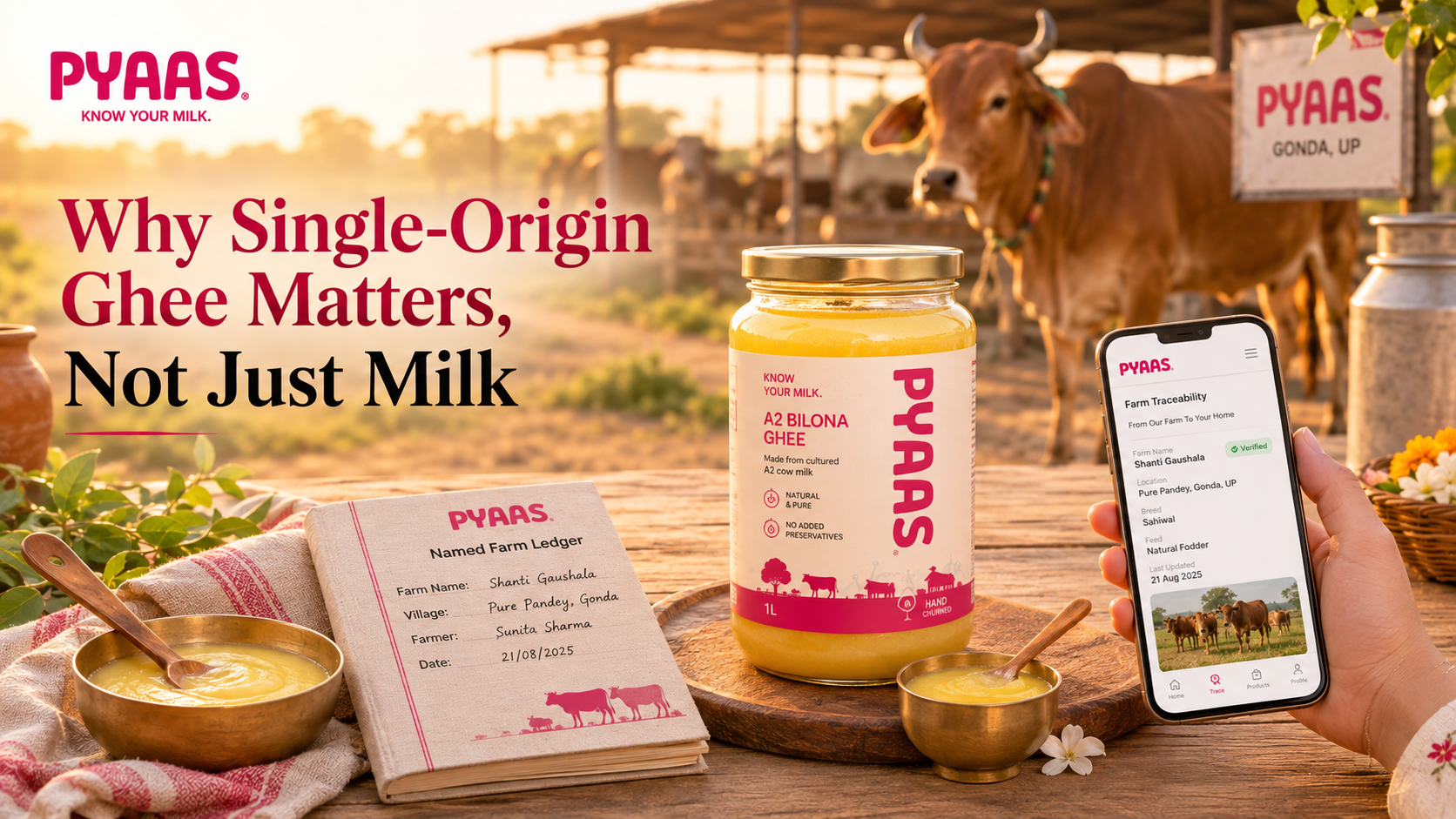
Why Single-Origin Ghee Matters, Not Just Milk
We've learned to ask where our coffee beans grew and which estate our chocolate came from. We read the origin on a wine label and nod knowingly. Then we buy a tin of ghee, a food we cook with almost every day, feed our families with, and pour into our most cherished recipes, and we ask it nothing at all. That gap always struck me as strange. If origin matters for a cup of coffee, why does it stop mattering for the fat at the centre of an Indian kitchen? That's the whole reason I want to talk about single origin ghee.
I'm Aryan, co-founder of PYAAS. My fellow founder Kushagra and I are two school friends from Amity who started this with one stubborn idea: you should be able to know exactly where your dairy comes from. Ghee included. Especially ghee.
What single-origin actually means
Single-origin isn't a fancy word for expensive. It simply means the product can be traced back to a specific, named source instead of being blended together from many places you'll never see. Most commodity ghee is the opposite of single-origin: milk from countless farms and animals is pooled into one enormous stream, turned into ghee at scale, and stamped with a brand. By the time it reaches you, the link between that jar and any real farm has completely dissolved.
Single origin ghee keeps that link intact. You can point at the jar and name the farm. That's it. And that small thing changes everything about accountability.
Why origin matters even more for ghee
Here's a fair pushback: ghee is a processed, shelf-stable fat, so does its origin really matter the way fresh milk's does? I'd argue it matters more, precisely because ghee hides its tracks so well.
Fresh milk gives you cues. It has a smell, a taste, a short life. Ghee is golden, glossy and long-lasting, which makes it wonderfully easy to disguise. A jar of ghee made from carefully sourced milk and a jar made from the cheapest pooled milk can look almost identical on a shelf. Colour tells you nothing. Fragrance can be coaxed. The one thing that can't be faked is a real, checkable answer to the question: which farm?
That's why traceability is the honest foundation. If you want the fuller argument, we've written about single-origin milk and why one farm beats a thousand, and the same logic carries straight into ghee.
Named farms, not anonymous tanks
When I say single-origin, I mean I can actually name the people. PYAAS partners with farms in Gonda, Uttar Pradesh. We partner with them; we don't own the cows. The farms behind our ghee include:
- Sri Radha Mohan Dairy Farm, run by farmer Ram, with a herd of around 76 cows.
- Gonard Dairy, run by Harsh Singh.
- Ranjeet Singh Dairy Farm, run by Ranjeet Singh.
These are real people in a real place, not a marketing illustration. You can read about one of them in our profile of Ram, and see the wider network on our farms page. When a farmer's name is on the origin, a shortcut is a lot harder to justify. Accountability has a face.
Where A2 fits, honestly
Our ghee is A2 Bilona ghee, and I want to be precise about what that does and doesn't mean. A2 is a per-animal genetic trait, so A2 milk comes only from the specific A2 cows within a herd, identified cow by cow. Our partner herds include Holstein Friesian and Sahiwal cattle, and we never claim a whole herd or breed is "all A2", because that isn't how genetics works. Single-origin is what lets us make that distinction with a straight face: when you know the exact farm and herd, you can be honest about which animals the milk came from instead of hiding behind a blend.
The QR code turns a claim into a fact
Talk is cheap, and "traceable" is a word every brand can print. So we made ours checkable. Every PYAAS A2 Bilona ghee pack carries a QR code. Scan it and you see the exact farm, the farmer, and that batch's quality-checked record. The origin stops being a story we tell and becomes a fact you confirm.
That's the difference between single-origin as marketing and single-origin as a promise you can hold us to. If we ever slipped, the QR would show it. We built it that way on purpose.
What single-origin doesn't promise
Let me be honest about the limits, because overselling would betray the whole point. Single-origin isn't an automatic quality medal, and it isn't a health claim. Ghee is not a cure for anything, and I won't pretend otherwise. What single-origin gives you is not magic; it's accountability and clarity. It tells you who stands behind the jar and lets you verify it. Everything else, the aroma, the care, the small-batch bilona method, has to earn its keep on top of that foundation.
The honest case, in one line
You already ask your coffee where it grew. Your ghee deserves the same question. Single origin ghee is simply ghee that can answer it, tied to a named farm, made in small batches, and backed by a QR record you can scan. PYAAS A2 Bilona ghee is our attempt to make that the normal expectation rather than a luxury. It's live and shipping across India today. Scan the code, meet the farm, and decide for yourself. That's the whole promise, and we'd rather be checked than believed.
Written by
Naina Sharma
Aryan Sharma is the Founder & CEO of PYAAS, an honest, traceable Indian dairy brand.
More from Naina SharmaCommon questions.
What does single-origin ghee actually mean?
Single origin ghee means the ghee can be traced back to a specific farm or source rather than being blended from many anonymous suppliers. It's the same idea as single-origin coffee: you can name where it came from. PYAAS ghee is tied to named partner farms in Gonda, and a QR code on each pack shows you the exact farm and batch.
Is single-origin ghee better quality than blended ghee?
Single origin isn't a magic quality grade by itself, but it gives you accountability. When ghee traces to one named farm, someone real stands behind it and you can check the record. Blended ghee from countless sources removes that link entirely, so you're trusting a brand name rather than a traceable source.
Which farms does PYAAS single-origin ghee come from?
PYAAS partners with named farms in Gonda, Uttar Pradesh, including Sri Radha Mohan Dairy Farm run by farmer Ram, Gonard Dairy run by Harsh Singh, and Ranjeet Singh Dairy Farm. We partner with these farms rather than owning cows, and the QR code on each pack links your jar to its actual source.
Get the next one in your inbox.
The occasional note on milk, ghee, and how we work. Plain words, no hype, and you can leave any time.
Keep reading.
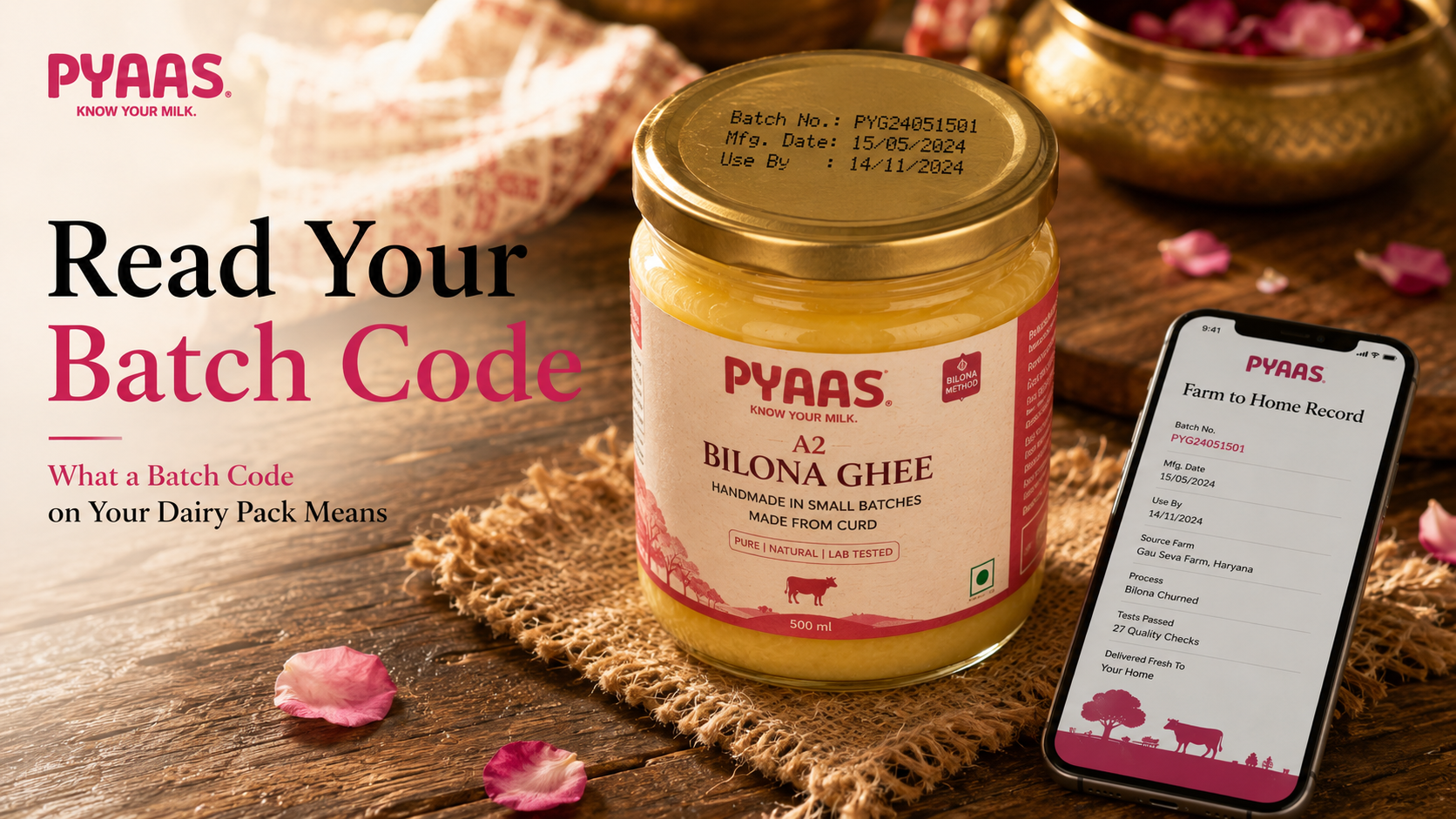
What a Batch Code on Your Dairy Pack Means
2 September 2026
How PYAAS Keeps Milk Fresh From Gonda to Lucknow
21 August 2026
From QR Code to Farm Record: The Full Trace
28 July 2026
Traceability Is How PYAAS Earns Trust at Scale
28 July 2026