How PYAAS Keeps Milk Fresh From Gonda to Lucknow
Milk is one of the most unforgiving things you can sell. A pack of biscuits is patient. A jar of ghee keeps for months. But fresh milk starts changing the moment it leaves the cow, and every extra hour and every stray degree of warmth is working against you. So when people ask me how PYAAS will keep fresh milk gonda to lucknow genuinely fresh, I don't reach for a slogan. I walk them through the actual chain, because that chain is the product.
I'm Kushagra, Founder and CTO at PYAAS. Before I write another word, one honest thing: our fresh A2 cow milk is not on sale yet. It launches in Lucknow from August 2026 and will expand across Uttar Pradesh from there. Our A2 Bilona ghee is already live and ships across India today, but the milk is still upcoming. Everything below is how we're building that system, told plainly, not a claim that you can order a carton this afternoon.
Why the Gonda-to-Lucknow route is the whole point
Freshness isn't a marketing adjective. It's arithmetic. The clock starts at milking, and the two things you're fighting are time and temperature. The best way to win that fight is embarrassingly simple: don't travel far, and stay cold the whole way.
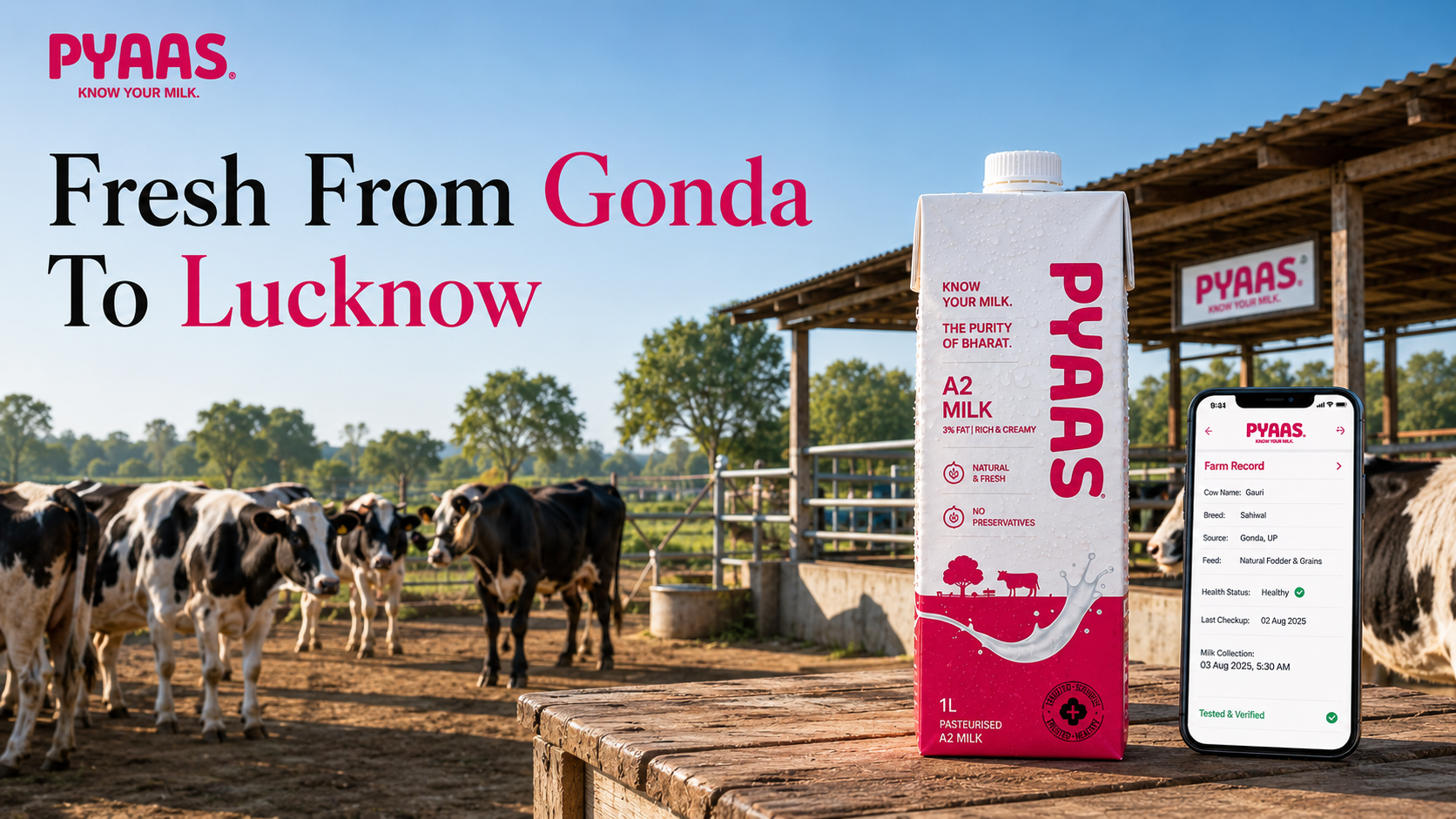
Gonda to Lucknow is a short regional hop, not a cross-country haul. That single fact does more for freshness than any additive or clever packaging ever could. When we talk about the route for fresh milk gonda to lucknow, we're really talking about keeping the number of hours between a cow and your fridge as small as we honestly can. Our partner farms sit in and around Gonda, and Lucknow is the first city we're serving. Short link, fewer failure points.
The cold chain, unglamorously explained
A cold chain is just the promise that milk stays cold from the farm to your door, without a warm gap in the middle. It sounds obvious. It's also where most milk quietly goes wrong.
Here's how we think about the links that have to hold:
- Chilling fast at source. The sooner raw milk is brought down to a safe cold temperature after milking, the slower everything unwanted happens. Speed at the start buys you quality at the end.
- Cold storage and cold transit. Milk should not sit around warming up while it waits, and it should not ride to the city in the heat. The goal is an unbroken cold line, not a cold start and a warm finish.
- Cold handoff. Every transfer, from tank to pack to transport to delivery, is a moment where the temperature can slip. Fewer handoffs and faster ones mean fewer chances to lose the thread.
- A short shelf window. Fresh milk should be treated as fresh, meant to be used soon, not stockpiled for weeks. We'd rather move small volumes quickly than pretend fresh milk is shelf-stable.
None of this is exotic. It's the boring discipline of not letting milk get warm. But boring discipline, done every single day, is exactly what freshness is made of.
Small batches, because you can't shortcut fresh
We make our ghee in small batches, and we're carrying the same instinct into milk. Small batches aren't a limitation we're apologising for; they're a choice. Smaller volumes are easier to chill quickly, easier to move quickly, and easier to trace back to a single farm and a single day. The moment you scale up to enormous tanks blended from everywhere, you lose the ability to say exactly where a given litre came from, and you slow down the very chilling that keeps it fresh.
Where A2 fits, honestly
Our milk is A2, and here I want to be precise, because this is where a lot of dairy marketing gets sloppy. A2 is a per-animal genetic trait. It comes only from the specific A2 cows within a herd, identified cow by cow. We never claim a whole herd or breed or tank is "all A2", because that isn't how the biology works. Our herds include Holstein Friesian and Sahiwal cattle, and the A2 milk is drawn from the A2 animals within them.
Many people find A2 milk easier to digest, and plenty of families prefer it for that reason. But the science is still settling, and A2 is not a cure for lactose intolerance, because lactose is the milk sugar and A2 is about the protein. If you're curious about the actual differences, we've written a plain-English explainer on A1 vs A2 milk that avoids the hype. You can also read what Know Your Milk really means to us.
The QR record: freshness you can actually check
Cold chains are invisible. You can't see whether a carton stayed cold, and "trust us" is exactly the phrase every dairy uses. So we decided freshness shouldn't be something you take on faith.
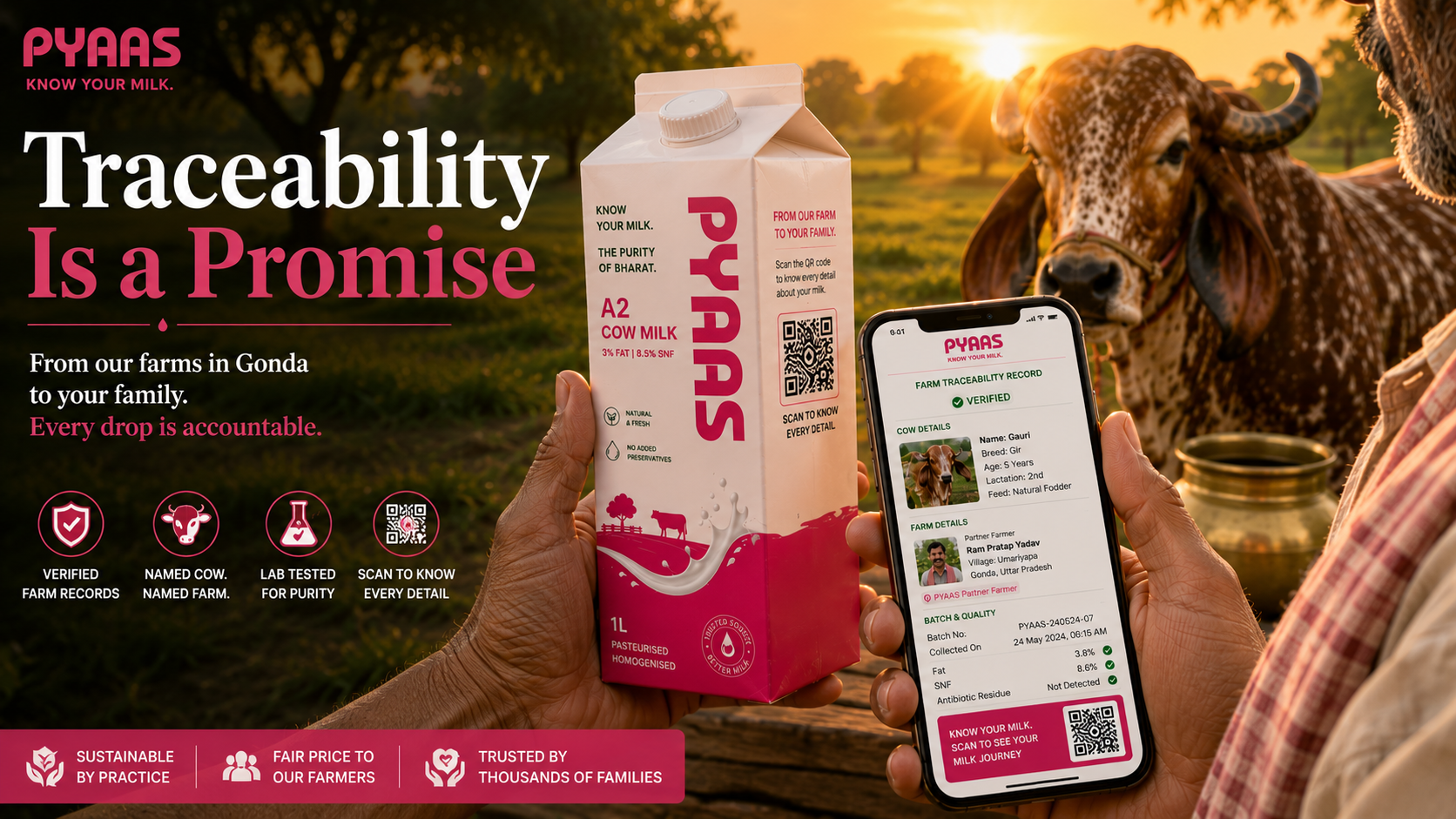
Every PYAAS pack carries a QR code. Scan it, and you see the exact farm, the farmer, and that batch's quality-checked record. It ties a physical pack in your hand to a specific source and a specific batch. That's the whole idea of traceability: instead of a vague promise on the label, you get a record you can open. If you want to see how that works step by step, here's our guide on how to scan the QR code on your milk.
The QR won't lie to make us look good. That's the point of building it. A traceable record is only worth anything if it's willing to be inconvenient.
What we're promising, and what we're not
Let me draw the line clearly, because honesty is the entire brand:
- We are not saying you can buy PYAAS fresh milk today. It launches in Lucknow from August 2026.
- We are saying the ghee is here now and ships across India.
- We are building the shortest sensible route, an unbroken cold chain, small batches, and a scannable record, so that when the milk does arrive, "fresh" is a fact you can verify rather than a word we printed.
Keeping fresh milk gonda to lucknow genuinely fresh isn't a trick. It's a short road, a cold line that never breaks, small honest batches, and a QR code that's happy to be checked. When our first cartons reach Lucknow in 2026, that's the system I want you to be able to hold up to the light. Until then, we'd rather tell you exactly how it works than promise you something that isn't ready.
Written by
Naina Sharma
Kushagra Shekhar Kaushik is the Founder & CTO of PYAAS, an honest, traceable Indian dairy brand.
More from Naina SharmaCommon questions.
When will PYAAS fresh milk actually be available in Lucknow?
PYAAS fresh A2 cow milk launches in Lucknow from August 2026, and we plan to expand across Uttar Pradesh after that. Right now our A2 Bilona ghee is already live and ships across India, but the fresh milk is genuinely upcoming, not something you can buy today.
Why does the distance between Gonda and Lucknow matter for freshness?
Milk quality is a race against time and temperature. A shorter, well-planned route for fresh milk gonda to lucknow means fewer hours between milking and your fridge, and less chance for the cold chain to be broken along the way. Short distance is one of the simplest, most honest advantages a regional dairy can offer.
What does the QR code on a PYAAS pack tell me about freshness?
Scanning the QR code shows you the exact partner farm, the farmer and that batch's quality-checked record. It ties a specific pack to a specific day and source, so freshness stops being a vague promise and becomes something you can actually look up.
Get the next one in your inbox.
The occasional note on milk, ghee, and how we work. Plain words, no hype, and you can leave any time.
Keep reading.
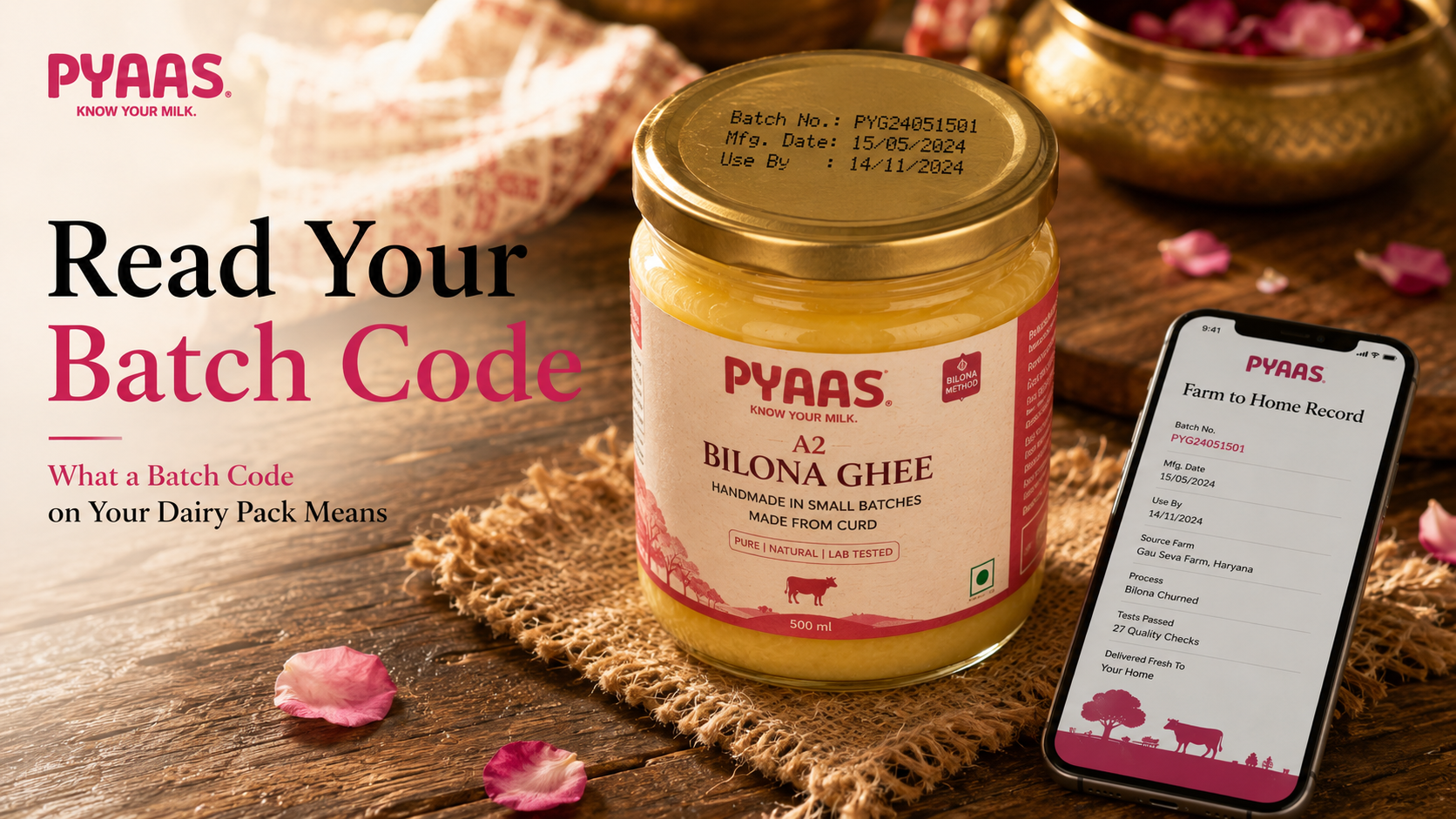
What a Batch Code on Your Dairy Pack Means
2 September 2026
Why Single-Origin Ghee Matters, Not Just Milk
23 August 2026
From QR Code to Farm Record: The Full Trace
28 July 2026
Traceability Is How PYAAS Earns Trust at Scale
28 July 2026