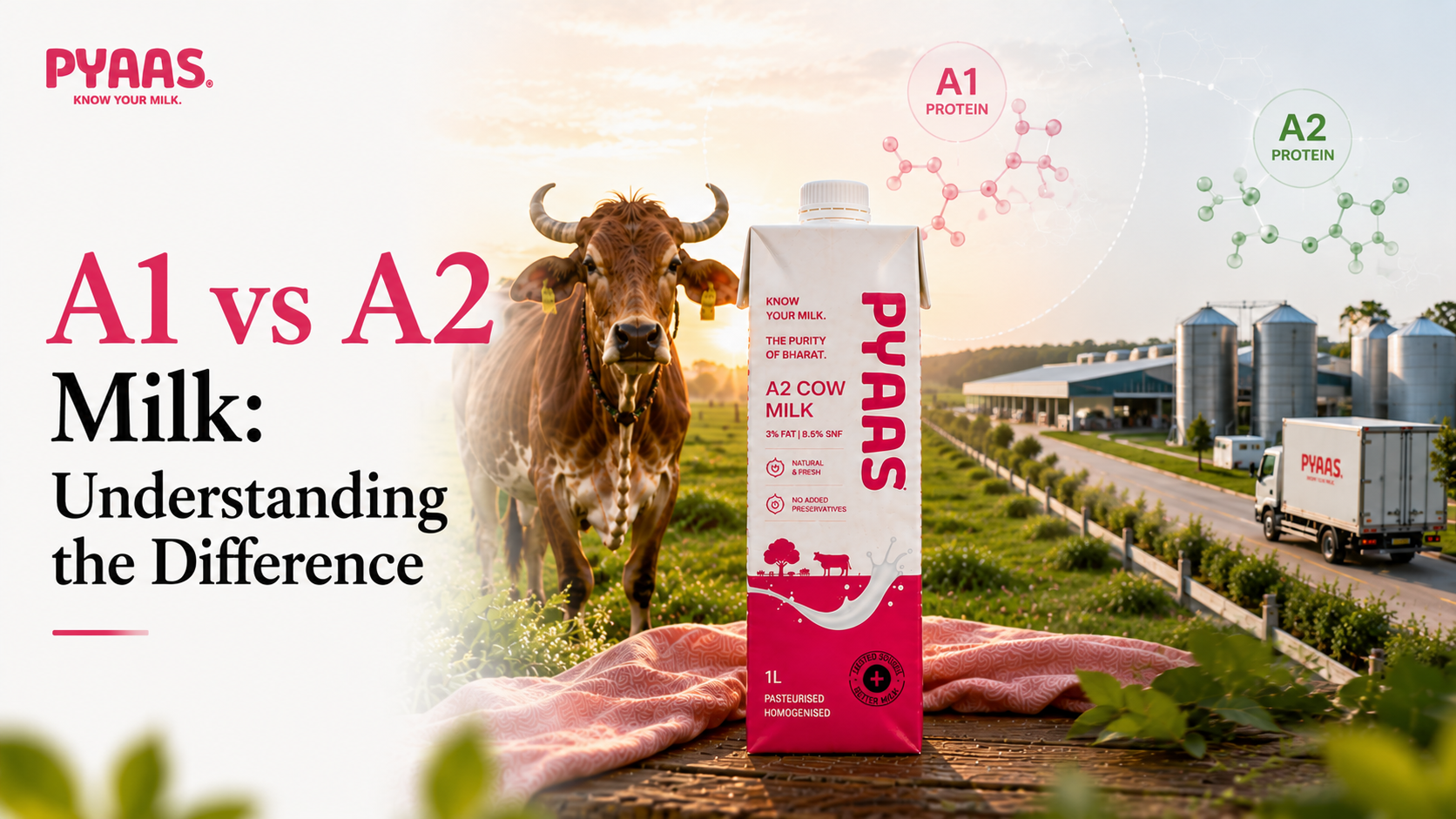
A1 vs A2 Milk: Understanding the Difference
If you have shopped for milk in India recently, you have almost certainly seen the labels "A1" and "A2" and wondered what they actually mean. The short answer is that the difference between A1 and A2 milk comes down to a single protein called beta-casein, and the form a cow produces is decided entirely by her genetics. It is one of the most talked about distinctions in modern dairy, yet it is also one of the most misunderstood.
At PYAAS, we think families deserve a clear, honest explanation rather than marketing jargon. This guide breaks down what A1 and A2 milk really are, how the proteins behave during digestion, which Indian cow breeds produce A2 milk naturally, and, just as importantly, why the source and traceability of your milk matter even more than the label on the carton.
What Are A1 and A2 Milk?
All cow milk contains proteins, and roughly 80 percent of them belong to a family called casein. Within that family, beta-casein is one of the most significant. Beta-casein comes in two main genetic variants: the A1 type and the A2 type. A single cow may produce A1 only, A2 only, or a mix of both, depending on the genes she inherited.
So when a pack says "A2 milk," it simply means the milk comes from cows that carry the genetics to produce only the A2 form of beta-casein. There is no chemical processing involved. The milk is not engineered or filtered to become A2. It is naturally A2 because of the cow herself.
The Genetic Story Behind A1 and A2
Scientists widely believe that ancient cattle originally produced only A2 beta-casein. At some point a natural genetic mutation appeared in certain European-origin herds, giving rise to the A1 variant, which then spread through generations of selective breeding. This is why many high-yield exotic and crossbred cows are associated with A1 milk, while many traditional breeds retain the older A2 genetics.
The Real Difference: How Beta-Casein Digests
The scientific conversation around A1 versus A2 milk centers on what happens during digestion. When A1 beta-casein is broken down in the gut, it can release a peptide known as BCM-7 (beta-casomorphin-7). A2 beta-casein has a different structure at one key point in the protein chain, so it does not release BCM-7 in the same way.
Some people report that they feel lighter or more comfortable after drinking A2 milk, and this is the area researchers continue to study. It is important to be honest here: the science is still evolving, conclusions vary, and A2 milk is not a cure or a medical product. What we can say plainly is that the structural difference in the protein is real, and it is the reason A1 and A2 are discussed as separate categories at all.
A2 Milk Is Not Lactose Free
A common myth deserves a direct answer. A2 milk still contains lactose. The A1 and A2 distinction is about a casein protein, not about the milk sugar lactose. If someone is genuinely lactose intolerant, switching from A1 to A2 milk will not remove the lactose. The two issues are completely separate, and it helps to keep them apart when making a choice for your family.
Indian Cow Breeds and Their A2 Heritage
India is fortunate to have a rich lineage of indigenous, or desi, cattle that naturally produce A2 milk. These breeds have been part of Indian households, farms and traditions for generations.
- Gir: A hardy breed from Gujarat, prized for rich, characterful milk. You can read more in our deep dive on Gir cow milk and why it is so sought after.
- Sahiwal: One of India's finest dairy breeds, known for both yield and quality. Learn more about Sahiwal cow milk and its strengths.
- Red Sindhi, Tharparkar and others: Regional desi breeds that have quietly sustained Indian dairy for centuries.
The growing interest in A2 milk has, happily, renewed appreciation for these native cows. If you want the bigger picture on the category, our overview of what A2 milk is, its benefits and the common myths is a useful companion to this article.
Why the Label Alone Is Not Enough
Here is the part many brands skip. The words "A2" on a pack tell you about the protein, but they tell you nothing about purity, freshness, or honesty. A label is only as trustworthy as the supply chain behind it. Two cartons can both say "A2" and be worlds apart in quality.
This is exactly why we built PYAAS around Know Your Milk, our promise that you should be able to see your milk's full story. When you choose milk, it is worth looking past the badge and asking the questions that actually protect your family:
- Where did this milk come from? Is the farm named, or is it anonymous?
- Who is the farmer? Real people behind real milk build real accountability.
- Was this batch tested? Values like SNF and FAT tell you about composition and quality.
- How fresh is it? Knowing when the milk left the farm matters more than most labels admit.
If purity is on your mind, you may also like our practical guide on how to check milk purity at home, and our explainer on why traceability matters in dairy. These are the habits that turn a confusing label into an informed choice.
How PYAAS Approaches A2 Milk
PYAAS sources single-origin A2 cow milk from named farms in Gonda, Uttar Pradesh, and delivers it fresh across Delhi NCR, Lucknow and Ayodhya. Every pack carries a QR code. When you scan it, you can see the exact farm, the named farmer, that batch's lab test for SNF and FAT, and the time the milk left the farm. The same care goes into our small-batch A2 Bilona ghee, churned the traditional way.
We do this because transparency is not a feature for us, it is the whole point. The story of our work and the family behind it is something we are proud of, and you can meet our founding family if you would like to know who we are.
A Quick, Honest Summary
- The difference: A1 and A2 refer to two genetic forms of the beta-casein protein in cow milk.
- The digestion point: A1 can release the peptide BCM-7 during digestion, A2 does not in the same way. Research is ongoing.
- The lactose myth: A2 milk is not lactose free. It still contains lactose.
- The Indian advantage: Many desi breeds like Gir and Sahiwal naturally produce A2 milk.
- The bigger truth: Source, freshness and traceability matter as much as the A1 versus A2 label.
Choosing between A1 and A2 milk is a personal decision, and there is no shame in either. What we gently encourage is this: do not stop at the label. Ask where your milk comes from, who made it, and whether it was tested. When you can answer those questions, you are no longer just buying milk, you are truly knowing your milk. Whenever you are ready to taste the difference that honesty makes, we would be glad to welcome your family to PYAAS.
Written by
PYAAS Team
The PYAAS Team writes about traceable, single-origin A2 dairy from named farms in Uttar Pradesh, helping Indian families truly know the milk they bring home.
More from PYAAS TeamCommon questions.
What is the main difference between A1 and A2 milk?
The difference lies in a protein called beta-casein, which exists in two genetic forms, A1 and A2. A2 milk comes from cows that naturally produce only the A2 variant. Both types are real milk with similar core nutrition, but the protein structure differs at one key point in the chain.
Is A2 milk lactose free?
No, A2 milk is not lactose free and still contains lactose. The A1 versus A2 distinction is about the beta-casein protein, not the milk sugar lactose. People who are lactose intolerant will not solve that by switching from A1 to A2 milk, since the two issues are separate.
Which Indian cow breeds produce A2 milk?
Many indigenous, or desi, Indian breeds naturally produce A2 milk. Well known examples include Gir, Sahiwal, Red Sindhi and Tharparkar. These breeds have been part of India's dairy heritage for generations and are central to the growing interest in A2 milk.
Is A2 milk healthier than A1 milk?
Both A1 and A2 milk provide similar essential nutrients, and A2 milk is not a medical product or a cure. Some people report feeling lighter after drinking A2 milk, which researchers continue to study, but the science is still evolving. The honest answer is that it is a personal choice rather than a guaranteed health upgrade.
Does an A2 label guarantee the milk is pure and fresh?
No. An A2 label only tells you about the protein type, not about purity, freshness or honest sourcing. A label is only as trustworthy as the supply chain behind it. That is why we recommend checking where the milk came from, who the farmer is, and whether the batch was tested, ideally through traceability like a QR code on the pack.
Get the next one in your inbox.
The occasional note on milk, ghee, and how we work. Plain words, no hype, and you can leave any time.
Keep reading.
What Is A2 Milk? Benefits, Myths and How It Differs from Regular Milk
4 July 2026
Gir Cow Milk: Why It Has Become One of India's Most Sought-After Dairy Products
11 July 2026
Sahiwal Cow Milk: Understanding One of India's Finest Indigenous Dairy Breeds
11 July 2026
Best A2 Milk in India: What Should Consumers Look For?
12 July 2026