Cream-Line Milk: What Non-Homogenised Means
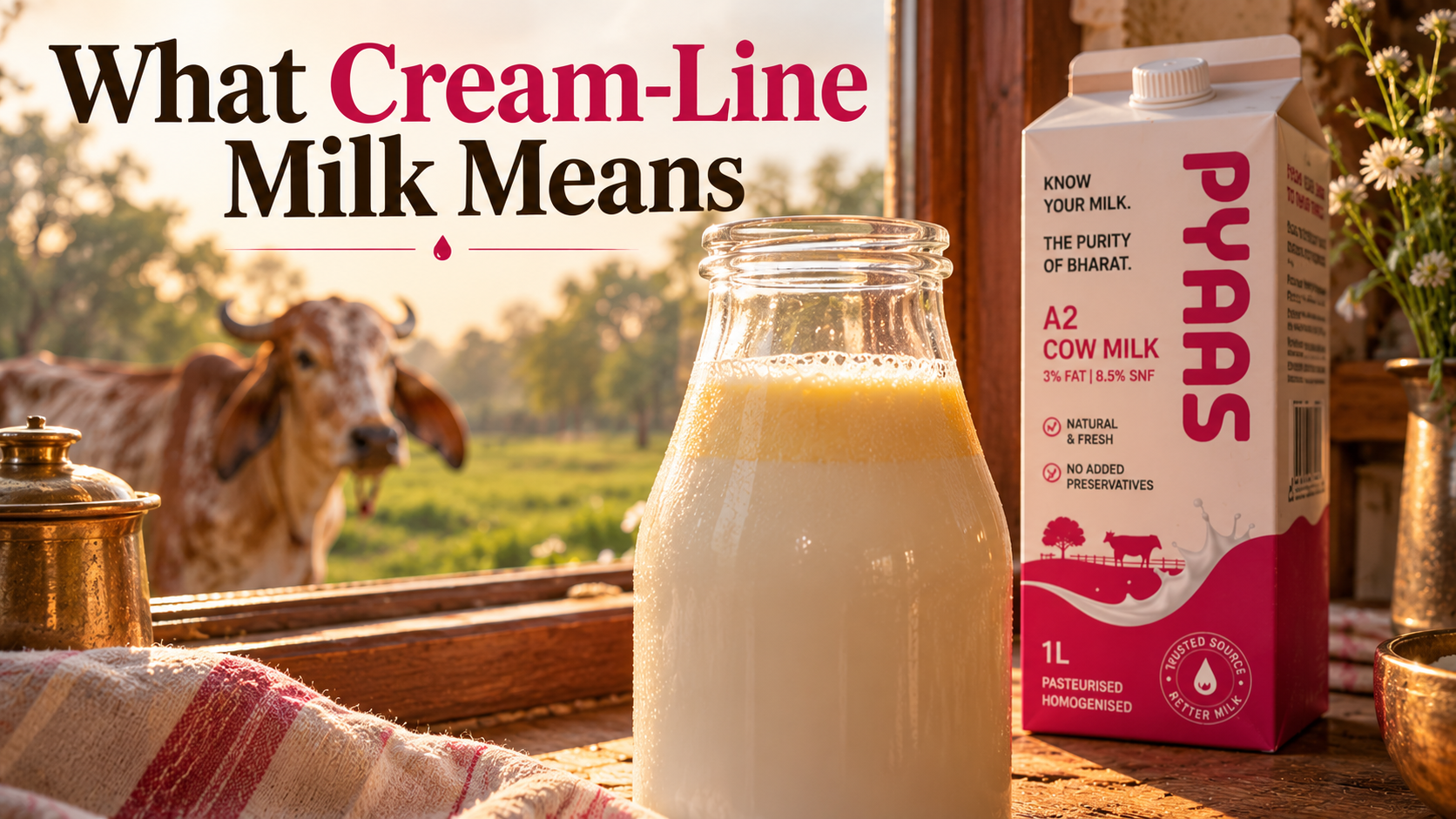
You pour a glass of milk, and there it is: a thicker, richer layer clinging to the top of the bottle or settling near the cap. For a moment you wonder if something is wrong. It is not. That is a cream line, and far from being a fault, it is one of the most natural things milk can do. Cream line milk is simply milk that has been left non-homogenised, allowing its cream to rise the way it has for as long as humans have kept cows. Let us explain what that means and why some families seek it out.
Why cream rises in the first place
Milk is fat suspended in water. Fat is lighter than water, so if you leave milk undisturbed, the fat globules drift upward and gather at the top as a layer of cream. This is exactly what happened in every household that kept milk before modern processing. The cream line is gravity doing its quiet work, and it tells you the milk still behaves the way nature intended.
What homogenisation does
Most packaged milk today is homogenised. In this process, the milk is forced under high pressure through tiny openings that shatter the fat globules into pieces so small they no longer float up. The result is milk with a uniform texture and no cream line, ever. It looks consistent and pours the same to the last drop.
Homogenisation is not sinister; it is a convenience and consistency choice. But it does change the milk from its natural state, and it removes that visible cream layer many people love. Non-homogenised milk simply skips this step, leaving the fat free to rise.
Cream line is a feature, not a flaw
This is the heart of the matter. A cream line is a sign of authenticity, not spoilage. Here is how to think about it.
- The cream rising means the milk was left close to its natural state.
- It does not mean the milk has curdled or gone off; sour milk has a very different smell and texture.
- A simple gentle shake or stir mixes the cream back through before you pour.
- You can also skim the cream off and use it on its own, which we will come to.
If anyone tries to tell you cream line milk is lower quality, they have it backwards. It is often a marker of milk that has been handled minimally.
Does it taste or feel different?
Many people say non-homogenised milk tastes richer and more natural, with a fuller mouthfeel, especially in that first creamy sip before you stir. The nutrition is essentially unchanged, since homogenisation alters only the size of the fat globules, not the milk's protein, calcium or vitamins. Some people also feel non-homogenised milk sits easier on the stomach, though the evidence on that is still developing and varies from person to person. As always, taste and personal comfort are fair reasons to choose it; sweeping health claims are not.
What to do with that cream layer
The cream line is a small kitchen gift if you want it to be.
- Stir it back in for a naturally richer glass of milk.
- Skim it off to enrich tea, coffee or a bowl of fruit.
- Collect the cream, or malai, over days to make butter, and from there, ghee at home.
That last one is a lovely tradition. If you would like to try it, our step-by-step on how to make ghee at home from malai shows you exactly how, and our piece on how ghee is made traces the whole journey from milk to golden ghee.
Why the source still matters most
A cream line tells you the milk was not homogenised. It does not, on its own, tell you the milk is clean, safe or honestly sold. Cream can be added back to poor milk to fake richness, which is why knowing your source matters more than any visual cue. Test what you buy if you are unsure; our guide on how to check milk purity at home is a practical place to start.
Where PYAAS fits in
At PYAAS, we believe milk should be as close to its natural self as it can safely be, and we believe you should be able to see where it came from. Our fresh A2 cow milk launches in Lucknow from August 2026 and will expand across Uttar Pradesh, drawn from named partner farms in Gonda. Every pack will carry a QR code you scan to see the exact farm, the farmer, and that batch's quality-checked record, our Know Your Milk promise. A2 milk, remember, comes only from the A2 cows within a herd, identified cow by cow.
Until the fresh milk reaches your city, our A2 Bilona cow ghee already ships across India today in small batches, made the slow traditional way. A rising cream line is a small, honest signal of natural milk, and honesty about milk is the whole reason PYAAS exists.
The honest bottom line
Cream line milk is not a defect to worry about; it is non-homogenised milk doing exactly what natural milk does when left to rest. The cream that rises is a feature you can stir back, skim off, or turn into ghee. What it cannot do is tell you the milk is trustworthy on its own, so let the source, not just the cream, be your guide. Know your milk, cream line and all.
Written by
Aryan Sharma
PYAAS is an honest, traceable Indian dairy brand from Gonda, Uttar Pradesh.
More from Aryan SharmaCommon questions.
Is cream line milk a sign that the milk has gone bad?
No, quite the opposite. A cream line means the milk is non-homogenised, so the natural fat has risen to the top as it always would if left undisturbed. It is a sign the milk was left close to its natural state, not a sign of spoilage. Just give it a gentle shake before pouring.
What does non-homogenised milk mean?
Homogenisation is a process that breaks the fat globules into tiny pieces so they stay evenly mixed and no cream layer forms. Non-homogenised milk skips that step, so the cream naturally separates and rises to the top. That visible cream line is exactly what non-homogenised milk is supposed to do.
Is non-homogenised cream line milk healthier?
The nutrition is essentially the same; homogenisation only changes the size of the fat globules, not the milk's core nutrients. Some people prefer non-homogenised milk for its natural taste and richer cream, and some find it easier on the stomach, though evidence there is still developing. Choose based on taste and trust in the source.
Get the next one in your inbox.
The occasional note on milk, ghee, and how we work. Plain words, no hype, and you can leave any time.