
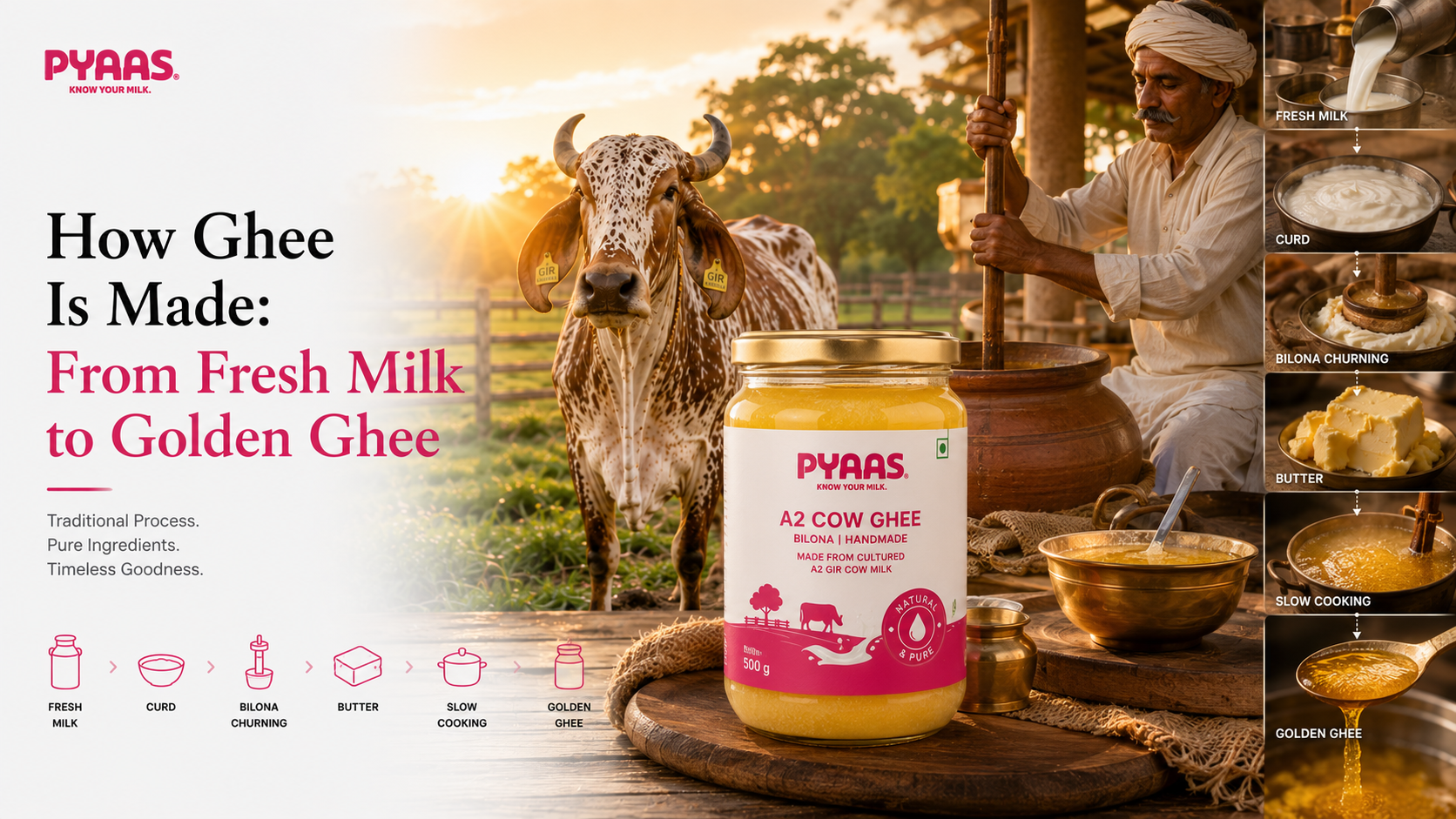
How Ghee Is Made: From Fresh Milk to Golden Ghee
Ghee has anchored Indian kitchens for thousands of years, prized for its nutty aroma, deep golden colour and the way a single spoonful can transform a dal, a sweet or a simple bowl of rice. Yet for all its familiarity, very few of us have actually watched ghee being made. Understanding how ghee is made, from fresh milk to golden ghee, tells you a great deal about what you are really buying, because the quality of the jar in your kitchen is decided long before the first drop of butter ever meets the heat.
This guide walks through the complete journey: the milk it starts with, the traditional bilona method, the slow simmer that creates that signature flavour, and the questions a thoughtful family should ask before choosing one ghee over another. Whether you are comparing labels at the store or trying to recreate the ghee your grandmother made, knowing each step helps you tell honest ghee from a shortcut.
It All Begins With the Milk
Every jar of good ghee starts with good milk. You cannot fix poor milk later in the process, so the source matters more than any single step that follows. Traditionally, the richest ghee comes from the milk of indigenous Indian cow breeds, whose milk carries the A2 type of beta-casein protein and a generous cream content.
Several factors shape the milk before production even begins:
- Breed: Indigenous desi breeds are widely favoured for traditional ghee. If you want to understand why, our pieces on Gir cow milk and Sahiwal cow milk explain these breeds in depth.
- Feed and care: What a cow eats and how it is kept directly affects the cream, the colour and the flavour of the milk.
- Freshness: Milk handled quickly and kept cool retains the qualities that make a fragrant ghee.
At PYAAS, this is where our story starts too. Our A2 cow milk comes from named farms in Gonda, Uttar Pradesh, and every pack carries a QR code you can scan to see the exact farm, the farmer's name, that batch's lab results and the time the milk left the farm. That same standard of milk is what we churn into our small batch ghee.
From Milk to Curd to Butter: The Bilona Method
The most traditional way to make ghee in India is the bilona method, and it takes a longer, gentler route than industrial production. Instead of separating cream from milk directly, the bilona process builds flavour through fermentation.
Step 1: Setting the Curd
Fresh milk is boiled, cooled and cultured into curd, just as you would set dahi at home. This fermentation step is what gives bilona ghee its distinctive aroma and is a key reason it tastes different from butter-based ghee. If you are curious about how this compares to factory methods, our guide on bilona ghee vs regular ghee breaks down the differences clearly.
Step 2: Churning the Curd
The set curd is then churned to separate makhan (butter) from buttermilk. Historically this was done by hand with a wooden churner called a bilona, pulled back and forth with a rope. Many small dairies now use gentle mechanical churners, but the principle stays the same: the butter is drawn from cultured curd, not directly from cream.
Step 3: Collecting the Butter
The fresh, cultured butter is gathered and rinsed. At this point you have makhan that is already deeply flavourful. The next stage turns it into ghee that can be stored for months.
The Slow Simmer That Creates Golden Ghee
This is the stage where butter becomes ghee, and patience makes all the difference. The butter is heated slowly over a steady flame. As it warms, three things happen in sequence:
- Moisture evaporates: The water in the butter gently bubbles away.
- Milk solids separate: The proteins and milk solids sink and begin to brown, releasing that unmistakable toasty fragrance.
- The colour deepens: The fat turns clear and takes on its characteristic golden hue.
The skill lies in stopping at exactly the right moment. Heat it too little and moisture remains, shortening its life. Heat it too long and the milk solids burn, leaving a harsh taste. A well made ghee is cooked to a warm gold, with a clean, grainy texture once it sets. To learn more about why this traditional fat is so valued, see our explainer on A2 ghee benefits.
Filtering, Cooling and Packaging
Once the ghee reaches its peak aroma and colour, the heat is switched off and the browned milk solids are allowed to settle. The clear golden liquid is then strained through a fine cloth to remove every trace of solids, leaving pure clarified butterfat.
As it cools, ghee naturally sets into a soft, granular state. Good packaging protects what the process worked so hard to create:
- Aroma and flavour, which fade if ghee is exposed to air for too long.
- Freshness, protected by clean, airtight containers away from light.
- Purity, kept intact from the moment it leaves the pan.
This careful finishing is why we make our A2 Bilona ghee in small batches rather than large industrial runs. Smaller batches mean closer control over every pan, so the flavour stays consistent from jar to jar.
Industrial Ghee vs Traditional Ghee: What Families Should Ask
Not all ghee is made the same way. Large scale production often separates cream mechanically, skips the curd stage entirely and processes butter at high volumes. The result can still be called ghee, but it usually lacks the depth that the cultured, slow cooked bilona route delivers.
Before you trust a jar, it helps to ask a few honest questions:
- Where did the milk come from? A trustworthy brand can name its source.
- What method was used? Cultured bilona ghee and cream based industrial ghee are genuinely different products.
- Can the quality be verified? Sourcing and testing should be visible, not vague.
These are the same questions driving the wider shift in Indian dairy. As we explain in why traceability matters in dairy, families increasingly want to follow their food back to its origin. Ghee is no exception, and the same farm to home thinking we describe in how milk reaches your home applies just as much to the jar on your shelf. Our whole approach is built around one simple promise you can read more about on our Know Your Milk page.
A Tradition Worth Keeping
From a pail of fresh milk to a jar of golden ghee, the journey is unhurried by design. Set the curd, churn the butter, simmer it slowly, strain it clean: each step is simple, but doing each one well is what separates ordinary ghee from the kind that fills a kitchen with memory. If you want to understand why so many households are returning to this method, our piece on desi cow ghee is a good next read.
At PYAAS, we make our ghee the patient way, from traceable A2 milk sourced from farms we can name. We would rather you understand exactly how your ghee is made than simply trust a label, because the more visible the journey, the easier it is to choose with confidence. When you are ready, scan, read and taste the difference for yourself.
Written by
PYAAS Team
The PYAAS Team writes about traceable, single-origin A2 dairy from named farms in Gonda, Uttar Pradesh, helping Indian families truly know their milk and ghee.
More from PYAAS TeamCommon questions.
How is ghee made from milk?
Ghee starts with fresh milk that is turned into curd, churned to separate butter, and then simmered slowly. As the butter heats, moisture evaporates and the milk solids brown and settle. The clear golden fat that remains is strained to make ghee.
What is the bilona method of making ghee?
The bilona method is a traditional Indian process where milk is first set into curd, then churned to draw out cultured butter, which is finally simmered into ghee. The fermentation step gives bilona ghee its distinctive aroma and flavour. It is slower than industrial methods but is widely valued for its taste and tradition.
What is the difference between bilona ghee and regular ghee?
Bilona ghee is made from cultured curd, so it carries a deeper, fermented aroma and flavour. Regular industrial ghee is often made by separating cream mechanically and skipping the curd stage. Both can be called ghee, but the bilona route generally produces a richer, more traditional result.
How can I tell if ghee is pure?
Pure ghee has a clean nutty aroma, a warm golden colour and a soft grainy texture once it sets. The most reliable check, though, is transparency about its source and method. A trustworthy brand can name the farm the milk came from and explain how the ghee was made rather than relying on vague claims.
Why does the milk used for ghee matter so much?
The quality of ghee is decided by the milk before any cooking begins. Breed, animal care, feed and freshness all shape the cream content, colour and flavour of the milk, and those qualities carry through to the final ghee. Milk from indigenous A2 cow breeds is widely favoured for traditional ghee.
Get the next one in your inbox.
The occasional note on milk, ghee, and how we work. Plain words, no hype, and you can leave any time.
Keep reading.
Bilona Ghee vs Regular Ghee: What's the Difference?
12 July 2026
A2 Ghee Benefits: Everything You Need to Know About Traditional Ghee
4 July 2026
Desi Cow Ghee Explained: Why Consumers Are Choosing Traditional Ghee
7 July 2026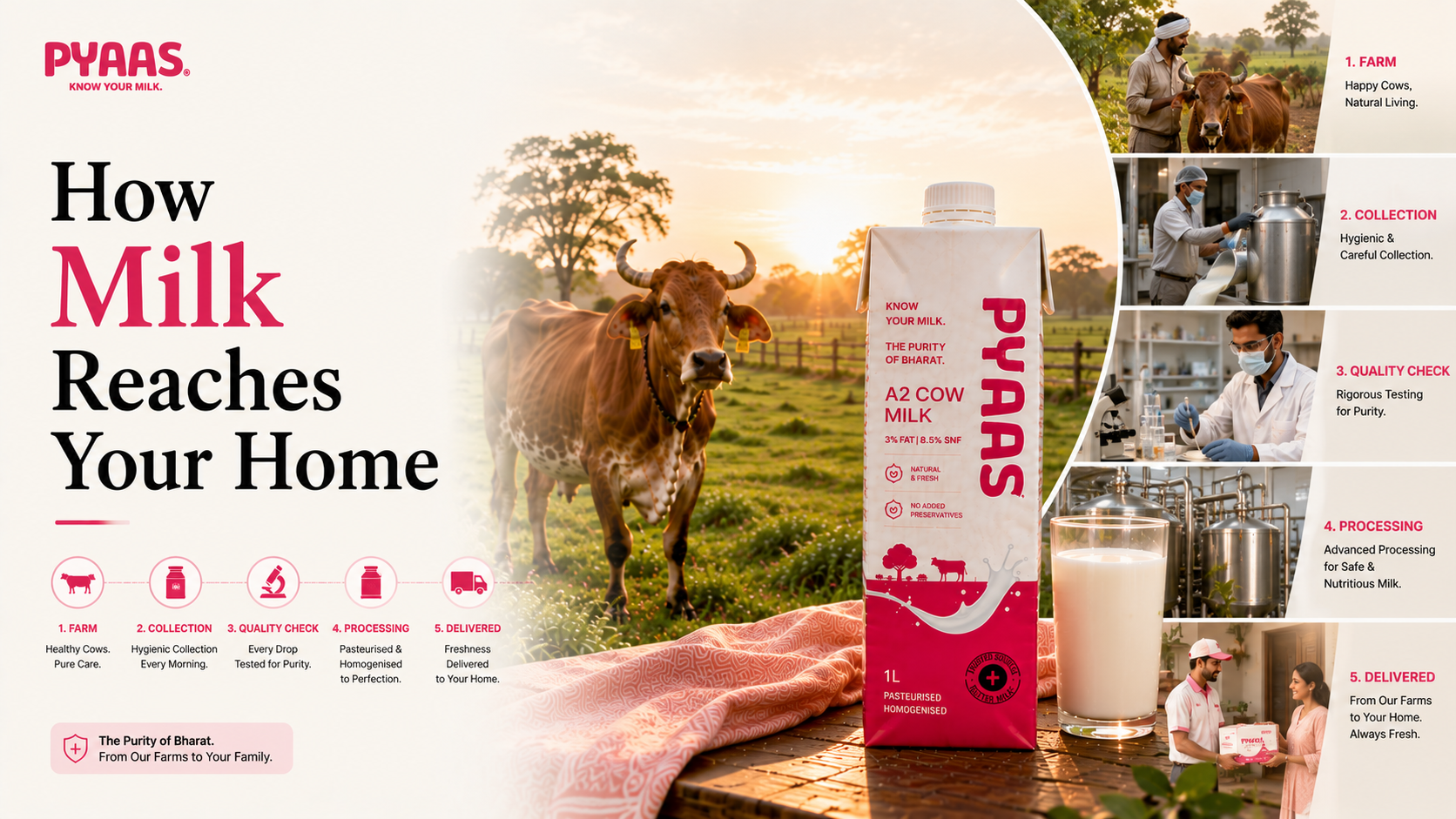
How Milk Reaches Your Home: The Journey from Farm to Table
11 July 2026