How Milk Reaches Your Home: The Journey from Farm to Table
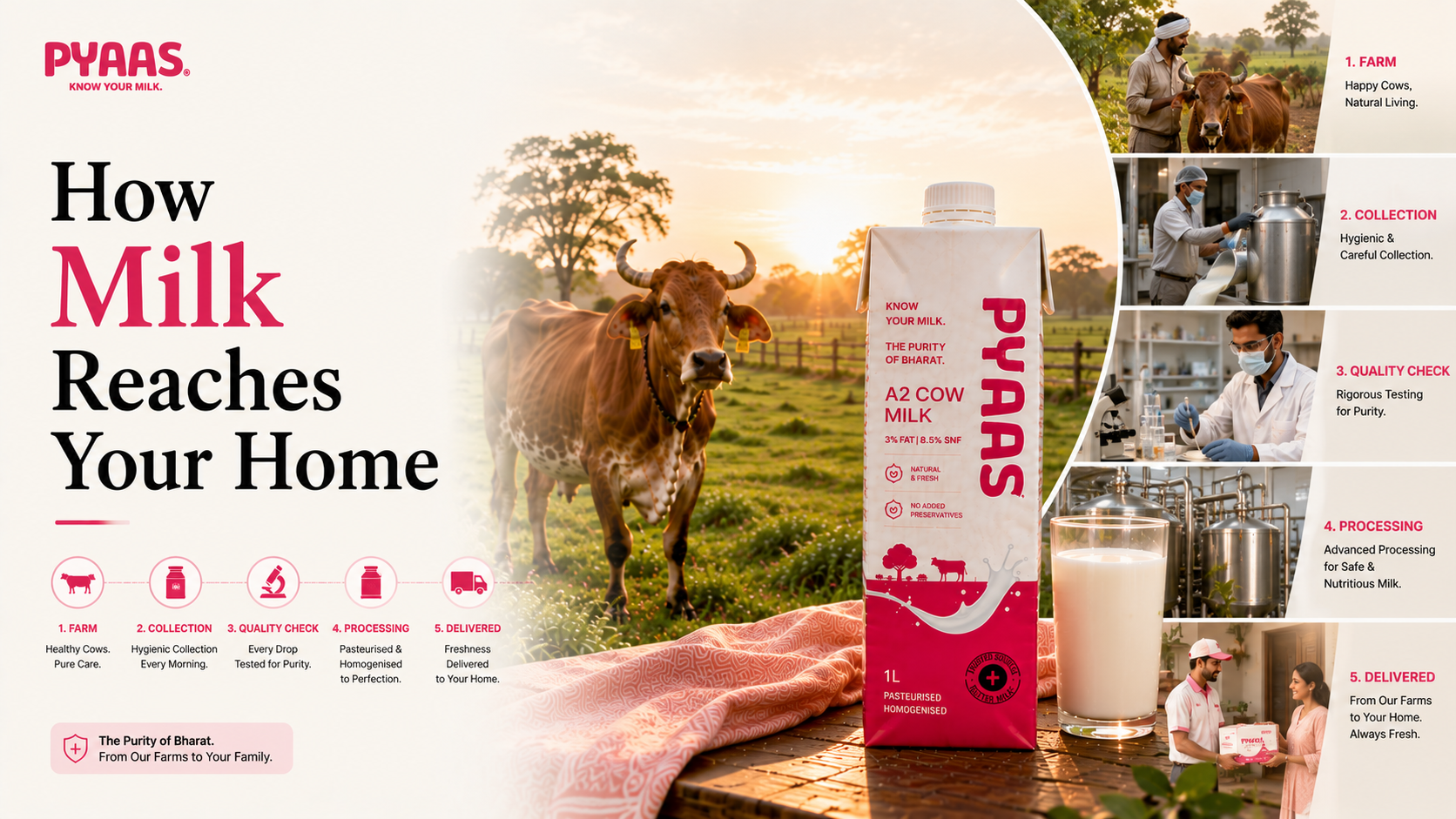
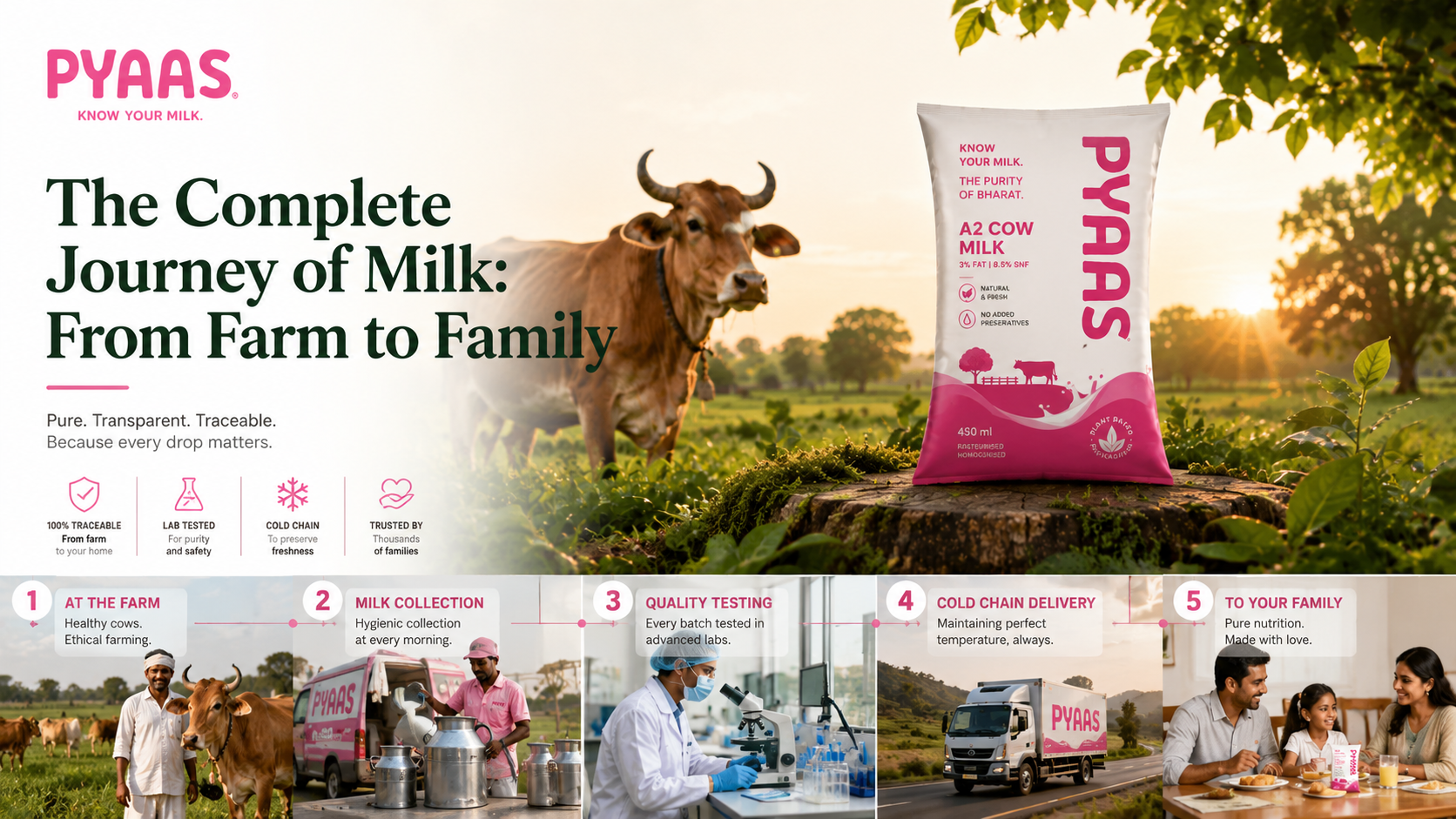
Have you ever wondered how milk reaches your home? Every carton and pouch you open in the morning is the final step of a long, carefully managed journey that begins on a farm hours before sunrise. The path from farm to table involves milking, cooling, testing, processing, packaging and delivery, and each stage quietly shapes the freshness, safety and nutrition of what your family drinks. Most of us never see this journey, yet it decides whether the milk in your glass is genuinely pure or simply labelled that way.
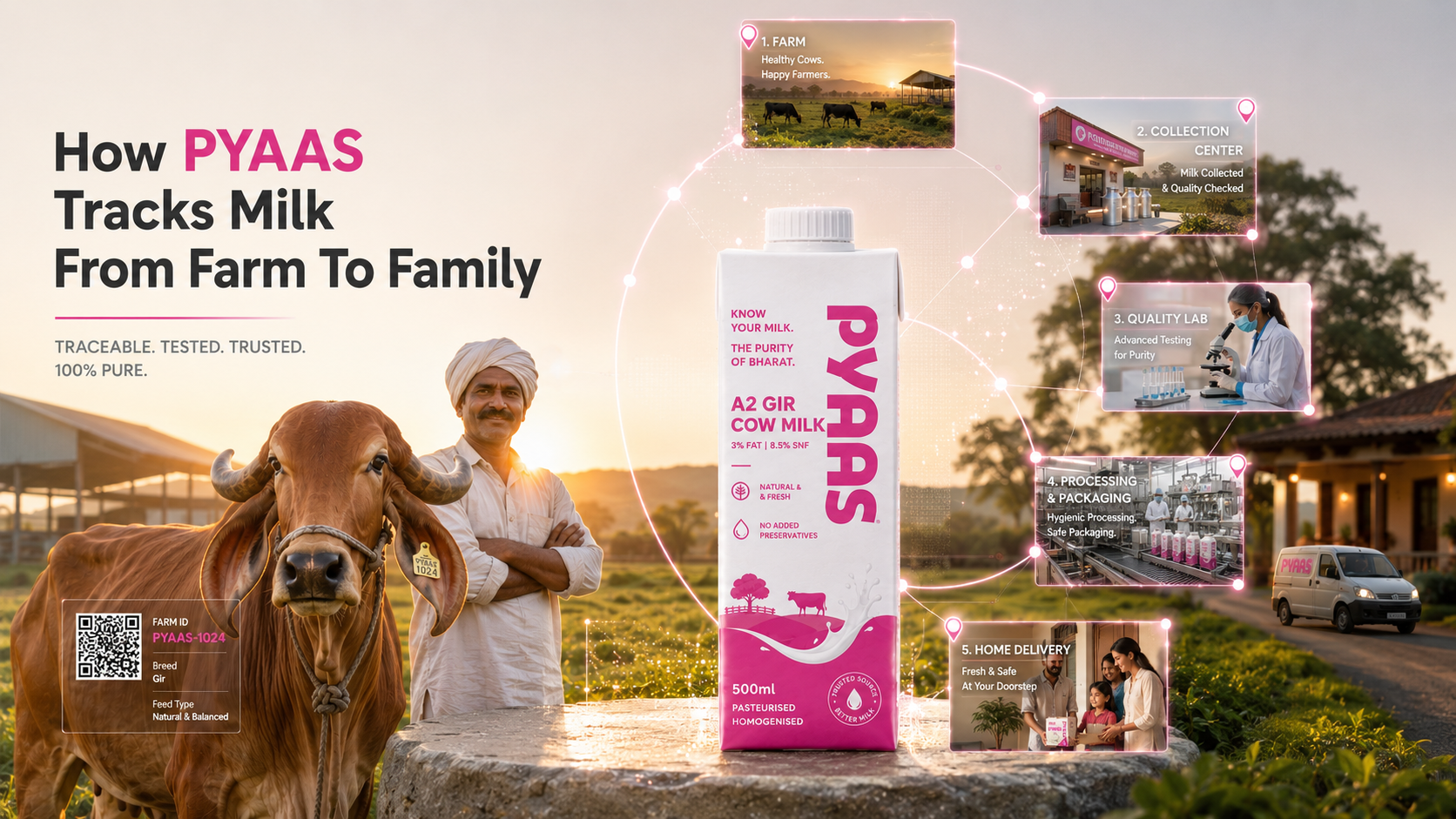
At PYAAS, we believe the journey of milk from farm to table should be something you can actually see, not just trust on faith. This is the idea behind Know Your Milk: when you understand how milk travels from a named farm in Gonda, Uttar Pradesh to your doorstep in Delhi NCR, Lucknow or Ayodhya, you can make better choices for the people you love. In this guide we walk through every stage of the farm-to-home milk journey and show where transparency can replace guesswork.
Where the Journey Begins: The Farm
The quality of milk is decided long before it is ever bottled or packed. It starts with the cow, her breed, her feed, her health and the care she receives every single day. Well-managed farms keep their animals clean, well-fed and stress-free, because a healthy cow produces healthier, more nutritious milk. Hygiene during milking is just as important, since even small lapses can introduce contamination at the very source.
For A2 milk specifically, the breed matters a great deal. Indigenous Indian cows such as Gir and Sahiwal naturally produce milk containing the A2 beta-casein protein. If you want to understand why this is significant, our explainer on what A2 milk is and how it differs from regular milk breaks it down clearly. The choice of farm and breed at this first stage influences everything that follows.
Why Single-Origin Sourcing Changes Everything
In a typical supply chain, milk from hundreds of unknown sources is pooled together, which makes it almost impossible to know whose milk you are actually drinking. PYAAS works differently. We source from named farms and named farmers, so each batch can be traced back to a specific origin. This single-origin approach is the foundation of accountability, and it is the reason we can tell you exactly where your milk began.
Collection and Quality Testing
Once milk is collected, it should be tested before it goes any further. Responsible dairies assess freshness and composition right at the start to make sure only suitable milk continues through the supply chain. Common checks include:
- Fat (FAT) content, which reflects the richness and creaminess of the milk.
- Solids-Not-Fat (SNF), an indicator of the protein, lactose and mineral content.
- Temperature and freshness, to confirm the milk was cooled quickly after milking.
- Adulteration screening, to catch added water or unwanted substances.
This testing stage is where many quality problems are caught or missed. To see how rigorous checks work in practice, read about how modern dairies ensure safe and pure milk. Sadly, adulteration remains a real concern in India, and our guide on milk adulteration in India explains what families should watch for. With PYAAS, each batch's lab results, including SNF and FAT, are recorded so they can be shared transparently rather than hidden.
The Cold Chain: Keeping Milk Fresh in Transit
Milk is highly perishable, and the moment it leaves the cow it begins a race against time and temperature. To preserve freshness, milk is moved through a controlled cold-chain system that keeps it chilled from collection to delivery. Temperature management is one of the most important parts of modern dairy logistics, because even a brief warm spell can encourage bacterial growth and shorten shelf life.
An unbroken cold chain protects flavour, nutrition and safety. When the chain breaks, milk can spoil quickly, which is why reliable logistics matter so much. The faster and colder the journey, the closer the milk in your home stays to how it was the moment it left the farm.
Processing: Pasteurisation and Homogenisation
Before reaching most consumers, milk usually passes through one or more processing steps designed to improve safety and consistency. The two most common are:
- Pasteurisation, a controlled heating process that reduces harmful microbes while keeping milk nutritious. Learn more in our piece on pasteurised milk explained.
- Homogenisation, which breaks down fat globules so the cream does not separate and the texture stays uniform. Our article on homogenised milk covers this in detail.
Each step is meant to improve consistency, safety and consumer confidence. Understanding these processes helps you read a label with clear eyes rather than confusion, and to decide what suits your family best.
Packaging: Protecting Milk on the Way to You
Packaging does far more than hold milk. It protects the product from light, air and contamination during transport and storage, and it preserves freshness until you open it at home. A good packaging system helps maintain hygiene, shelf life and nutritional integrity. PYAAS delivers milk in cartons and pouches and our ghee in a jar, formats chosen for protection, convenience and responsible use of materials.
Packaging is also where transparency can come to life. On a PYAAS pack, a simple QR code lets you scan and see the exact farm, the named farmer, that batch's lab test and the time the milk left the farm. Instead of trusting a generic label, you get to verify the story yourself.
Distribution, Delivery and Traceability
After packaging, milk travels through distribution networks that connect farms and processing facilities to homes. Efficient logistics ensure timely delivery while keeping the product cold and fresh. For many families, a daily delivery routine makes this effortless, and our look at milk subscription benefits explains why so many are switching.
The final, and most modern, layer of the journey is traceability. Traceability systems allow a dairy to document and share key information across the entire supply chain, so you can trace your milk from a specific farm all the way to your table. This builds trust, improves accountability and helps catch problems early. To go deeper, read what traceable milk really is.
Why Today's Families Expect More
Consumers today want more than just milk. They want to know the source, see proof of quality and feel confident about what they are feeding their children. Brands that offer genuine visibility into the milk journey are earning that confidence. This same expectation extends to other products too: the same care that defines our milk also goes into our A2 Bilona ghee, made in small batches with the traditional method.
The PYAAS Promise: A Journey You Can See
Every step of the dairy journey matters, from the health of the cow to the temperature in the delivery van. The difference with PYAAS is that you do not have to take any of it on faith. We trace milk from named farms in Gonda to homes across Delhi NCR, Lucknow and Ayodhya, and we share the proof on every pack. If you would like to know the people behind this promise, meet our founding family.
The next time you pour a glass for your family, remember the long journey behind it. You deserve to know where your milk came from, who produced it and how it reached your home. That is what we mean when we say: Know Your Milk.
Written by
PYAAS Team
The PYAAS Team writes about dairy transparency, milk quality and traceability, drawing on PYAAS's work sourcing single-origin A2 milk from named farms in Gonda, Uttar Pradesh.
More from PYAAS TeamCommon questions.
How does milk get from the farm to my home?
Milk travels through several stages: it is collected at the farm, tested for quality, cooled and moved through a cold chain, processed by pasteurisation and often homogenisation, then packaged and delivered. Each step is designed to protect freshness, safety and nutrition. With a traceable brand, you can follow this journey from a named farm right to your doorstep.
Why is the cold chain important for milk?
Milk is highly perishable and begins to change the moment it leaves the cow. A controlled cold chain keeps it chilled from collection to delivery, which slows bacterial growth and preserves flavour and nutrition. If the cold chain breaks even briefly, milk can spoil faster and its shelf life drops. Reliable temperature management is one of the most important parts of dairy logistics.
What quality tests does milk go through before delivery?
Responsible dairies test milk for fat (FAT) and Solids-Not-Fat (SNF) to assess richness and nutrition, along with temperature, freshness and screening for adulteration. These checks ensure only suitable milk continues through the supply chain. PYAAS records each batch's lab results so they can be shared openly rather than hidden from you.
What does traceable milk mean?
Traceable milk is milk whose entire journey can be documented and verified, from a specific farm to your home. With PYAAS, a QR code on the pack lets you see the exact farm, the named farmer, that batch's lab test and the time the milk left the farm. This visibility replaces blind trust with proof you can check yourself.
Is farm-fresh delivered milk safer than store-bought milk?
Safety depends less on where you buy milk and more on how it was handled along the way. Properly tested, cold-chain-managed and pasteurised milk is safe whether delivered or bought in a store. The real advantage of a traceable, single-origin brand is that you can verify the source and quality instead of guessing. That accountability is what builds genuine confidence.
Get the next one in your inbox.
The occasional note on milk, ghee, and how we work. Plain words, no hype, and you can leave any time.
Keep reading.
The Complete Journey of Milk: From Farm to Family
4 July 2026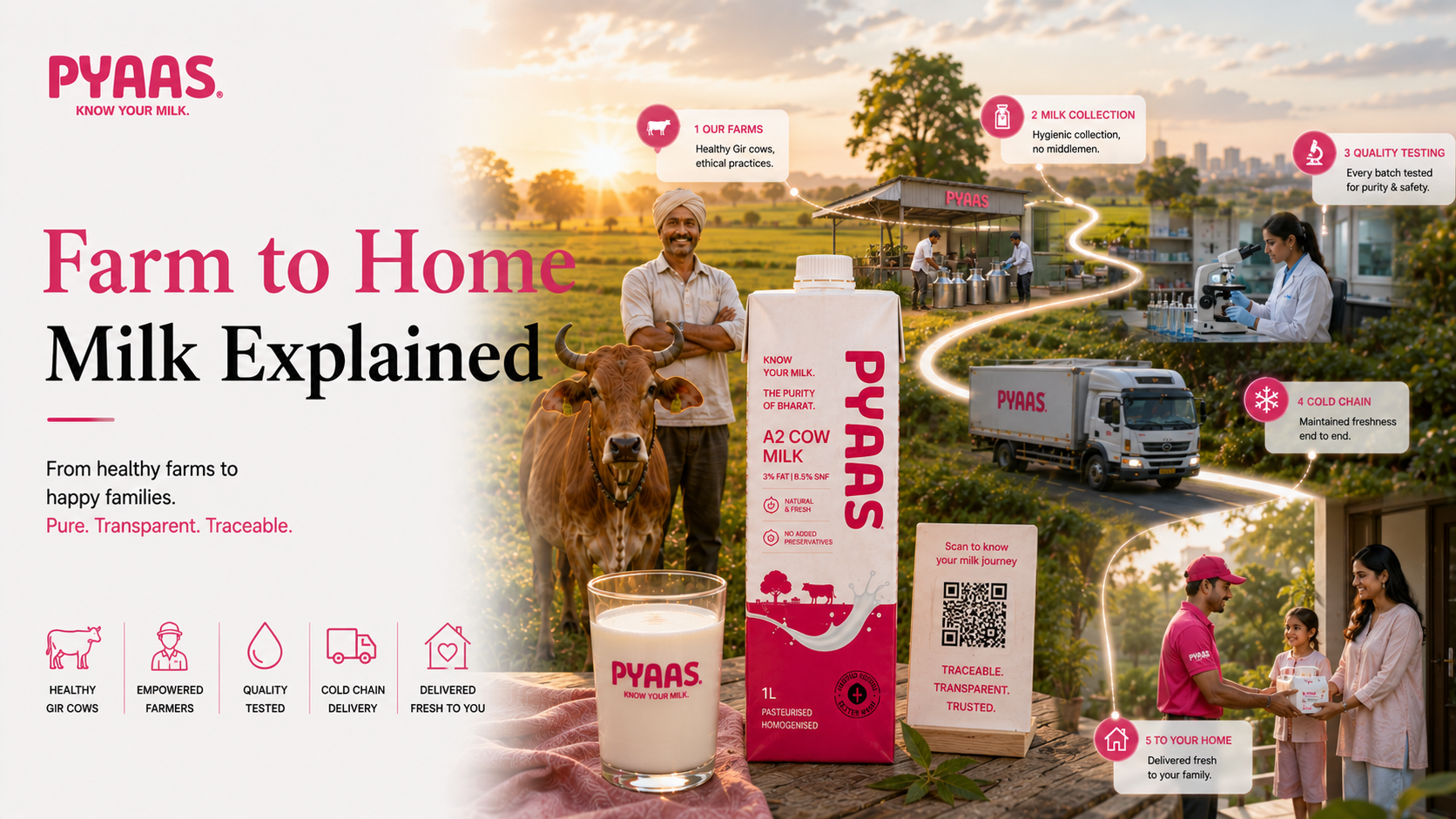
Farm to Home Milk Explained: The Journey Behind Every Glass
7 July 2026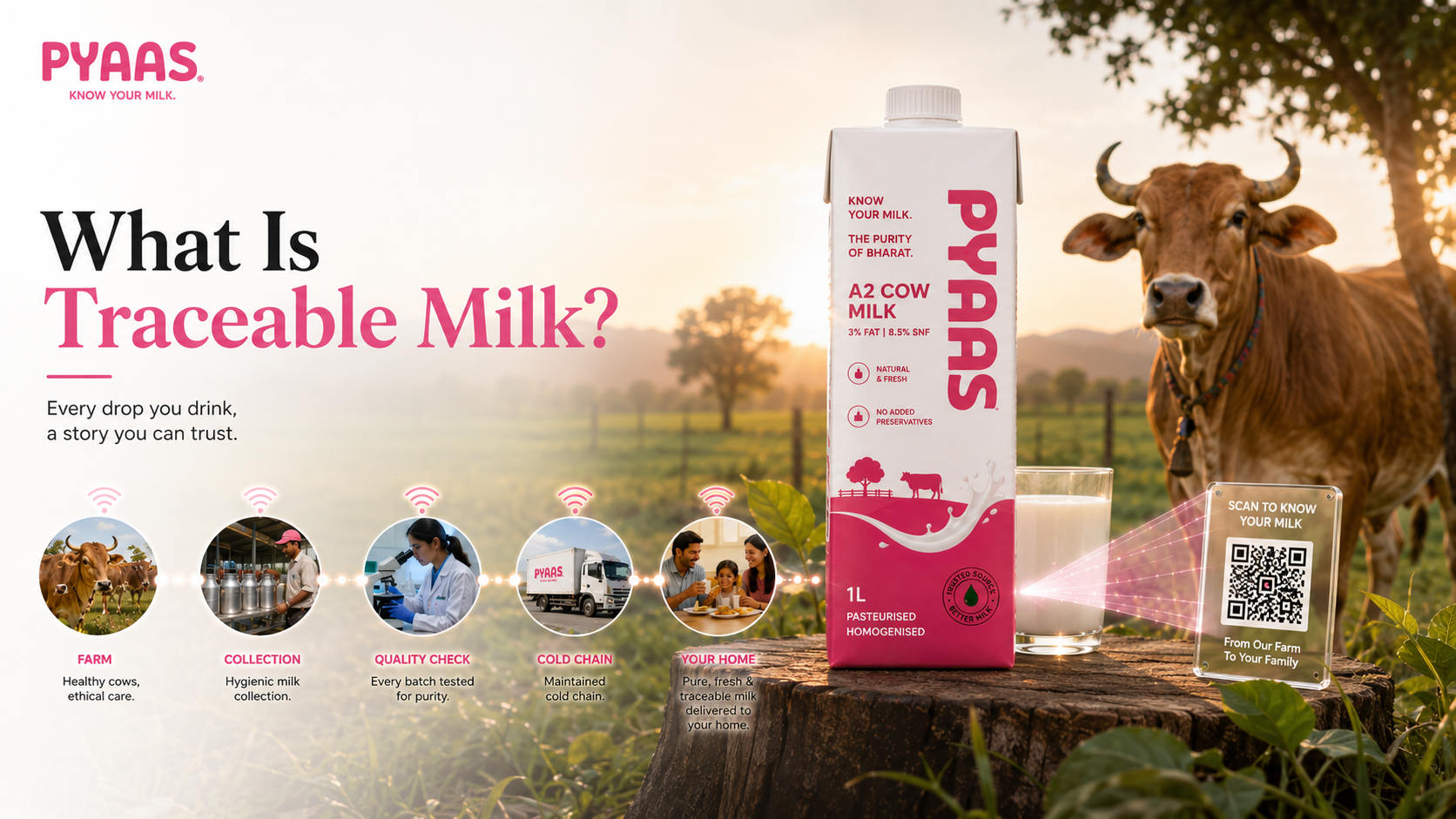
What Is Traceable Milk? Why Modern Consumers Want to Know Their Milk
5 July 2026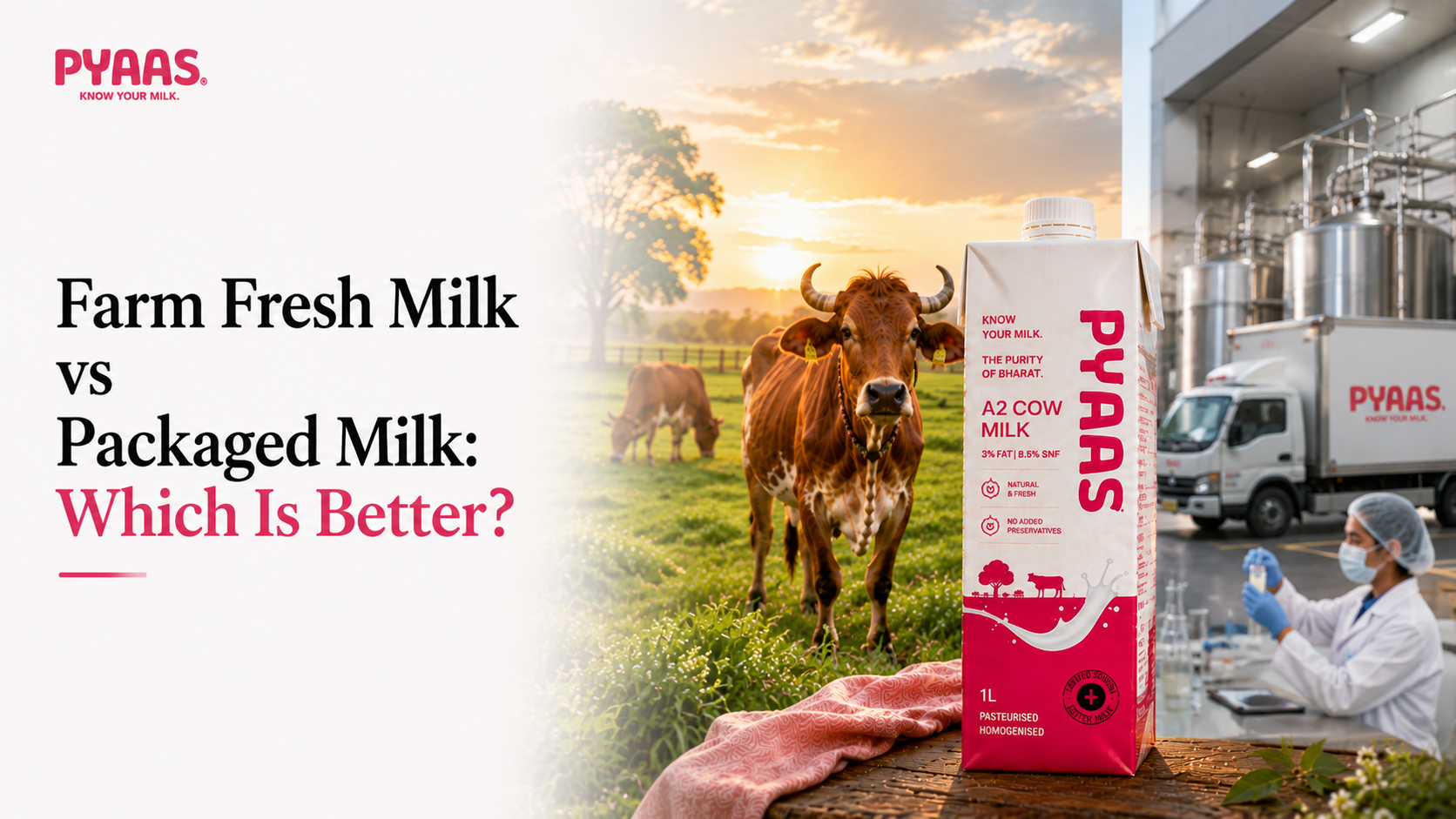
Farm Fresh Milk vs Packaged Milk: Which Is Better for Your Family?
9 July 2026