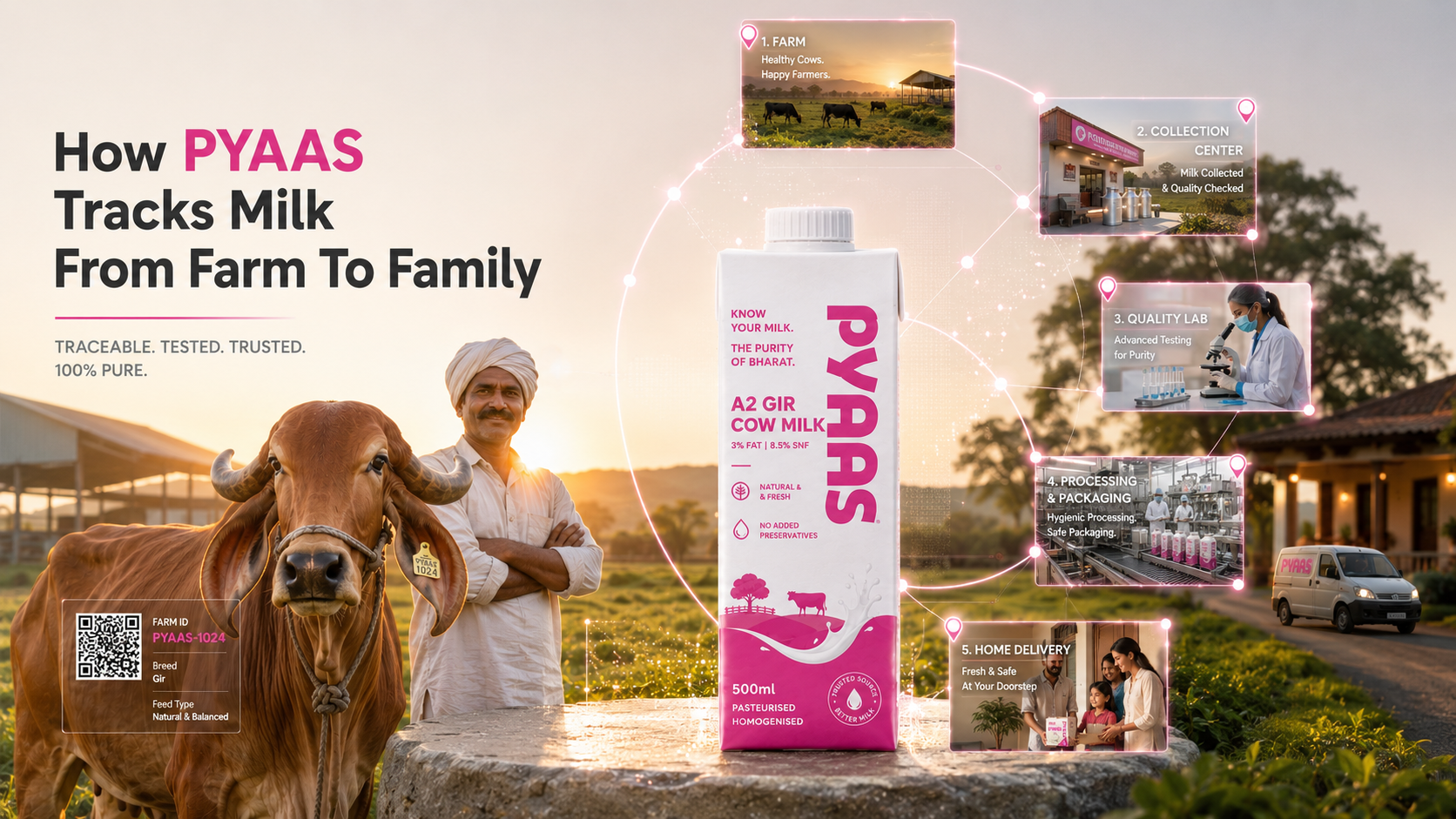
How PYAAS Tracks Milk From Farm To Family
Most dairy brands ask you to trust them. PYAAS asks you to verify. That single shift sits at the heart of how we track milk from farm to family, and it is the reason every PYAAS pack carries a QR code instead of a marketing promise. When you scan it, you do not see a slogan. You see the exact farm in Gonda, Uttar Pradesh, the named farmer who milked the cow, that batch's lab results for SNF and FAT, and the time the milk left the farm. The milk stops being anonymous, and your family stops having to guess.
This article walks through the complete farm to family journey behind a carton of PYAAS A2 cow milk, step by step, so you understand exactly what milk traceability means in practice and why it matters for an Indian household choosing milk every single day. There are no invented statistics here and no hidden steps. Just an honest look at how traceable, single-origin milk reaches your home in Delhi NCR, Lucknow and Ayodhya.
Why "farm to family" needs to be more than a slogan
Almost every milk brand in India uses some version of "farm fresh" or "farm to home." The phrase has become so common that it tells you nothing. The real question is simple: can you point to the farm? Can you name the farmer? Can you see whether that specific batch was tested?
For most milk, the answer is no. Milk from hundreds of unnamed suppliers is pooled, mixed and packed, so the journey behind any single carton becomes impossible to trace. That anonymity is exactly where trust breaks down, and it is the gap we explore in the hidden problem with India's milk supply chain. PYAAS was built to close that gap. We keep milk single-origin, which means the milk in your carton can be traced back to one named source rather than a faceless pool.
Step one: it starts with a named farmer in Gonda
Every litre of PYAAS milk begins on a real farm with a real family behind it. We work with carefully selected farmers in Gonda, Uttar Pradesh, who raise indigenous A2 cows. The farmer is the first and most important link in the chain, and we treat that relationship as a partnership rather than a transaction.
We do not pick farms at random. There is a deliberate selection and onboarding process behind every source, which we describe in how PYAAS selects farmers and builds trust from the source. The same farmer whose name appears in our records is the name you can see when you scan the pack. This is how we connect families directly to the people who produce their milk, an idea we are extending further through how PYAAS Saathi is connecting farmers and families.
Why single-origin A2 milk matters
PYAAS milk is A2 cow milk, which comes from indigenous breeds that produce the A2 type of beta-casein protein. Keeping it single-origin is not just a quality choice, it is what makes true traceability possible. When milk from one farm stays separate, every later record, from the lab test to the dispatch time, can be tied back to that source. If you are still weighing A2 against ordinary milk, our guide to what A2 milk is, its benefits and myths is a useful companion read.
Step two: testing every batch before it moves
Fresh milk is collected and then checked before it goes anywhere near a carton. Two of the most important quality markers for milk are SNF (solids-not-fat) and FAT, which together tell you a great deal about the milk's richness and integrity. Each batch is tested, and those results are recorded against the batch rather than kept out of sight.
This matters because testing only builds trust when the results are visible to you. Honest quality control also means being willing to reject milk that does not meet the mark. We are open about both sides of that process: you can read how our checks work in inside the PYAAS quality testing process, and what we do with milk that falls short in what happens when a milk batch fails quality testing. In India, milk quality is also governed by FSSAI standards, which set the baseline every responsible dairy is expected to meet.
- SNF and FAT recorded per batch: the numbers tied to the exact milk you receive, not an average.
- Batch-level accountability: if something is off, it can be traced to a specific source and day.
- Visible, not hidden: the test summary is part of what you scan, so quality is something you can check rather than take on faith.
Step three: from farm to your doorstep, with the clock recorded
Once a batch passes, the milk is packed into cartons and pouches and moved quickly toward families in Delhi NCR, Lucknow and Ayodhya. Speed and cold handling protect freshness, but the part that sets PYAAS apart is that the time the milk left the farm is captured and made visible. You are not guessing how old your milk is. You can see when its journey began.
This is the difference between a vague "fresh" claim and verifiable freshness. The broader logistics of how milk travels from a farm to a home are worth understanding too, and we lay them out plainly in how milk reaches your home, the journey from farm to table.
Step four: scan the QR code and see the whole story
Everything above comes together in one simple action. On every PYAAS carton, pouch and ghee jar, there is a QR code. Scan it with your phone, and the journey unfolds:
- The exact farm in Gonda, Uttar Pradesh, where the milk came from.
- The named farmer who is behind that batch.
- The batch's lab test, including SNF and FAT, so quality is verifiable.
- The time the milk left the farm, so freshness is a fact and not a feeling.
This is what Know Your Milk means in practice. It is not a tagline we print and walk away from. It is a working system that turns a carton of milk into something you can actually investigate. The same principle extends to our A2 Bilona ghee, where the source and batch story travel with the jar just as they do with the milk.
Why traceability is becoming the new normal
Indian families are asking sharper questions about their food than ever before. Where did this come from? Who made it? Was it tested? These are reasonable questions, and the dairy industry has been slow to answer them. We believe transparency will soon be an expectation rather than a premium feature, a shift we explore in why traceability matters in dairy.
Trust is not built through advertising. It is built through visibility. The more you can see about your milk, the more confident you can be in it, and the stronger the relationship becomes between your family and the farm that feeds it. Behind all of this is a real family with a clear belief about how dairy should work, and you can read more about our founding family and why they started PYAAS.
The honest bottom line
We are not claiming to be perfect, and we will never invent numbers to look impressive. What we can promise is this: with PYAAS, you do not have to take our word for it. The farm, the farmer, the test and the timing are right there for you to check. If knowing your milk this clearly sounds like the way dairy should always have been, scan a PYAAS pack, see the story for yourself, and decide with confidence. That is the whole point of farm to family done honestly.
Written by
PYAAS Team
The PYAAS Team writes about milk traceability, A2 dairy and food transparency, drawing on our work with named farmers in Gonda, Uttar Pradesh to help Indian families truly know their milk.
More from PYAAS TeamCommon questions.
How does PYAAS track milk from farm to family?
PYAAS keeps milk single-origin so it can be traced to one named farm in Gonda, Uttar Pradesh. Each batch is tested for SNF and FAT, and the dispatch time is recorded. A QR code on every carton, pouch and ghee jar lets you scan and see the farm, the farmer, the test and the time the milk left the farm.
What information can I see when I scan the PYAAS QR code?
Scanning the QR code shows the exact farm the milk came from, the named farmer behind that batch, the batch lab test including SNF and FAT, and the time the milk left the farm. It turns an anonymous carton into a verifiable story instead of a marketing claim.
What does single-origin milk mean and why does it matter?
Single-origin means the milk in your pack comes from one named source rather than a pool of many unnamed suppliers. This is what makes true traceability possible, because every later record, from the lab test to the dispatch time, can be tied back to that one farm. It is the foundation of how PYAAS guarantees you can know your milk.
What are SNF and FAT in a milk test?
SNF stands for solids-not-fat and FAT is the fat content of the milk. Together they are key markers of milk richness and integrity, and they are part of how quality is assessed in India under FSSAI standards. PYAAS records these results per batch and makes them visible when you scan the pack.
Where does PYAAS deliver traceable A2 milk?
PYAAS delivers fresh, traceable single-origin A2 cow milk and small-batch A2 Bilona ghee in Delhi NCR, Lucknow and Ayodhya. The milk is sourced from named farms in Gonda, Uttar Pradesh, and the same source and batch story travels with every carton, pouch and ghee jar.
Get the next one in your inbox.
The occasional note on milk, ghee, and how we work. Plain words, no hype, and you can leave any time.
Keep reading.
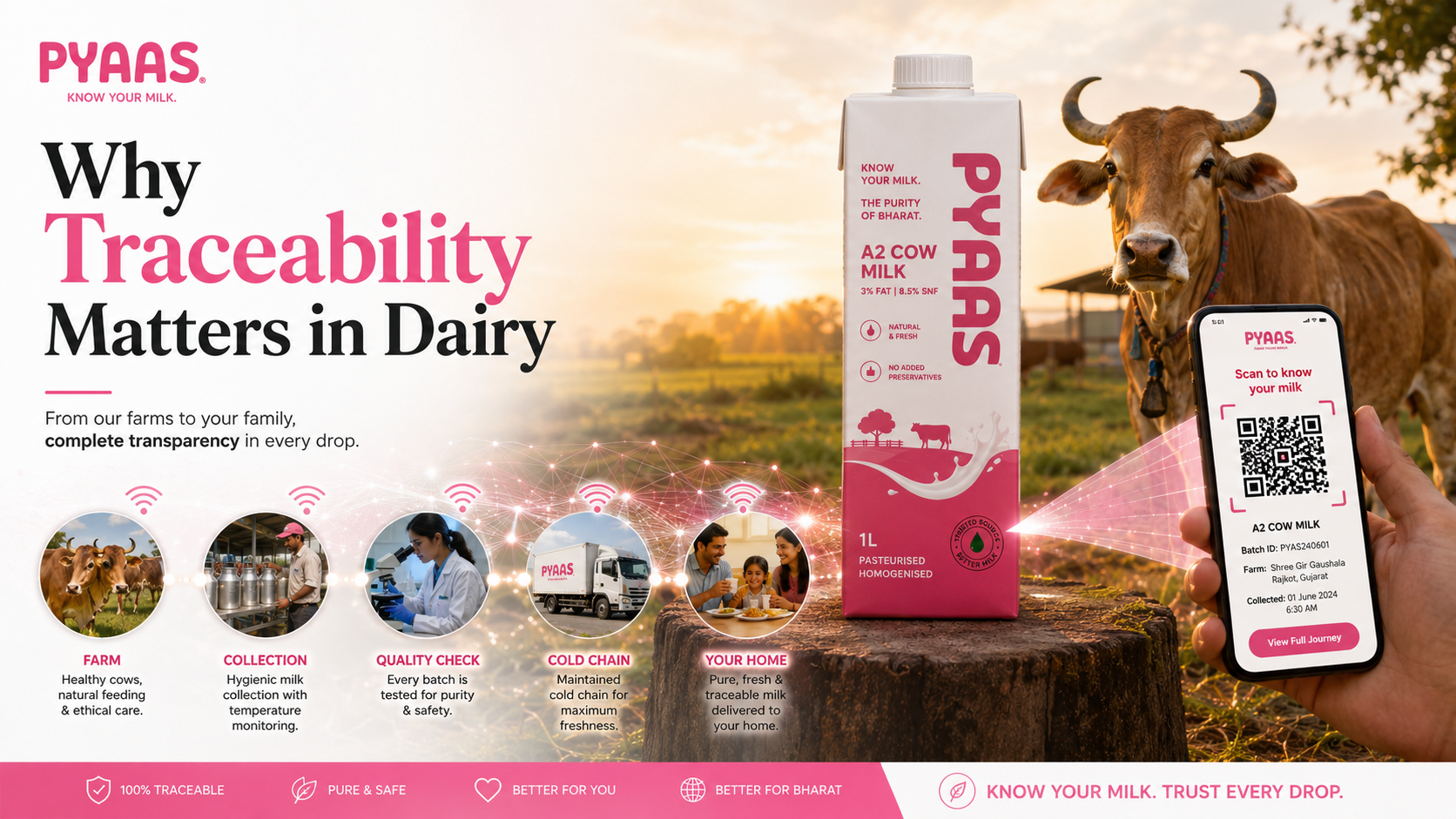
Why Traceability Matters in Dairy: The Future of Consumer Trust
5 July 2026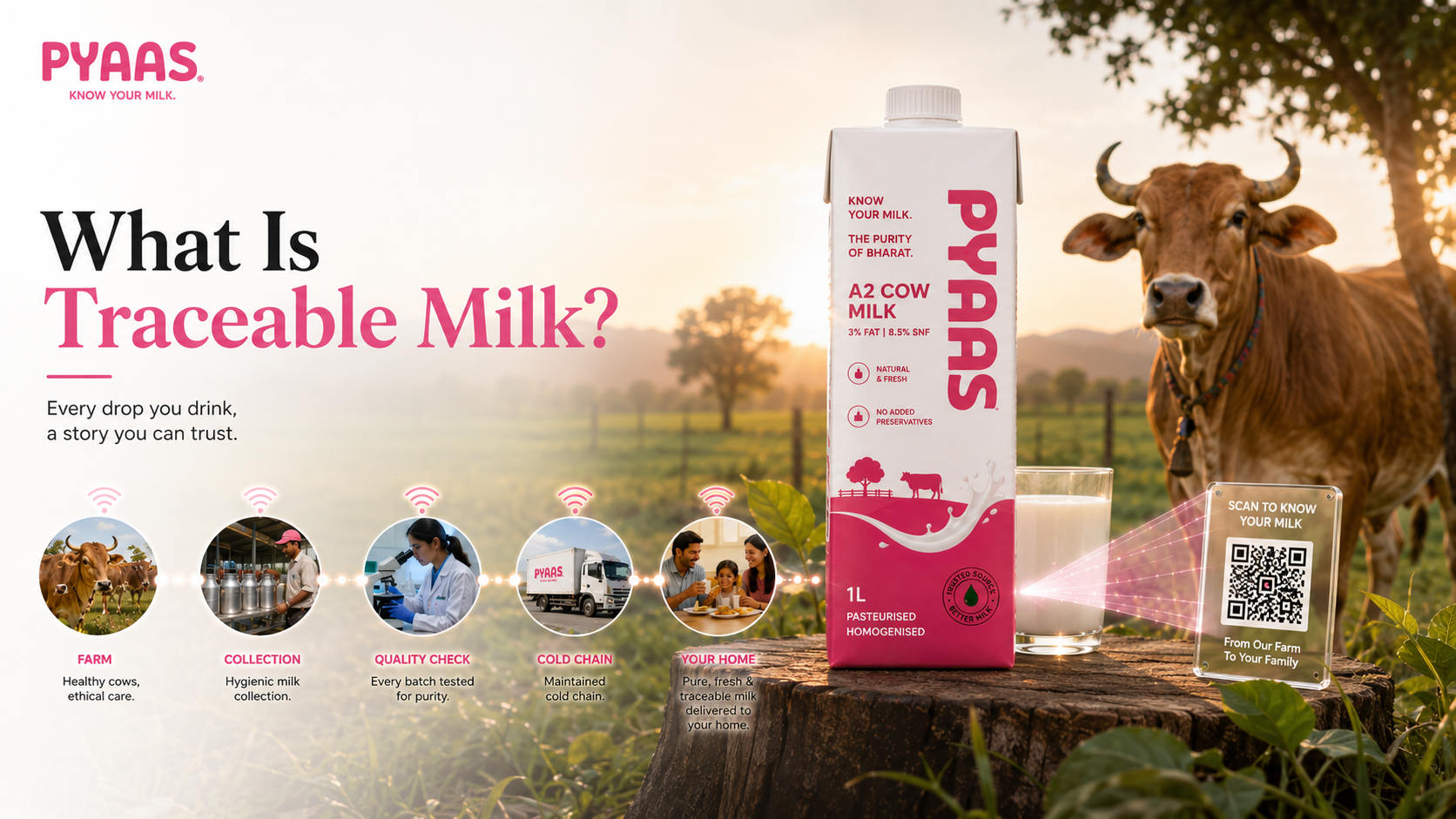
What Is Traceable Milk? Why Modern Consumers Want to Know Their Milk
5 July 2026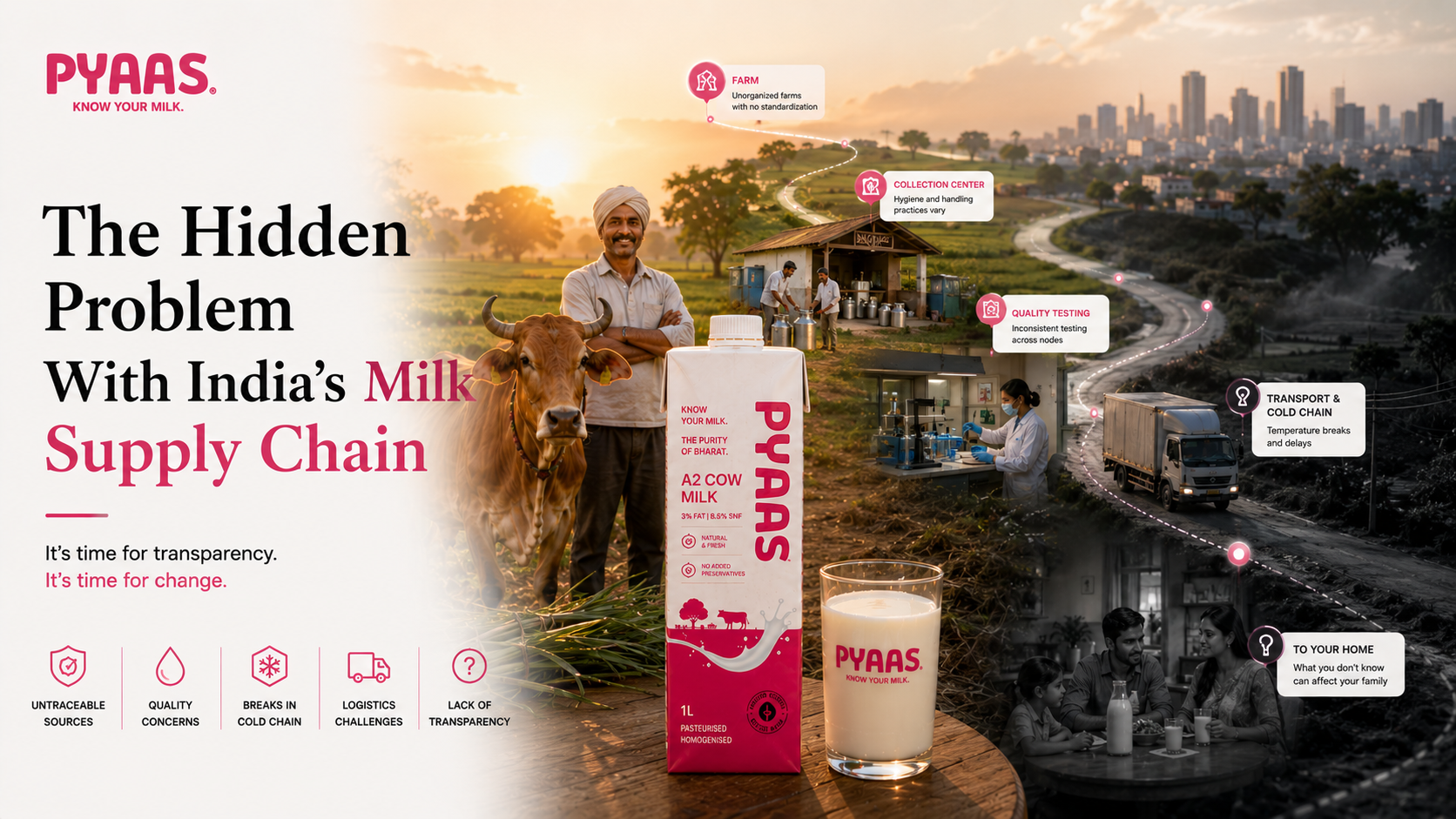
The Hidden Problem With India's Milk Supply Chain
7 July 2026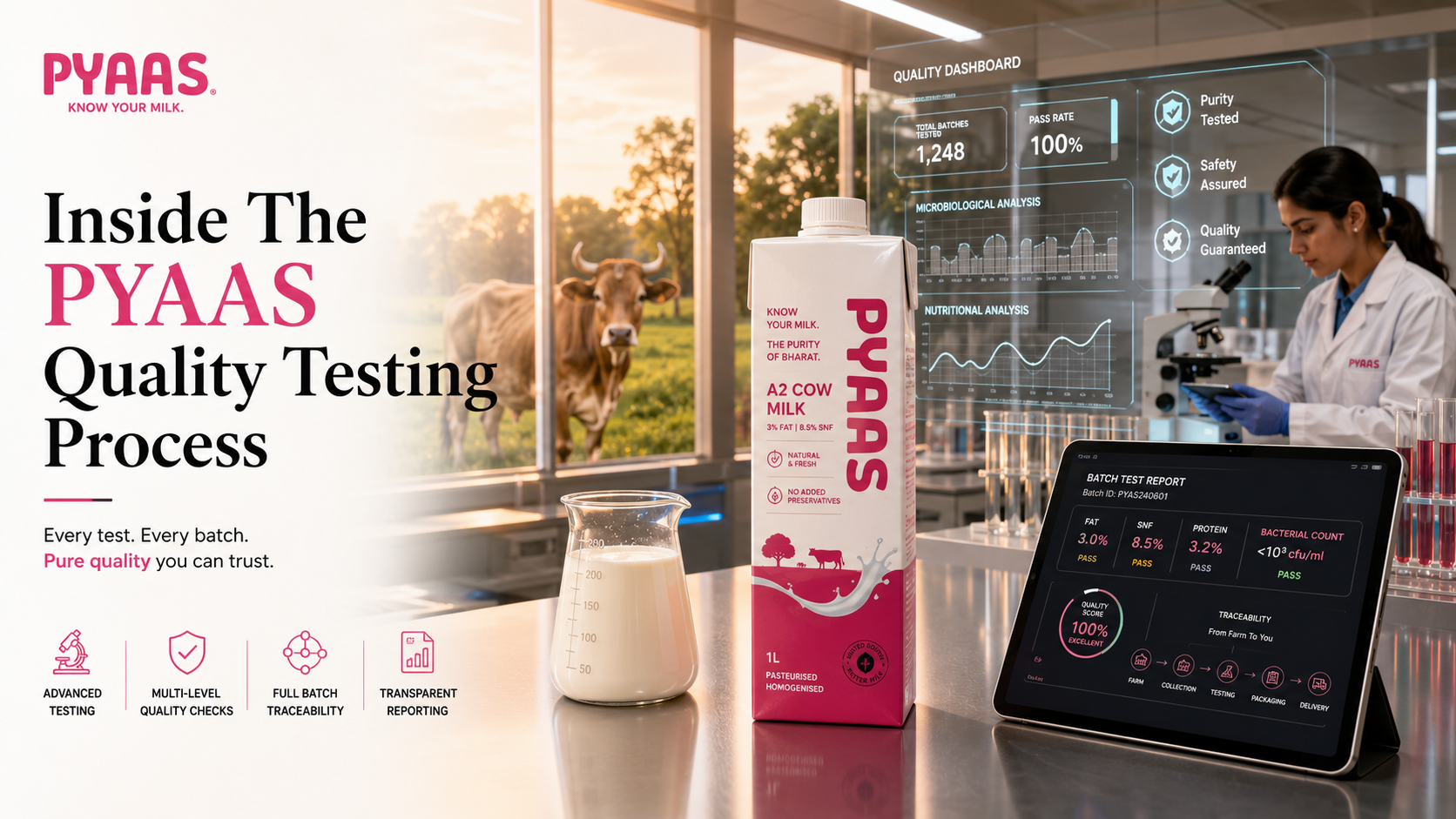
Inside The PYAAS Quality Testing Process
5 July 2026