
What Happens When A Milk Batch Fails Quality Testing?
Every dairy brand talks about quality. Far fewer are willing to talk about the moment quality fails. Yet that moment, when a milk batch does not meet the standard, is where a brand's real character shows. The honest question is not whether a batch ever falls short, because in any food system some will. The question is what happens next: who finds out, who decides, and whether the milk that did not pass ever reaches a family's kitchen.
At PYAAS, we built our entire model around answering that question openly. This guide explains what actually happens when a milk batch fails quality testing, why a failed batch is a sign of a working system rather than a broken one, and how traceability turns a private internal decision into something a family can see and trust. If you have ever wondered what stands between a tested farm and your morning glass, this is it.
What "Failing Quality Testing" Actually Means
A milk batch does not fail because of a single dramatic flaw. Most often it falls outside the expected range for routine parameters that are checked before milk is ever cleared for delivery. These checks are ordinary and constant, and they are the reason a quality system exists at all.
Common reasons a batch is held back include:
- Composition outside the expected band: the SNF (Solids Not Fat) or FAT reading does not match what a healthy single-origin batch should look like.
- Freshness and temperature concerns: milk that was not chilled or moved within the right window after milking.
- Signs of adulteration or contamination: anything that suggests the milk is not pure, single-origin cow milk.
- Sensory red flags: off smell, off taste or off appearance noticed during handling.
None of these mean a farm is "bad." Milk is a living product. A cow's diet, the weather, the time of milking and dozens of small variables shift a batch from day to day. A failed reading is simply the system catching a difference before it becomes your problem. To understand the full set of checks involved, see our explainer on how modern dairies test milk for safety and purity.
What Happens Step by Step When a Batch Fails
The most important thing to understand is that a failed batch never quietly disappears into the supply chain. It is stopped, recorded and accounted for. Here is the path a flagged batch follows.
1. The batch is isolated immediately
The moment a reading falls outside the accepted range, that batch is separated from cleared milk. It does not get blended in, topped up or "averaged out" with good milk to make the numbers look acceptable. Blending away a problem is exactly the practice transparency is meant to prevent.
2. The result is traced back to the source
Because every PYAAS batch is single-origin and tied to a named farm and farmer in Gonda, Uttar Pradesh, a failed result is never anonymous. We can see exactly which farm, which collection and which time window the milk came from. That is the difference between traceable milk and pooled milk, and it is explained further in our piece on how PYAAS tracks milk from farm to family.
3. The cause is understood, not just the symptom
A single odd reading prompts a conversation with the farmer, not a punishment. Was the cow recently calved? Was there a change in feed? Was the chilling delayed? Understanding the cause is how the next batch comes back to standard, and it is why our relationship with each farm is built on long-term trust rather than blame. You can read about that approach in how PYAAS selects farmers and builds trust from the source.
4. The failed milk does not reach you
This is the non-negotiable part. Milk that does not pass is not delivered as drinking milk. Protecting the standard sometimes means a real cost: a batch withheld, a delivery short, a difficult call made in favour of trust over convenience. We accept that cost because the alternative, sending out milk we are unsure about, would break the only promise that matters.
Why a Failed Batch Is a Sign the System Works
It can feel strange to say, but a quality system that never flags anything is not a reassuring system. It usually means nothing is really being checked, or that failures are being hidden. A process that occasionally stops a batch is a process that is genuinely looking.
Consider the alternative that has long troubled Indian dairy: pooled milk from countless unnamed sources, mixed together, where a single weak or adulterated lot is invisible because it has been diluted into a tanker. When milk is anonymous, accountability is impossible. We have written about this at length in our look at the hidden problem with India's milk supply chain and why milk adulteration in India remains so hard for families to detect on their own.
A working quality system does three things well:
- It catches problems early, before milk leaves the cold chain.
- It records honestly, so a pattern at one farm can be spotted and fixed.
- It chooses standards over shortcuts, even when that is the more expensive choice.
How Traceability Makes Accountability Visible to You
Most quality decisions in the dairy industry happen behind closed doors. A consumer is simply asked to trust that the right call was made. Transparency-first dairy flips that. With a QR code on every PYAAS pack, you can scan and see the exact farm, the named farmer, that batch's lab readings for SNF and FAT, and the time the milk left the farm. The proof travels with the product.
This matters because it changes what "passing" means. A batch that reaches you has not only cleared testing, it has cleared testing you can verify. That is the heart of Know Your Milk: not a slogan, but a checkable record. The same discipline carries into our small-batch A2 Bilona ghee, made only from milk that earned its place. If you want the bigger picture on why this shift is happening across food, our article on what traceable milk really means is a good next read.
What you can do as a family
- Scan before you pour: check the farm, farmer and batch readings on the pack.
- Ask brands what happens to failed batches: the answer tells you everything.
- Prefer single-origin over pooled milk, so accountability is even possible.
- Learn the basics of how milk should look and test, so you are an informed buyer.
The Honest Truth About Quality
Perfection is not a promise any honest dairy can make. What we can promise is a process that takes failure seriously, traces it to the source, fixes the cause and never lets uncertain milk reach your family. A failed batch is not a scandal to hide. It is the quality system doing its job.
If that kind of honesty is what you want from the milk your children drink, we would be glad to earn your trust one verifiable batch at a time. Scan a pack, read the record, and decide for yourself. That is the whole point of building dairy this way, and it is the future our founding family set out to create.
Written by
PYAAS Team
The PYAAS Team writes about traceable, single-origin A2 cow milk and small-batch A2 Bilona ghee, sourced from named farms in Gonda and delivered fresh across Delhi NCR, Lucknow and Ayodhya.
More from PYAAS TeamCommon questions.
What does it mean when a milk batch fails quality testing?
It means the batch fell outside the expected range for routine checks such as SNF and FAT composition, freshness, or purity. It does not mean a farm is bad, since milk naturally varies day to day with feed, weather and milking time. A flagged batch is simply the system catching a difference before it reaches a family.
What happens to milk that fails quality testing at PYAAS?
The batch is isolated immediately and never blended with cleared milk to hide the issue. Because every batch is single-origin, the result is traced back to the exact farm and farmer, and the cause is understood. Milk that does not pass is not delivered as drinking milk, even when withholding it carries a real cost.
Is a failed milk batch a bad sign for a dairy brand?
Not at all. A quality system that never flags anything usually means nothing is genuinely being checked, or that failures are being hidden. A process that occasionally stops a batch is a process that is truly looking and choosing standards over shortcuts.
How can I verify that the milk I receive actually passed testing?
With PYAAS you can scan the QR code on the pack to see the exact farm, the named farmer, that batch's lab readings for SNF and FAT, and the time the milk left the farm. This means a batch has not only cleared testing, it has cleared testing you can verify yourself. The proof travels with the product.
Why is single-origin milk easier to hold accountable than pooled milk?
Pooled milk mixes countless unnamed sources together, so a single weak or adulterated lot becomes invisible once diluted into a tanker. Single-origin milk is tied to one named farm, so any failed reading can be traced, understood and fixed. When milk is anonymous, accountability is essentially impossible.
Get the next one in your inbox.
The occasional note on milk, ghee, and how we work. Plain words, no hype, and you can leave any time.
Keep reading.
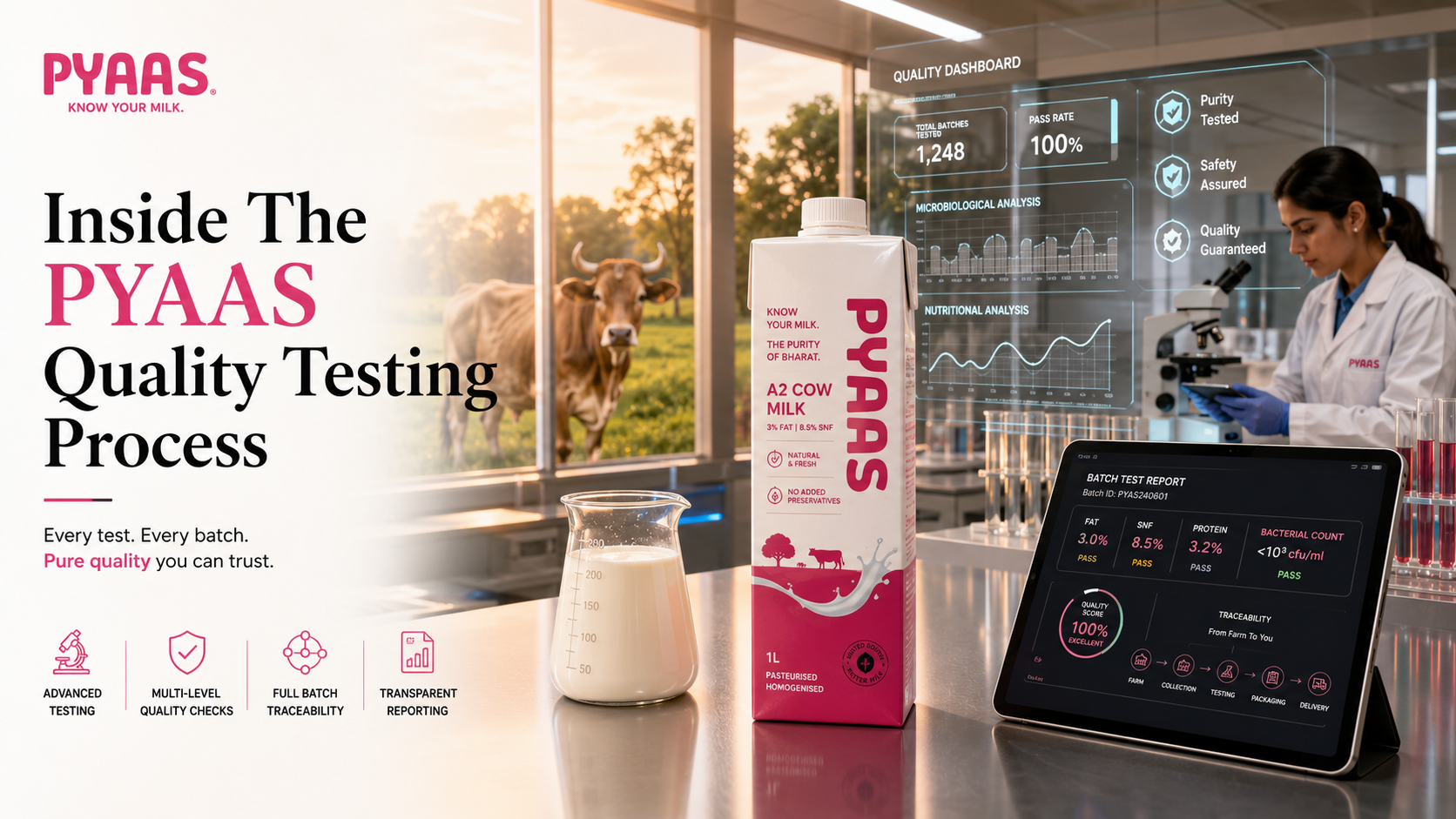
Inside The PYAAS Quality Testing Process
5 July 2026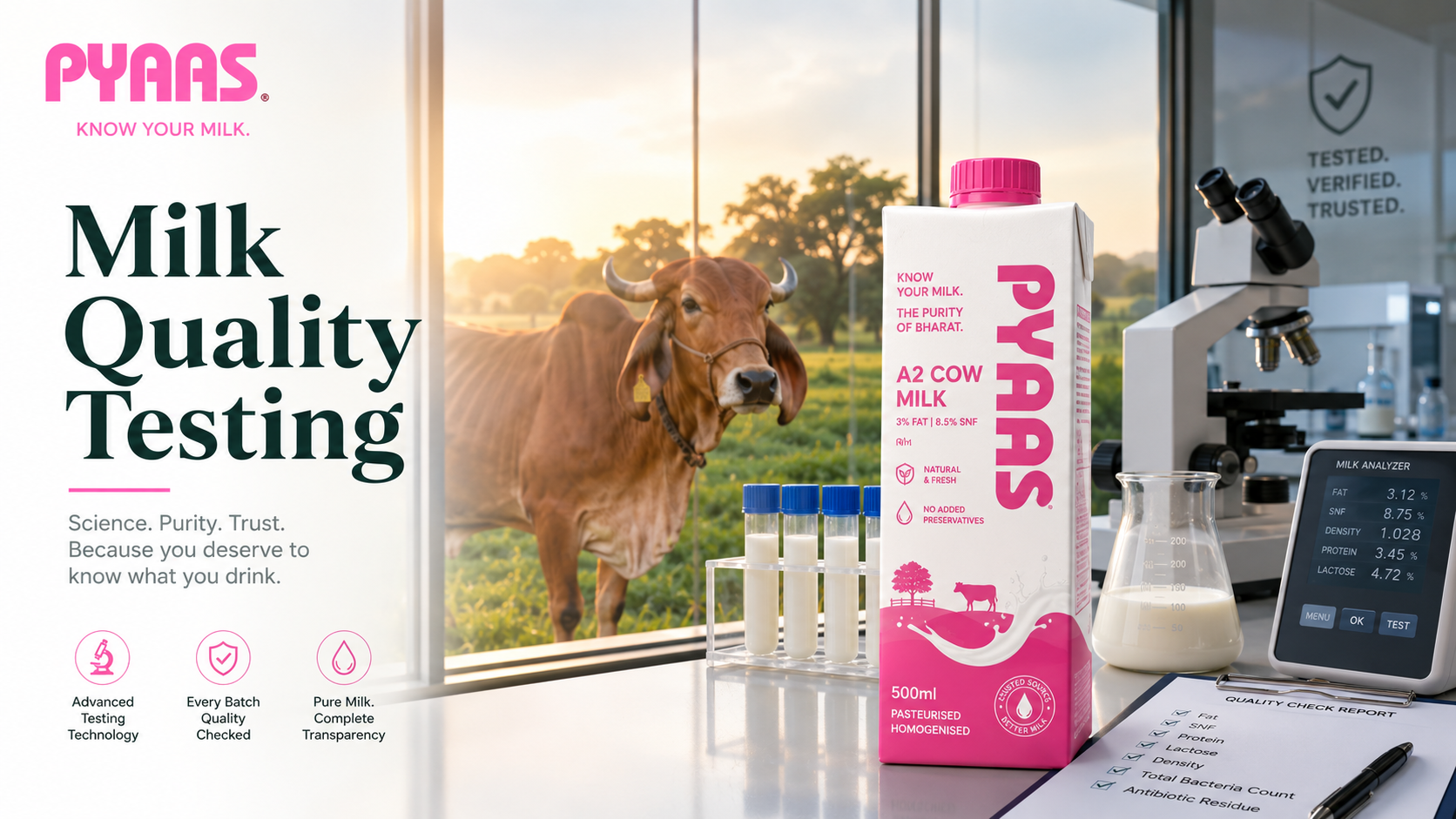
Milk Quality Testing: How Modern Dairies Ensure Safe and Pure Milk
3 July 2026
FSSAI Milk Standards Explained: How Milk Quality Is Regulated in India
6 July 2026
How PYAAS Tracks Milk From Farm To Family
28 June 2026