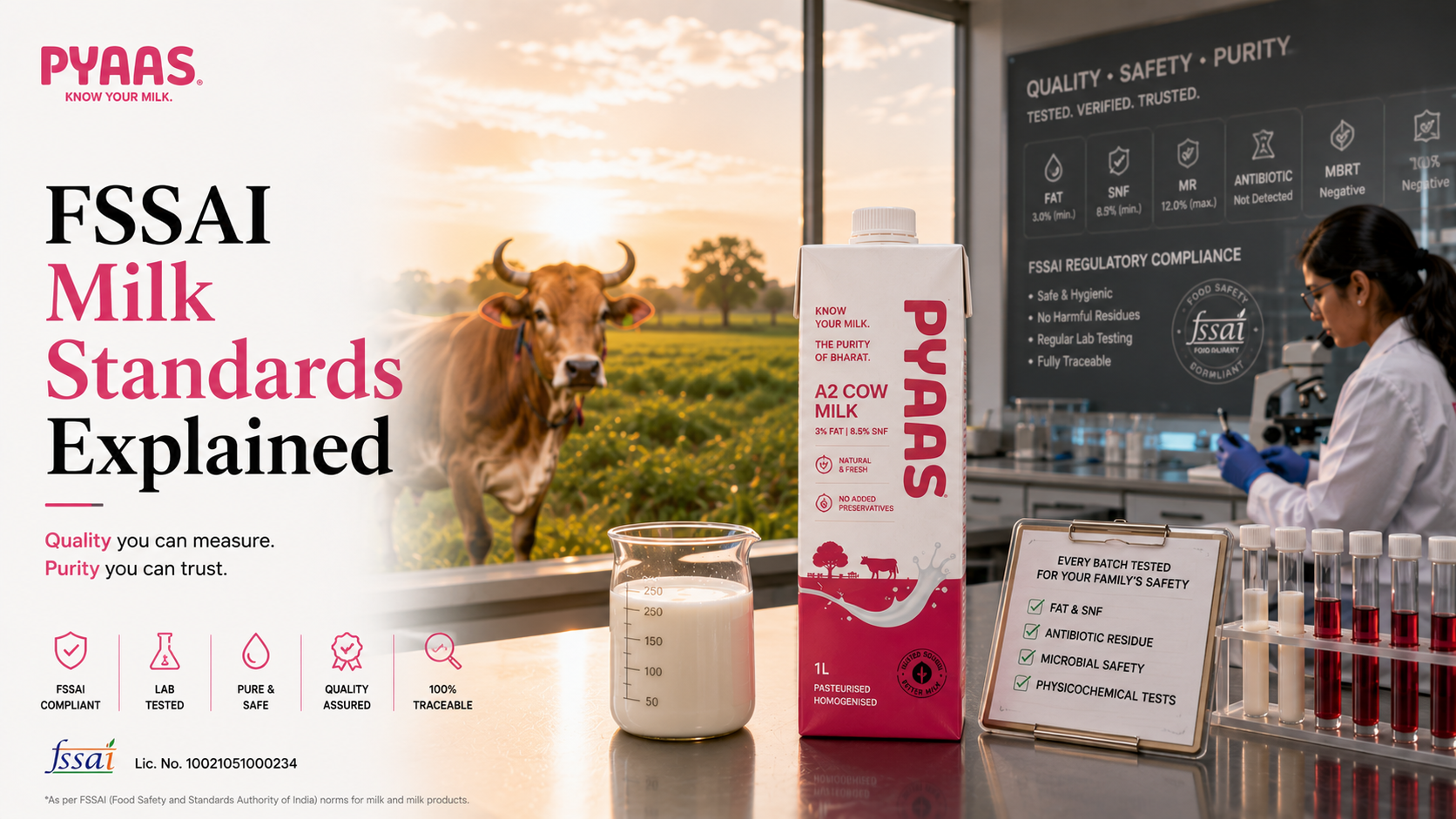
FSSAI Milk Standards Explained: How Milk Quality Is Regulated in India
Every glass of milk your family drinks passes through a quiet web of rules before it reaches your kitchen. In India, that web is held together by the Food Safety and Standards Authority of India, better known as FSSAI. Understanding FSSAI milk standards is the first step toward knowing whether the milk you pour for your children actually meets the quality and safety expectations you assume it does.
This guide explains, in plain language, how milk quality is regulated in India: what FSSAI does, the key parameters used to judge whether milk passes muster, where testing happens along the supply chain, and why even the best regulation still leaves a gap that only transparency can fill. By the end, you will know what to look for and what questions to ask.
What Is FSSAI and Why Does It Regulate Milk?
FSSAI is India's national food regulatory authority. It was set up under the Food Safety and Standards Act to bring food safety in the country under a single, science-based framework. Its job is to lay down standards for food products, license and register food businesses, and ensure that what reaches consumers is safe and honestly labelled.
Milk sits at the very top of FSSAI's priority list, and for good reason. It is consumed daily by hundreds of millions of Indian households, it is given to infants, the elderly and the unwell, and it spoils quickly. That combination of mass consumption, vulnerability of the people who drink it, and perishability makes milk one of the most closely watched food categories in the country. Strong milk quality standards in India exist precisely because the stakes are so high.
The Key FSSAI Milk Quality Parameters
When milk is judged against FSSAI standards, it is not a single pass-or-fail test. Quality is measured across several parameters, and the most important ones every family should recognise are:
- Fat (FAT): The percentage of milk fat, which affects richness, creaminess and nutritional value.
- Solids-Not-Fat (SNF): Everything nutritious in milk apart from fat and water, including proteins, lactose and minerals. SNF is a key indicator of whether milk has been diluted.
- Freedom from adulterants: Milk should be free of added water, starch, detergent, urea and other substances that are sometimes used to bulk it up or mask spoilage.
- Microbial safety: Limits on harmful bacteria, which is why processes like pasteurisation matter so much.
- Honest labelling: What the pack claims, such as toned, full cream or A2, should match what is inside.
FAT and SNF are the two numbers dairy professionals quote most often, because together they reveal whether milk has been watered down. If you would like a deeper look at how laboratories actually measure these, our explainer on how modern dairies ensure safe and pure milk walks through the process step by step.
How These Standards Connect to Adulteration
Many FSSAI parameters exist to catch one core problem: adulteration. Adding water lowers SNF, adding cheap fillers changes the chemistry, and these are exactly what the standards are designed to detect. To understand the scale of the issue and how to protect your own household, read our guide on milk adulteration in India and what consumers need to know. You can also try a few quick checks yourself using our list of simple milk purity tests every family should know.
Where Milk Is Tested Along the Supply Chain
Quality control does not begin on a supermarket shelf. It starts at the source and continues at every handoff. Under a well-run system, milk may be checked:
- At the farm or collection point, where incoming milk is tested for fat, SNF and obvious signs of dilution before it is accepted.
- During processing, where it is screened, pasteurised and verified against the standards for its category.
- Before dispatch, where finished batches are confirmed to meet specifications.
- Through routine regulatory sampling, when food safety officers collect market samples to keep businesses accountable.
Each stage adds a layer of consistency and accountability. The catch is that almost none of this is visible to the family actually drinking the milk. The systems work quietly behind the scenes, which means consumers are usually asked to simply trust that everything was done correctly. To see how milk physically moves through these checkpoints, our piece on the journey of milk from farm to table maps the whole route.
The Gap Between Compliance and Confidence
Here is the honest truth about regulation: meeting FSSAI standards proves that milk is safe and not adulterated, but it does not tell you the story behind your milk. Compliance is a floor, not a window. Two cartons can both clear the same standards while one comes from a single named farm and the other is pooled from dozens of anonymous sources.
Modern families increasingly want more than a pass mark. They are asking questions that standards alone were never designed to answer:
- Which farm did this specific milk come from?
- Who is the farmer, and how were the cows cared for?
- What did this exact batch test for fat and SNF?
- How long ago did it leave the farm?
This is where traceability picks up where regulation stops. Instead of asking you to trust an invisible system, traceability lets you see it. If this idea is new to you, our explainer on what traceable milk means and why consumers want to know their milk is a good next read.
How PYAAS Goes Beyond the Standard
At PYAAS, we treat FSSAI standards as the starting line, not the finish line. We source traceable, single-origin A2 cow milk from named farms in Gonda, Uttar Pradesh, and deliver it fresh across Delhi NCR, Lucknow and Ayodhya. The difference is that we make the proof visible.
Scan the QR code on a PYAAS pack and you can see the exact farm your milk came from, the named farmer who produced it, that batch's lab test results for SNF and FAT, and the time the milk left the farm. The same commitment to traceability runs through our small-batch A2 Bilona ghee, made the slow, traditional way. This philosophy is the heart of everything we do, and you can explore it fully on our Know Your Milk page.
Regulation will always be essential. It protects every family in the country and keeps the industry honest. But the future of dairy belongs to brands willing to show their work rather than ask for blind faith. If you want to understand why this shift matters for the whole industry, our article on why traceability matters in dairy goes deeper.
FSSAI sets the rules that keep your milk safe, and that work matters. Our promise is simply to take it one step further: to let you see, with your own eyes, exactly where your milk comes from and how it was tested. Quality should be visible, not hidden. That is what we mean when we say, know your milk.
Written by
PYAAS Team
The PYAAS Team writes about milk quality, traceability and honest dairy, drawing on the brand's farm-to-home work sourcing single-origin A2 cow milk from named farms in Gonda, Uttar Pradesh.
More from PYAAS TeamCommon questions.
What does FSSAI do for milk quality in India?
FSSAI is India's national food regulator. It sets science-based standards for milk, licenses dairy businesses, and conducts sampling to ensure milk is safe, unadulterated and honestly labelled. Milk is one of its highest priority categories because it is consumed daily by vulnerable groups like infants and the elderly.
What are the main FSSAI milk standards and parameters?
The key parameters include fat (FAT) and solids-not-fat (SNF), which together reveal whether milk has been diluted. FSSAI also checks for freedom from adulterants, microbial safety, and honest labelling that matches what is actually inside the pack.
What is the difference between FAT and SNF in milk?
FAT is the percentage of milk fat, which affects richness and nutrition. SNF, or solids-not-fat, includes proteins, lactose and minerals, everything nutritious apart from fat and water. A low SNF reading is one of the clearest signs that milk has been watered down.
Does meeting FSSAI standards mean my milk is fully traceable?
No. FSSAI compliance proves milk is safe and not adulterated, but it does not tell you which farm it came from or who produced it. Two cartons can both pass the same standards even if one is single-origin and the other is pooled from many anonymous sources. Traceability fills this gap.
How does PYAAS go beyond FSSAI milk standards?
PYAAS treats FSSAI standards as a starting line. We source single-origin A2 cow milk from named farms in Gonda, Uttar Pradesh. By scanning the QR code on the pack, you can see the exact farm, the named farmer, that batch's FAT and SNF results, and the time the milk left the farm.
Get the next one in your inbox.
The occasional note on milk, ghee, and how we work. Plain words, no hype, and you can leave any time.
Keep reading.
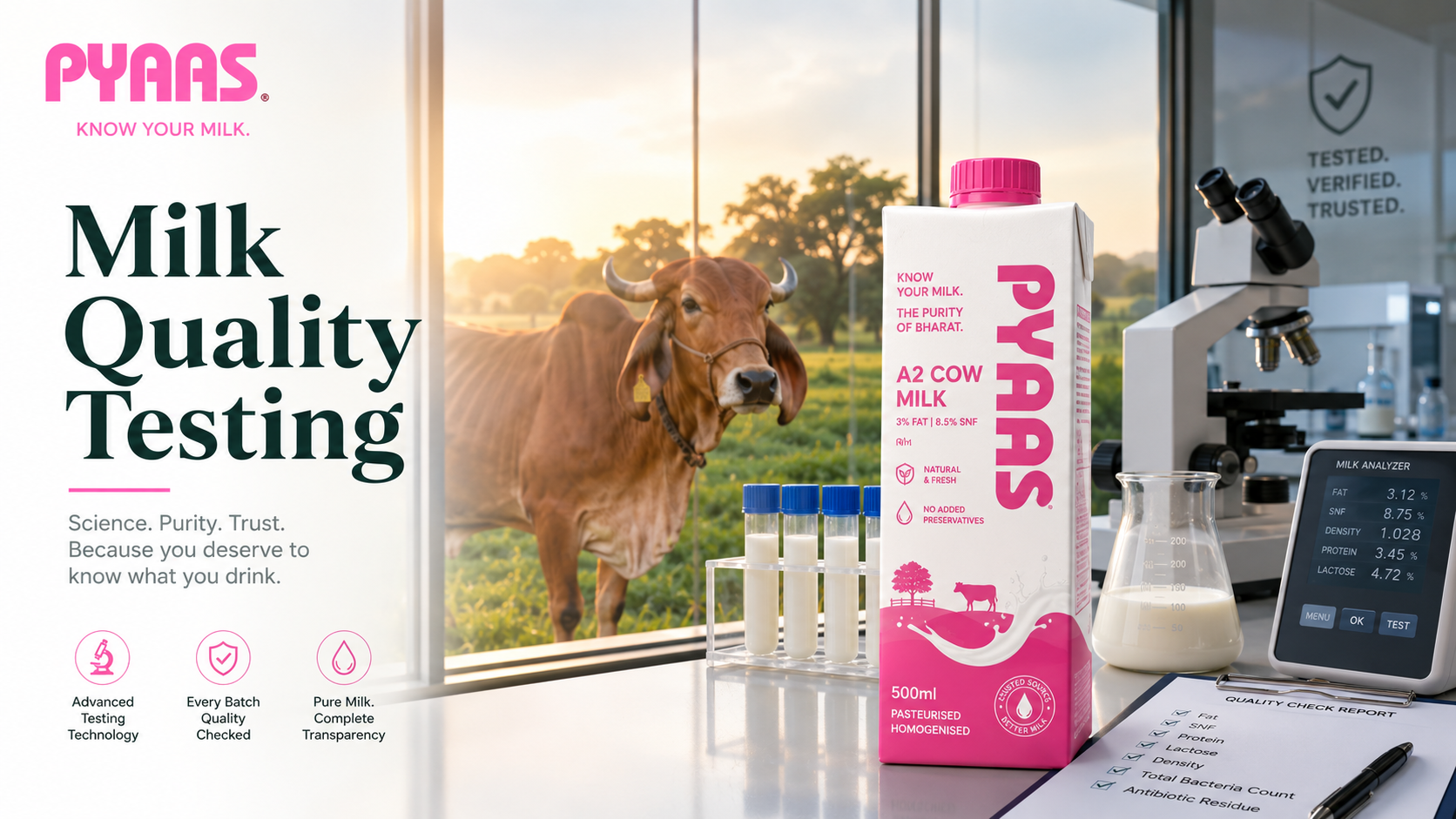
Milk Quality Testing: How Modern Dairies Ensure Safe and Pure Milk
3 July 2026
Milk Adulteration in India: What Consumers Need to Know
28 June 2026
How to Check Milk Purity at Home: 7 Simple Tests Every Family Should Know
9 July 2026
What Is Traceable Milk? Why Modern Consumers Want to Know Their Milk
5 July 2026