Milk Quality Testing: How Modern Dairies Ensure Safe and Pure Milk
Every glass of milk poured for a child, a parent or a guest carries a quiet promise: that it is safe, fresh and exactly what it claims to be. Behind that promise sits a process most families never see, milk quality testing, the set of checks modern dairies run to confirm that milk is pure, nutritious and free from adulteration before it ever reaches your kitchen. Understanding how this works is the difference between trusting milk blindly and truly knowing your milk.
In India, where milk is part of nearly every meal and ritual, the question of quality is deeply personal. Adulteration, inconsistent fat content and unclear sourcing have made many households cautious. This guide explains how milk quality testing works at each stage of the dairy supply chain, what the key parameters actually mean, and how transparency turns a hidden lab report into something you can verify for yourself.
What Is Milk Quality Testing?
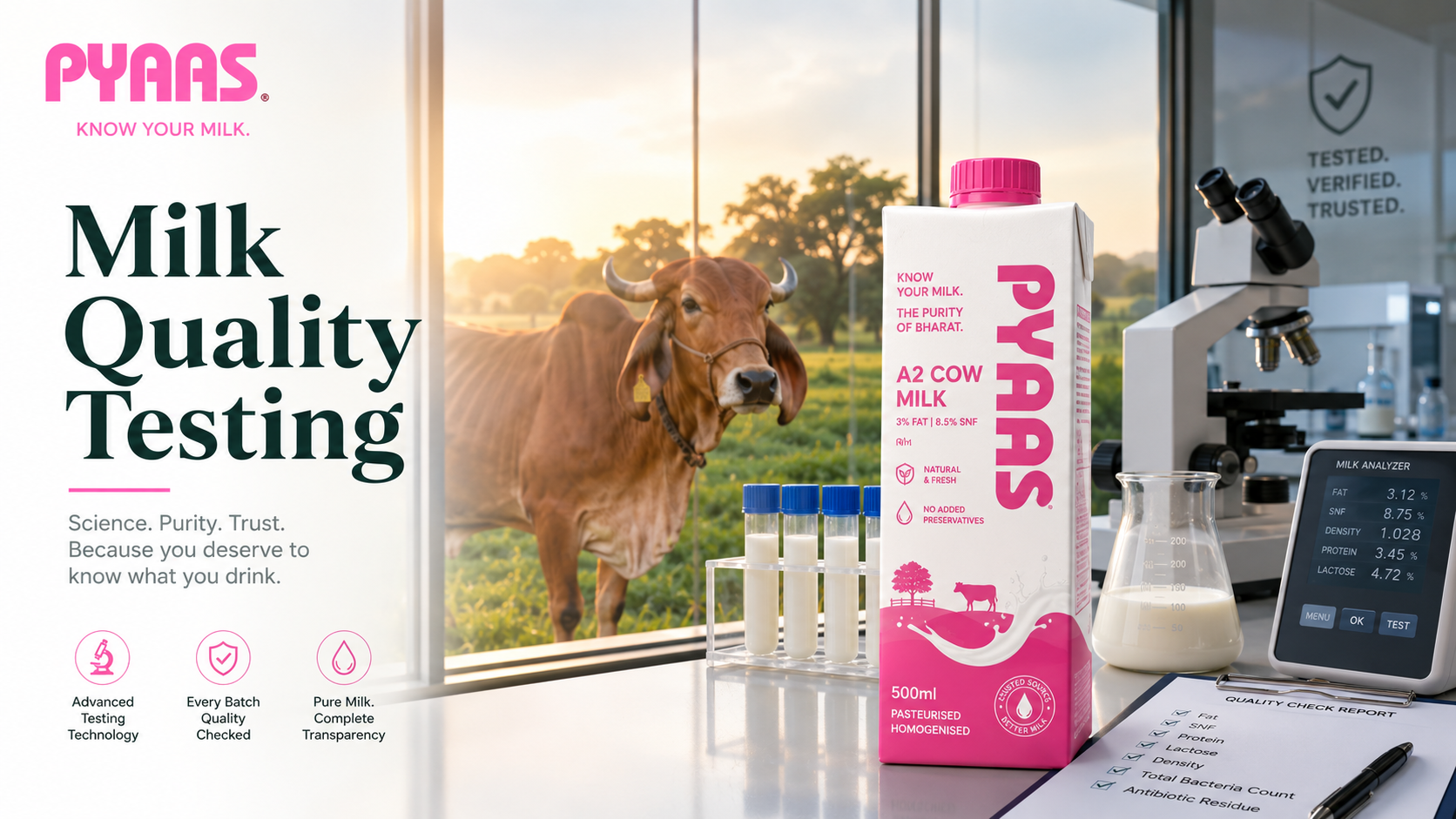
Milk quality testing refers to the procedures used to evaluate the composition, freshness and purity of milk at different points in the dairy supply chain. It is not a single test but a layered system of checks, each designed to catch a different kind of problem, from natural variation in fat content to deliberate adulteration.
Good testing answers three simple questions for every batch of milk:
- Is it pure? Free from water, starch, detergents, urea or other adulterants.
- Is it nutritious? Carrying the expected fat, protein and solids.
- Is it safe and fresh? Handled hygienically and cooled quickly after milking.
When a dairy can answer all three honestly and show its work, quality stops being a marketing claim and becomes a fact you can check. If you want a deeper look at the broader idea behind this, our pillar guide on Know Your Milk explains why visibility into your milk matters more than ever.
The Key Parameters Dairies Measure
Modern dairies focus on a handful of well established measures. You may have seen some of these printed on a pack or quoted by a delivery service without knowing what they mean.
Fat and SNF
FAT is the milk fat percentage, the part that gives milk its richness and creaminess. SNF, or Solids Not Fat, captures the proteins, lactose, vitamins and minerals dissolved in milk. Together, FAT and SNF are the backbone of milk quality grading in India. Higher and more consistent values usually signal well fed, healthy cattle and careful handling. If these terms are new to you, our explainer on milk nutrition facts breaks down what is really inside your glass.
Purity and Adulteration Checks
Beyond composition, dairies screen for adulterants. Standard checks look for added water, starch, neutralisers and other substances that do not belong in milk. This is one of the most important safeguards for Indian families, and you can read more about the scale of the issue in our piece on milk adulteration in India. For households that like to verify things themselves, we also share simple milk purity tests you can do at home.
Freshness and Temperature
Milk is highly perishable. The speed at which it is cooled after milking, and how steadily that cold chain is maintained, has a large effect on freshness and shelf life. Quality systems track the time milk leaves the farm and the temperature it is held at, because warm milk left too long simply will not be the same product by the time it reaches you.
Testing at Every Stage of the Supply Chain
Quality is not decided at one moment. It is protected at several checkpoints, each catching what the others might miss.
- At the farm: The first line of defence. Healthy cattle, clean milking and quick cooling set the ceiling for how good the milk can ever be.
- At collection: Milk is often checked the moment it is received, so problems are caught before a single batch can affect the wider supply.
- At processing: Composition and purity are confirmed again, and the milk is treated, for example through pasteurisation, to make it safe.
- Before packaging: A final review confirms the batch meets standard before it is sealed and sent out.
This layered approach is exactly why the route milk travels matters so much. We trace that route in detail in how milk reaches your home, which follows milk from the farm to your table.
How Regulation and Technology Raise the Bar
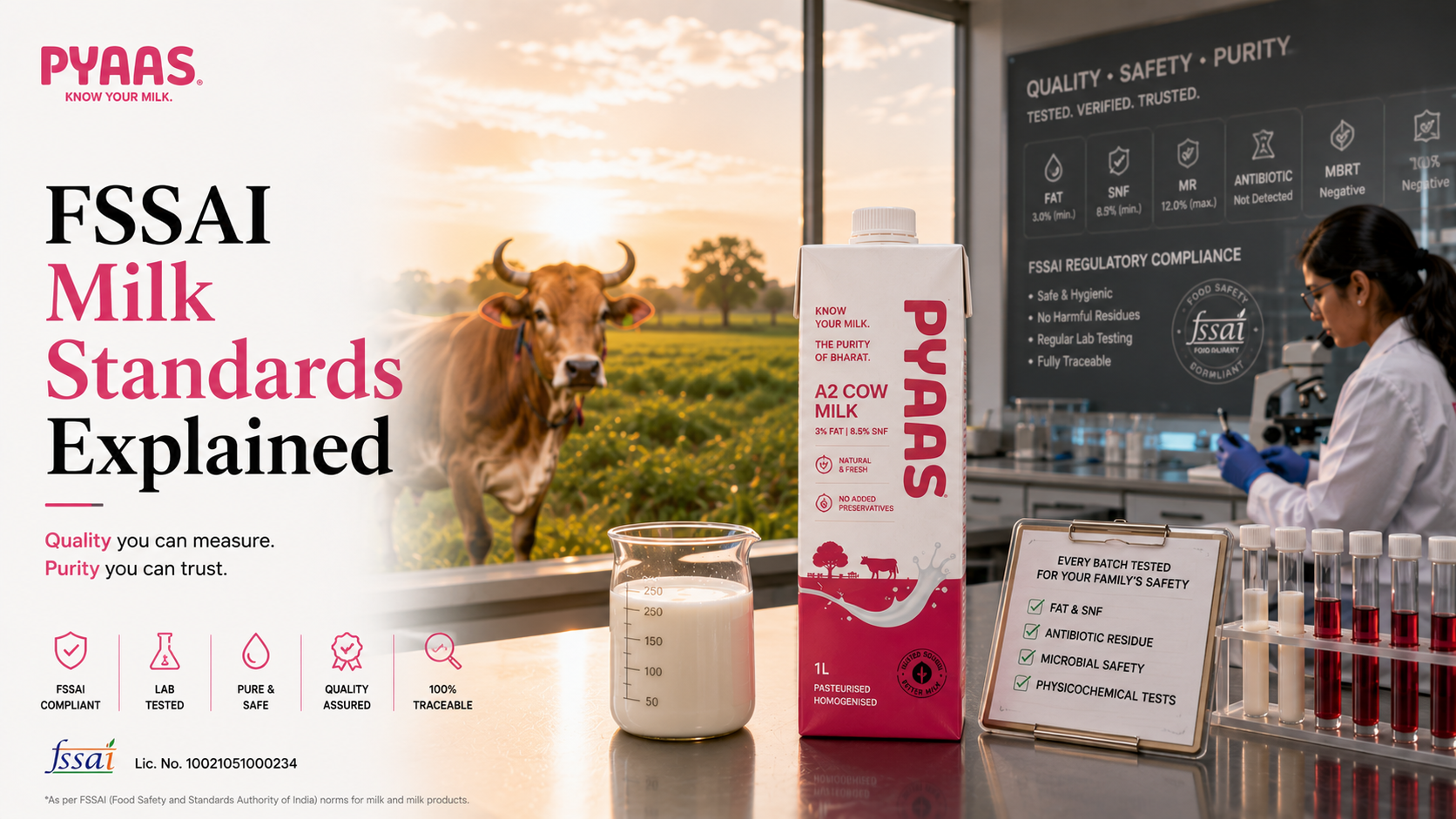
In India, the Food Safety and Standards Authority of India, or FSSAI, sets the baseline that all milk must meet. These standards define minimum requirements for composition and safety, giving families a common floor to rely on. Our guide to FSSAI milk standards explains how milk quality is regulated nationally.
Technology is steadily raising that bar. Many dairies now use:
- Automated analysers that measure FAT and SNF in seconds at collection points.
- Digital batch records that store each test result instead of relying on paper logs.
- Cold chain monitoring that flags temperature breaks in real time.
- Traceability systems that link a finished pack back to its source.
The most meaningful shift is the last one. When test data is tied to a specific farm and batch, quality testing stops being something a company asks you to trust and becomes something you can confirm. This is the heart of traceable milk, and why modern consumers increasingly want to know exactly where their milk comes from.
Why Testing Builds Real Trust
Consistent quality is one of the foundations of a dairy brand families come back to. When milk tastes the same, performs the same in tea and curd, and is verifiably pure each time, trust grows quietly with every delivery.
But trust deepens fastest when testing is open rather than hidden. A lab result locked in a back office protects the dairy. A lab result you can actually see protects you. That is the principle we have built PYAAS around. Every batch of our single origin A2 cow milk is sourced from named farms in Gonda, Uttar Pradesh, and you can scan the QR code on the pack to see the exact farm, the named farmer, that batch's SNF and FAT results, and the time the milk left the farm.
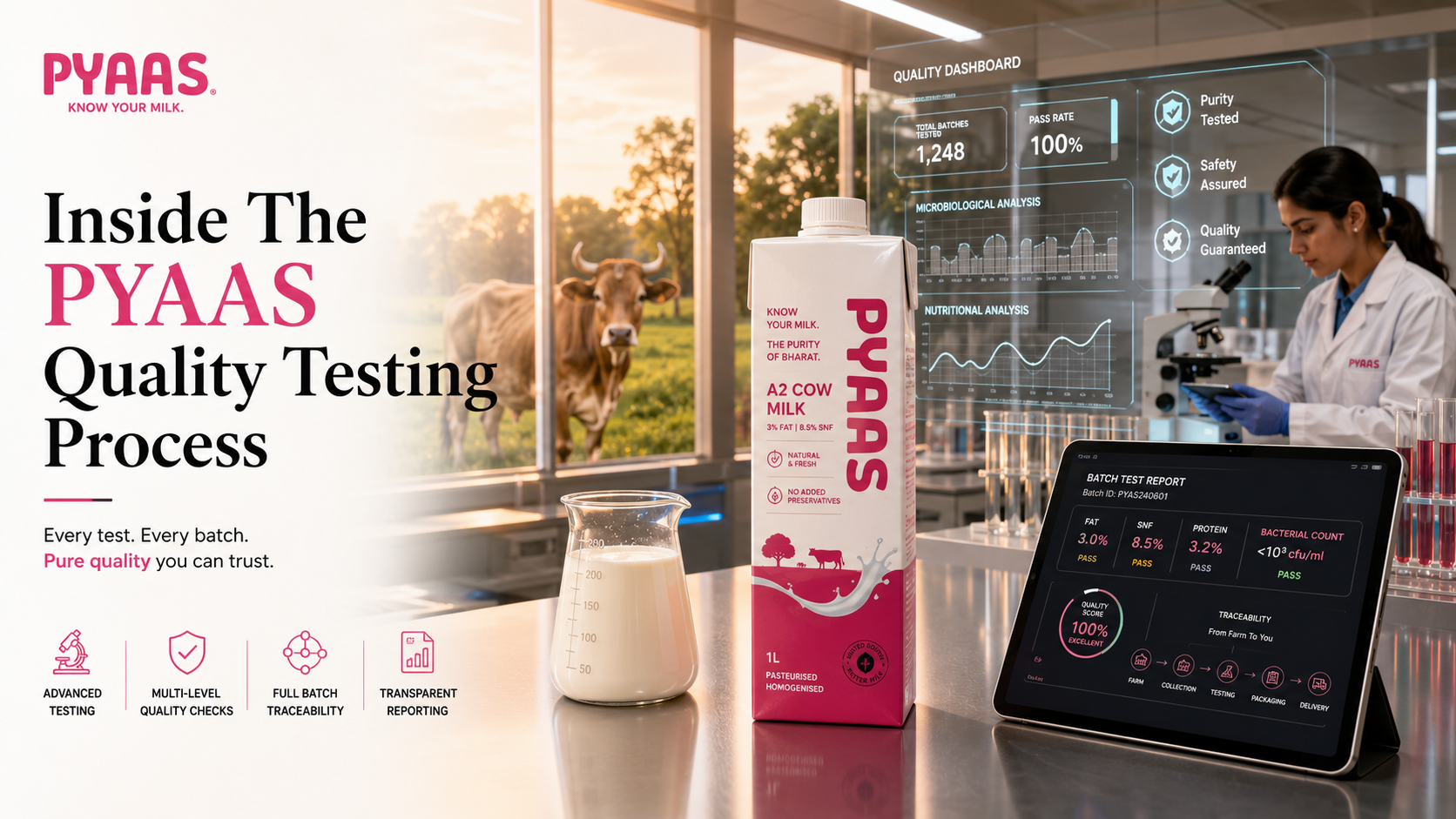
We are honest about the fact that no single number tells the whole story. What matters is the full picture, the source, the handling and the results, shown openly. You can read how we put this into practice in our look inside the PYAAS quality testing process, and what happens on the rare occasion a batch does not meet standard.
What This Means for Your Family
You do not need a laboratory to make better milk choices. A few habits go a long way:
- Ask where it comes from. A dairy that can name the farm and farmer is usually one that tests rigorously.
- Look for verifiable results, not just claims. A QR code that opens a real batch report is more reassuring than a generic promise.
- Pay attention to freshness, including how quickly milk reaches you and how cold it stays.
- Verify when you can. Even simple home checks add a useful layer of confidence.
The same care extends beyond liquid milk. Our small batch A2 Bilona ghee follows the same traceable, single origin philosophy, made the slow traditional way from milk we can stand behind.
The Bottom Line
Milk quality testing is how modern dairies turn a fragile, perishable product into something families can rely on every day. The strongest dairies do not stop at testing well. They show their work, linking each result to a real farm and a real batch so quality is something you can verify, not just hope for. At PYAAS, that openness is the whole point, and it is why we keep coming back to three simple words: Know Your Milk. If that is the kind of milk you want for your family, we would love for you to see exactly what is in yours.
Written by
PYAAS Team
The PYAAS Team writes about traceable, single origin A2 dairy from Gonda, Uttar Pradesh, helping families across Delhi NCR, Lucknow and Ayodhya truly know their milk.
More from PYAAS TeamCommon questions.
What is milk quality testing?
Milk quality testing is the set of checks dairies run to confirm milk is pure, nutritious and safe before it reaches you. It is a layered system rather than a single test, covering composition, adulteration and freshness. Testing happens at the farm, at collection, during processing and before packaging.
What do FAT and SNF mean in milk testing?
FAT is the milk fat percentage, the part that makes milk rich and creamy. SNF, or Solids Not Fat, covers the proteins, lactose, vitamins and minerals dissolved in milk. Together they form the backbone of milk quality grading in India, and consistent values usually signal healthy, well managed cattle.
How can I tell if milk has been adulterated?
Dairies screen for added water, starch, neutralisers and other substances that do not belong in milk. At home, you can use a few simple checks to spot common adulterants. The most reliable approach, though, is choosing milk whose batch test results you can actually verify rather than relying on claims alone.
Who regulates milk quality in India?
The Food Safety and Standards Authority of India, or FSSAI, sets the national baseline that all milk must meet. These standards define minimum requirements for composition and safety. They give families a common floor to rely on, while responsible dairies usually aim well above the minimum.
How does PYAAS make milk quality testing transparent?
PYAAS sources single origin A2 cow milk from named farms in Gonda, Uttar Pradesh. Every pack carries a QR code you can scan to see the exact farm, the named farmer, that batch's SNF and FAT results, and the time the milk left the farm. This turns a hidden lab report into something you can verify yourself.
Get the next one in your inbox.
The occasional note on milk, ghee, and how we work. Plain words, no hype, and you can leave any time.
Keep reading.
Inside The PYAAS Quality Testing Process
5 July 2026
What Happens When A Milk Batch Fails Quality Testing?
5 July 2026
How to Check Milk Purity at Home: 7 Simple Tests Every Family Should Know
9 July 2026
Milk Adulteration in India: What Consumers Need to Know
28 June 2026