Homogenised Milk Explained: Everything You Need to Know
If you have ever opened a carton of milk and noticed that the texture is perfectly smooth from the first glass to the last, with no thick cream layer settling on top, you have experienced homogenised milk. It is one of the most common forms of milk on Indian shelves today, yet very few families actually know what homogenisation is, how it works, or how it differs from the milk our grandparents used to boil and stir. Understanding this simple process helps you read a label with confidence and choose the milk that genuinely suits your home.
In this guide to homogenised milk, we will explain exactly what the process does, how it differs from non-homogenised and raw milk, whether it changes the nutrition inside your glass, and the questions that matter most for Indian families. We will keep it honest and jargon-free, because at PYAAS we believe processing should never be a mystery hidden behind a brand name.
What Is Homogenised Milk?
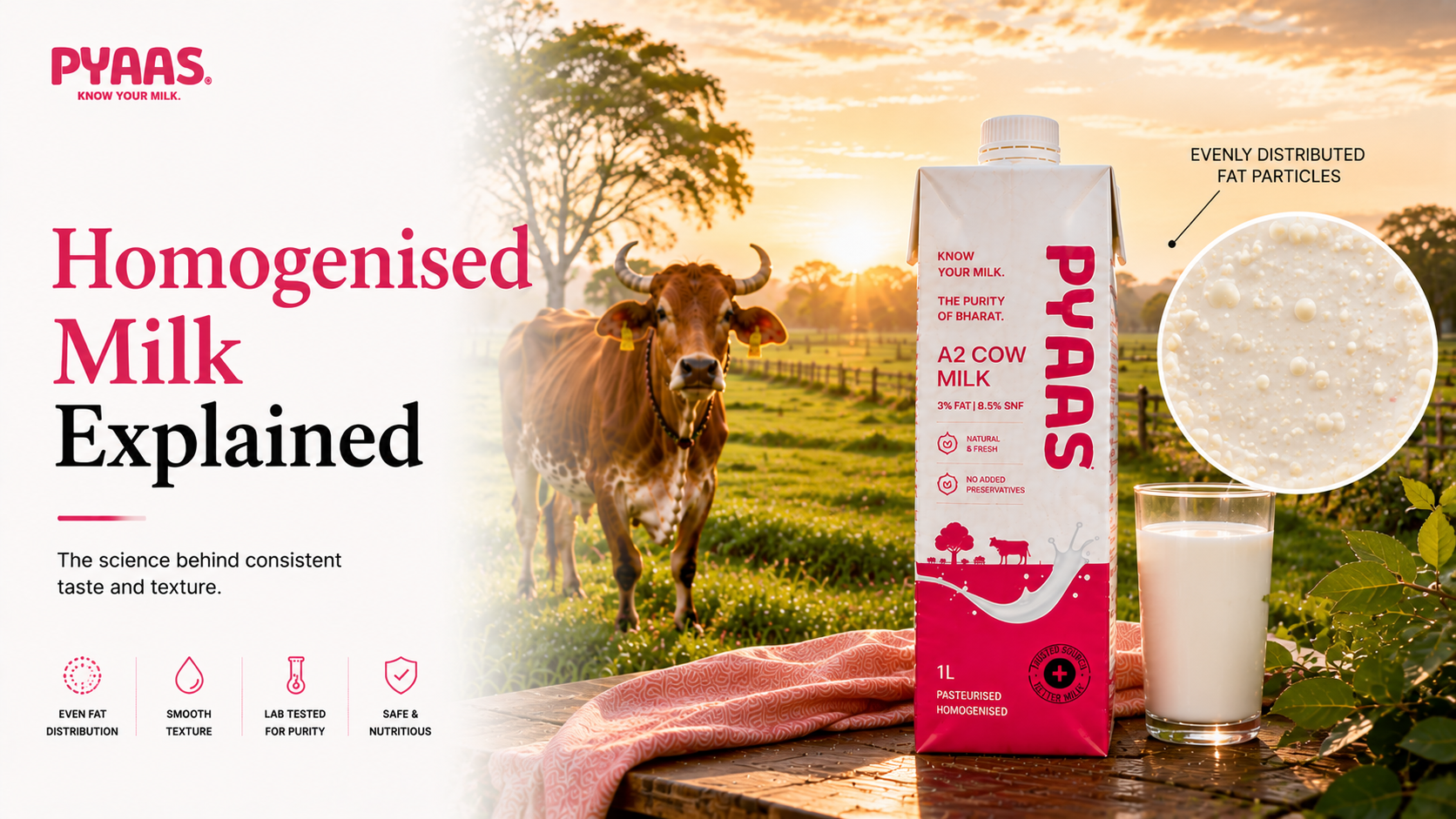
Homogenised milk is milk that has been pushed through a mechanical process designed to break down its fat globules and spread them evenly throughout the liquid. In milk that has not been treated this way, fat is lighter than water, so it slowly floats to the top and forms the familiar cream layer, the malai many of us grew up scooping off boiled milk.
Homogenisation prevents that separation. The result is milk with a uniform, consistent texture and a slightly creamier mouthfeel, where the fat stays suspended instead of rising. It is important to understand that homogenisation is a physical change to fat structure, not a measure of purity or quality. A milk can be homogenised and still be excellent, and another can be homogenised and still be ordinary. The process tells you about texture, not about the farm, the breed, or how clean the supply chain is.
How Does the Homogenisation Process Work?
The science is simpler than it sounds. During homogenisation, milk is forced under very high pressure through extremely small openings inside a machine called a homogeniser. This intense pressure shears the larger fat globules into much smaller, more uniform particles.
Because these smaller fat particles are too tiny to clump together and float, they stay distributed evenly throughout the milk. A few practical effects follow from this:
- No cream line: the milk looks the same top to bottom, with no layer to stir back in.
- Smoother texture: the milk feels more uniform and slightly richer on the tongue.
- Longer visual consistency: the appearance stays stable across the life of the carton.
Homogenisation is almost always paired with heat treatment. To understand the full picture of how packaged milk is made safe and shelf-stable, it helps to read our explainer on what pasteurisation is and why it matters, because the two processes often happen together but do completely different jobs.
Does Homogenisation Change the Nutrition of Milk?
This is the question most parents ask, and the honest answer is reassuring. Homogenisation changes the size and distribution of fat particles, but it does not strip the milk of its core nutrition. Homogenised milk still delivers the same essential building blocks your family relies on:
- Protein for growth and repair.
- Calcium and other minerals that support bone strength.
- Vitamins naturally present in dairy.
- Fat and energy, simply spread more evenly through the liquid.
If you want a deeper look at everything dissolved in your glass, our breakdown of what is really inside your glass of milk walks through it in detail. The key takeaway is that homogenisation is mostly about texture and consistency, not about adding or removing nutrients.
Homogenised vs Non-Homogenised Milk: What Is the Difference?
The most visible difference is the cream layer. Non-homogenised milk will naturally develop a cream line at the top, which many traditional households actively prefer because it signals richness and lets them collect malai for ghee or tea. Homogenised milk stays uniform with no separation.
Which one should you choose?
There is no single right answer. It comes down to how your family likes to use milk:
- Choose homogenised if you value a consistent texture, smooth tea and coffee, and milk that pours the same every time.
- Choose non-homogenised if you love the cream layer, want to set malai, or prefer milk closer to its natural state.
If you are weighing convenience against tradition more broadly, our comparison of farm fresh milk versus packaged milk covers the trade-offs many Indian families think about. And if you are curious about milk in its most untouched form, raw milk versus pasteurised milk is a useful next read.
Is Homogenised Milk Good or Bad for You?
Homogenised milk is safe, nutritious, and consumed by millions of families every day. It is neither a health hazard nor a magic upgrade. The far more important questions are not whether the milk is homogenised, but rather:
- Where did this milk actually come from?
- What breed of cow produced it, and is it A1 or A2?
- Was the supply chain clean, and was the batch tested?
- How fresh is it, and how long ago did it leave the farm?
These factors decide the real quality of your milk far more than homogenisation ever could. For example, the A1 versus A2 protein difference matters to many families with sensitive stomachs, which we explain in A1 vs A2 milk: understanding the difference. A perfectly homogenised milk from an unknown source is still a question mark, while traceable milk lets you answer every one of the questions above.
Why Transparency Matters More Than Processing
Here is the part the dairy industry rarely talks about. Processing words like homogenised, toned, or standardised describe what was done to the milk, but they tell you nothing about its origin or honesty. That is the gap PYAAS was built to close.
Every pack of PYAAS milk carries a QR code. Scan it and you can see the exact named farm in Gonda, Uttar Pradesh, the farmer who milked the cow, that specific batch's lab results for SNF and FAT, and the time the milk left the farm. That is what we mean when we say Know Your Milk. We do not ask you to trust a label. We let you check the facts yourself.
This commitment runs through everything we make, including our small-batch A2 Bilona ghee, churned the traditional way from the same traceable single-origin milk. If you would like to understand why traceability is becoming the new standard for trust, why traceability matters in dairy explains where the future of food is heading.
The Bottom Line for Indian Families
Homogenisation is a useful, harmless process that gives you smooth, consistent milk with no cream layer to manage. It does not improve or harm the nutrition in any meaningful way, and it certainly does not guarantee quality on its own. When you choose milk for your family, look past the processing terms on the front of the pack and ask the deeper questions about source, breed, freshness and testing.
At PYAAS, we believe you deserve answers, not assumptions. Whether you prefer homogenised or non-homogenised milk, the most important thing is knowing exactly where it came from. Scan, check, and decide for yourself. That is the simple promise behind every carton we deliver across Delhi NCR, Lucknow and Ayodhya.
Written by
PYAAS Team
The PYAAS Team writes about dairy science, milk quality and traceability to help Indian families understand exactly what is in their glass and where it came from.
More from PYAAS TeamCommon questions.
What is homogenised milk in simple terms?
Homogenised milk is milk that has been pushed through a machine under high pressure to break its fat globules into tiny, evenly spread particles. This stops the fat from rising and forming a cream layer, so the milk stays smooth and uniform from top to bottom. It is a change to texture, not a measure of purity.
Is homogenised milk bad for your health?
No, homogenised milk is safe and consumed by millions of families every day. Homogenisation changes the size of fat particles but does not strip out protein, calcium, vitamins or energy. What matters far more for health is the source of the milk, the breed of cow, and whether the batch was tested.
What is the difference between homogenised and non-homogenised milk?
The most visible difference is the cream layer. Non-homogenised milk develops a cream line on top because the fat rises, while homogenised milk stays uniform with no separation. Many traditional households prefer non-homogenised milk to collect malai, while others choose homogenised milk for a consistent texture.
Does homogenisation reduce the nutrition in milk?
Homogenisation does not significantly change the nutritional profile of milk. It only changes the size and distribution of fat particles, so the protein, calcium, vitamins and fat remain. The milk simply becomes smoother and more consistent rather than richer or poorer in nutrients.
Is homogenised milk the same as pasteurised milk?
No, they are two different processes that often happen together. Pasteurisation uses heat to make milk safe by reducing harmful bacteria, while homogenisation uses pressure to spread the fat evenly. Milk can be one, both or neither, so it helps to read the label and understand what each term actually means.
Get the next one in your inbox.
The occasional note on milk, ghee, and how we work. Plain words, no hype, and you can leave any time.
Keep reading.
Pasteurised Milk Explained: What It Is and Why It Matters
11 July 2026
Raw Milk vs Pasteurised Milk: Understanding the Differences
12 July 2026
Milk Nutrition Facts: What Is Really Inside Your Glass of Milk?
12 July 2026
Farm Fresh Milk vs Packaged Milk: Which Is Better for Your Family?
9 July 2026