
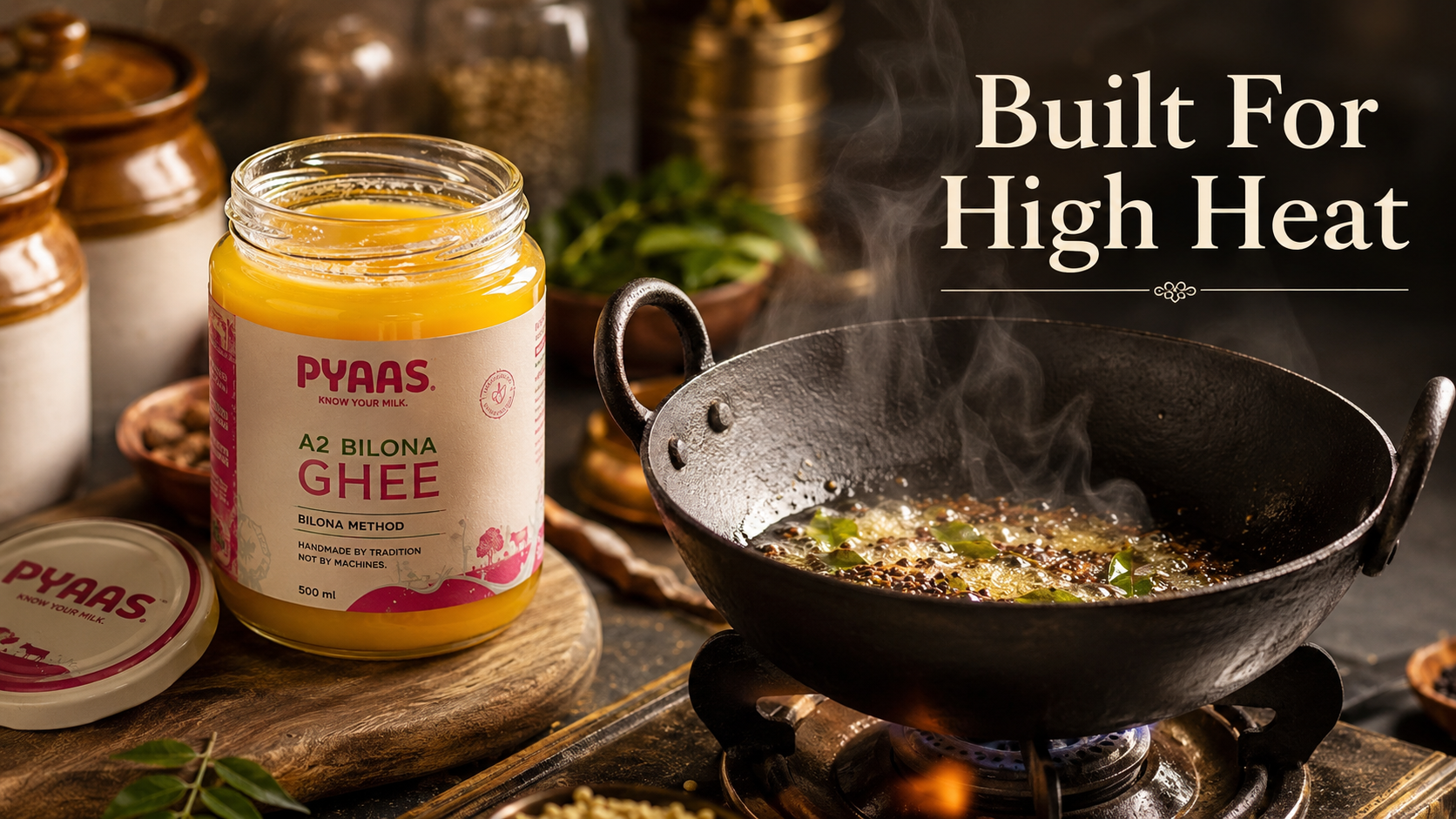
Ghee Smoke Point: Why Ghee Is Best for High-Heat Cooking
Every cooking fat has a breaking point. Heat it far enough and it stops shimmering pleasantly and starts to smoke, throwing off an acrid smell and a faint blue haze. That temperature is called the smoke point, and it is one of the most useful things to understand about the fat in your pan. The ghee smoke point happens to be one of the highest in an ordinary kitchen, and that is exactly why ghee has anchored Indian high-heat cooking for generations.
What a smoke point actually is
The smoke point is the temperature at which a fat begins to break down and burn. Past it, the fat produces smoke, develops a bitter, scorched taste, and starts to degrade. Below it, the fat stays stable, carries flavour, and cooks food cleanly. So a fat with a high smoke point gives you more room to work at the searing, sizzling temperatures a lot of cooking actually needs.
Two things push a smoke point down: water and other impurities such as milk solids or plant particles. Anything in the fat that is not pure fat tends to burn earlier. This single idea explains almost everything about why ghee behaves the way it does.
Why the ghee smoke point is so high
Butter has a fairly low smoke point, somewhere around 150 degrees Celsius, because it contains water and milk solids that scorch quickly. That is why butter browns and burns so fast in a hot pan. Ghee is what you get when you cook those problems out. Simmering butter drives off the water and lets the milk solids separate and settle, and you strain them away. What is left is nearly pure golden butterfat with very little to burn.
The result is a ghee smoke point generally in the range of 230 to 250 degrees Celsius. That is comfortably above the temperature of a normal tadka, a deep-fry, or a hard sear. The traditional bilona method PYAAS uses builds this stability in naturally, and you can see how the whole transformation works in our piece on how ghee is made from fresh milk to golden ghee.
How ghee compares to common cooking fats
Smoke points vary by batch, brand and how refined an oil is, so treat these as general ranges rather than exact numbers:
- Ghee: very high, roughly 230-250 degrees Celsius
- Refined vegetable and seed oils: high, but they are heavily processed to get there
- Mustard oil: fairly high, a traditional Indian frying oil
- Cold-pressed and unrefined oils: often lower, and best kept off high heat
- Butter: low, around 150 degrees Celsius, burns easily
What stands out about ghee is that it reaches a high smoke point without industrial refining. It is simply clarified butter, an old and simple process, yet it performs at the top end of the range.
Why this matters for the way Indians cook
Indian cooking is full of high-heat moments. The tadka, where spices are bloomed in fat hot enough to make them crackle. The bhuna, where masala is browned patiently. The deep-frying of pooris, jalebis and pakoras. In each case, a fat that burns early would turn bitter and drag the whole dish down with it. Ghee's high smoke point means the cumin toasts instead of scorching, the masala deepens instead of catching, and the frying stays clean.
There is a flavour payoff too. Because ghee is not smoking and degrading, it keeps its warm, nutty character throughout cooking rather than turning harsh. That stability is a big part of why food cooked in ghee simply tastes better.
An honest word on heat and health
A high smoke point is a genuine practical advantage, and it is fair to say ghee is one of the more heat-stable fats you can keep at home. That said, no fat should be pushed to smoking and reused endlessly. Even ghee, left smoking in an empty pan or repeatedly overheated, will eventually break down. Good practice is simple: heat it until it shimmers, cook, and do not let it sit and smoke. Used sensibly, ghee's stability is exactly why it has earned its place at the stove.
It is also worth being clear-eyed that ghee is a rich, calorie-dense fat. Its high smoke point makes it a smart choice for high-heat cooking, but that does not mean drowning food in it. A little, used well, is the whole idea.
Ghee you can cook with confidently
PYAAS A2 Bilona ghee is live and ships across India today, made in small batches the traditional way. The A2 comes only from the A2 cows within our partner herds in Gonda, Uttar Pradesh, identified cow by cow, and every jar carries a QR code that shows you the exact farm, farmer and batch record. If you want to understand what you are paying for and why bilona ghee performs the way it does, our guide on bilona ghee versus regular ghee is a good next stop.
Understanding the ghee smoke point is really understanding why a simple, traditional fat has quietly outlasted a parade of trendy oils. It takes the heat, it carries the flavour, and it does not fall apart when the pan gets serious. For the crackle of a tadka or the sizzle of a fry, that is exactly what you want. Cook with it well, and let the jar tell you honestly where it came from.
Written by
PYAAS
PYAAS is an honest, traceable Indian dairy brand from Gonda, Uttar Pradesh.
More from PYAASCommon questions.
What is the smoke point of ghee?
Ghee has a high smoke point, generally in the region of 230 to 250 degrees Celsius, which is higher than butter and most refined and unrefined oils used in home kitchens. This is because the milk solids and water that cause butter to burn have already been removed during clarification. The exact figure varies a little between batches.
Why does ghee have a higher smoke point than butter?
Butter contains water and milk solids that scorch at relatively low temperatures. Making ghee cooks off the water and separates out those milk solids, leaving almost pure butterfat. With those burn-prone bits gone, the ghee smoke point rises well above butter's, which is why ghee is far better for frying and tempering.
Is it safe to fry in ghee?
Yes. Ghee's high smoke point means it stays stable at frying temperatures better than many oils, and it is traditionally used for frying Indian sweets and snacks. It is richer and costlier than neutral oil, so most people fry in it occasionally rather than daily, but it is a sound choice for high-heat cooking.
Get the next one in your inbox.
The occasional note on milk, ghee, and how we work. Plain words, no hype, and you can leave any time.