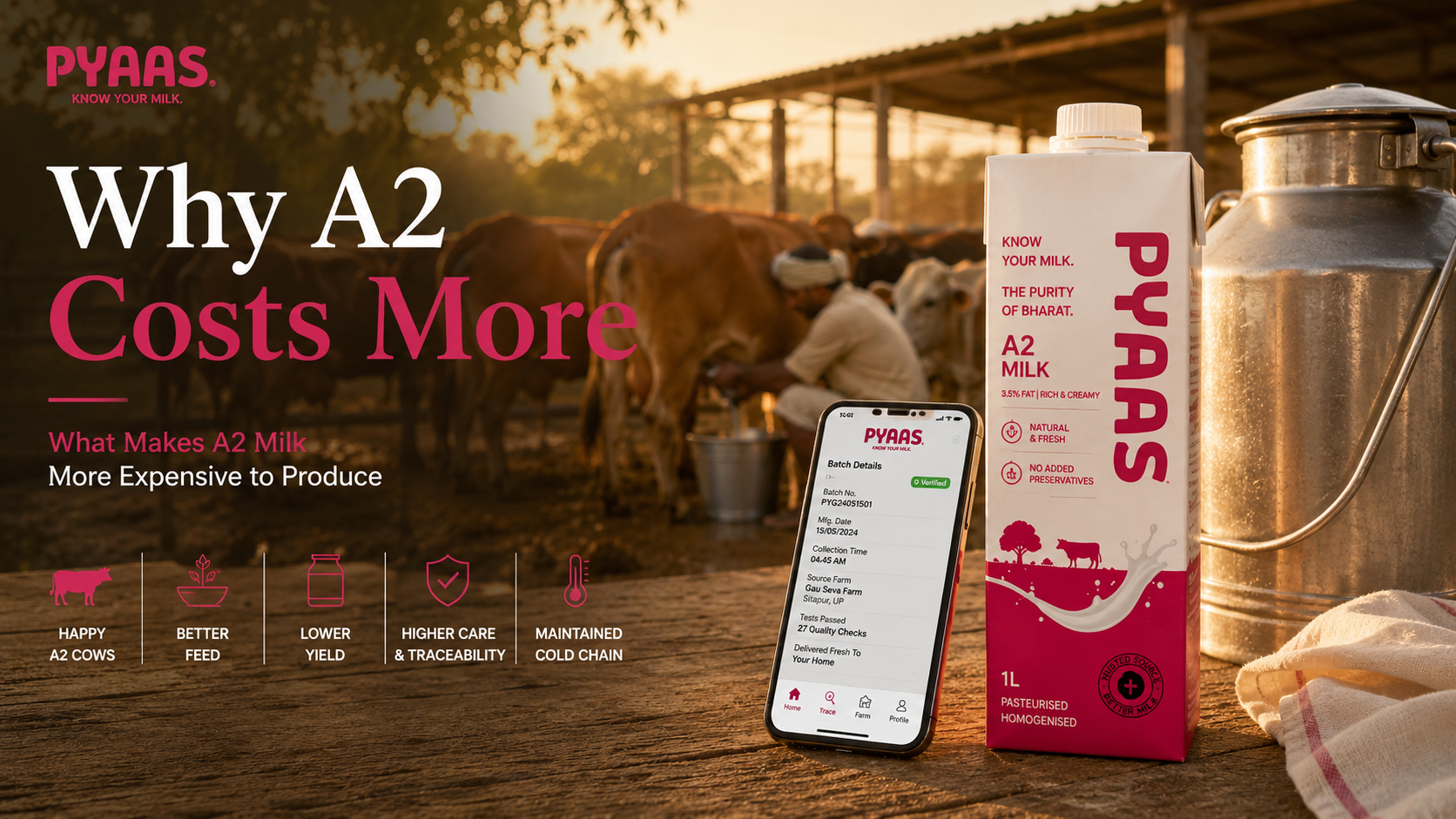
What Makes A2 Milk More Expensive to Produce
Stand in front of two cartons, one ordinary and one marked A2, and the price gap is hard to ignore. It is a completely fair thing to question. So rather than hide behind the word premium, let us open the books, in plain language, on why A2 milk is expensive to produce. No invented rupee figures, no fake lab costs, just the honest mechanics of how this milk reaches you.
It starts with finding the right cows
The first cost is one most people never think about. A2 is a per-animal genetic trait. A cow either carries the genes to produce only A2 beta-casein or she does not, and this has nothing to do with how she looks or which breed she belongs to. That means you cannot simply point at a herd and call it A2. Each cow has to be identified individually as an A2 producer. This is why PYAAS never claims a whole herd, breed or tank is all A2, and why the milk we describe as A2 comes only from the identified A2 cows within a herd.
That identification work is careful, ongoing and unglamorous, and it shrinks your usable pool of animals. Fewer eligible cows means less milk from the same farm, and lower volume almost always costs more per litre.
Keeping A2 milk genuinely separate
Here is the cost that quietly does the heavy lifting. Once you have identified your A2 cows, their milk has to stay separate from everything else, at every single step. Separate milking discipline, separate collection, separate storage, separate handling. The moment A2 milk mixes with the rest, it is no longer honestly A2, so the separation is not optional, it is the entire integrity of the claim.
Maintaining that separation takes labour, attention and space that a single undifferentiated tank never requires. On a large commodity operation, everything can pour into one pipeline. An honest A2 supply chain deliberately refuses that efficiency, and refusing efficiency has a price.
Single origin adds real cost, and real value
Much cheap milk is pooled from countless anonymous sources into one giant tank. It is efficient and it is cheap, and it is also why you can never really know where it came from. PYAAS works the opposite way, with named partner farms in Gonda, Uttar Pradesh, and single-origin sourcing. There is genuine cost in that choice:
- Smaller batches from specific farms instead of endless pooled volume.
- Relationships and fair dealing with named farmers rather than a faceless supply chain.
- Logistics that keep each farm's milk distinct rather than blended into anonymity.
We think that trade is worth it, and we explain why in our piece on single-origin milk and why one farm beats a thousand. But we will not pretend it is free.
Traceability is a feature you are paying for
Every PYAAS pack carries a QR code you scan to see the exact farm, the farmer and that batch's quality-checked record. That capability does not appear by magic. It requires the records, the checks and the systems that let a batch be traced back to a real animal on a real farm. Traceability is one of the most valuable things about honest dairy, and it is also a genuine operating cost. If you want to understand why it matters so much for Indian dairy, our article on why India needs milk traceability makes the case.
Care, handling and smaller scale
Several smaller drivers stack on top:
- Animal care. Attentive husbandry of a smaller, identified group of cows is more hands-on than mass management.
- Quality checks. Checking each batch and standing behind that record costs time and diligence.
- Lower economies of scale. Commodity milk wins on sheer volume. Careful A2 milk simply cannot, and does not want to, play that game.
None of this is exotic. It is just the ordinary arithmetic of doing dairy carefully instead of cheaply. For the broader picture of what goes into A2 pricing, our honest guide to what you are paying for in A2 ghee follows the same logic through to the finished product.
What the premium does not buy
In the spirit of honesty, here is what the higher price does not automatically mean. It does not mean A2 milk is a proven health upgrade or a cure for anything, because it is not. It does not mean every person will feel a difference, because many will not. The premium buys real production care, separation and traceability. It does not buy medical claims, and we will not sell you those.
The honest bottom line
A2 milk is expensive to produce because honesty is expensive. Identifying A2 cows one by one, keeping their milk separate at every step, sourcing from named single-origin farms and making every batch traceable all cost more than pouring anonymous milk into one big tank. At PYAAS, that cost is not a markup for its own sake, it is the price of being able to show you exactly where your milk came from. Our fresh A2 cow milk launches in Lucknow from August 2026, and our A2 Bilona ghee already ships across India today, and in both cases you are paying for care you can actually verify, one scan at a time.
Written by
Naina Sharma
PYAAS is an honest, traceable Indian dairy brand from Gonda, Uttar Pradesh.
More from Naina SharmaCommon questions.
Why is A2 milk more expensive than regular milk?
A2 milk is more expensive to produce mainly because A2 cows must be identified individually, their milk kept separate at every stage, and volumes are smaller. When you also insist on single-origin sourcing, traceability and careful handling, costs rise further. You are paying for that extra care and separation, not just the milk itself.
Is A2 milk worth the higher price?
That depends on what you value. If traceable sourcing, individually identified A2 cows and the comfort some people feel matter to you, the premium buys real work rather than just a label. If your only concern is calories per rupee, ordinary milk is cheaper. Both are valid choices.
Does expensive A2 milk mean it is healthier?
Not necessarily. A higher price reflects production costs like keeping A2 milk separate and sourcing from named farms, not a proven health upgrade. A2 milk is not a cure or a superfood. Judge it on sourcing, freshness and how it feels for you, rather than assuming cost equals health.
Get the next one in your inbox.
The occasional note on milk, ghee, and how we work. Plain words, no hype, and you can leave any time.
Keep reading.
Ghee for Immunity: What Tradition and Sense Say
3 September 2026
How to Store Ghee So It Stays Fresh for Months
3 September 2026
When to Introduce Ghee to Your Baby: A Parent's Guide
3 September 2026
How Much Ghee Per Day Is Actually Healthy?
3 September 2026