
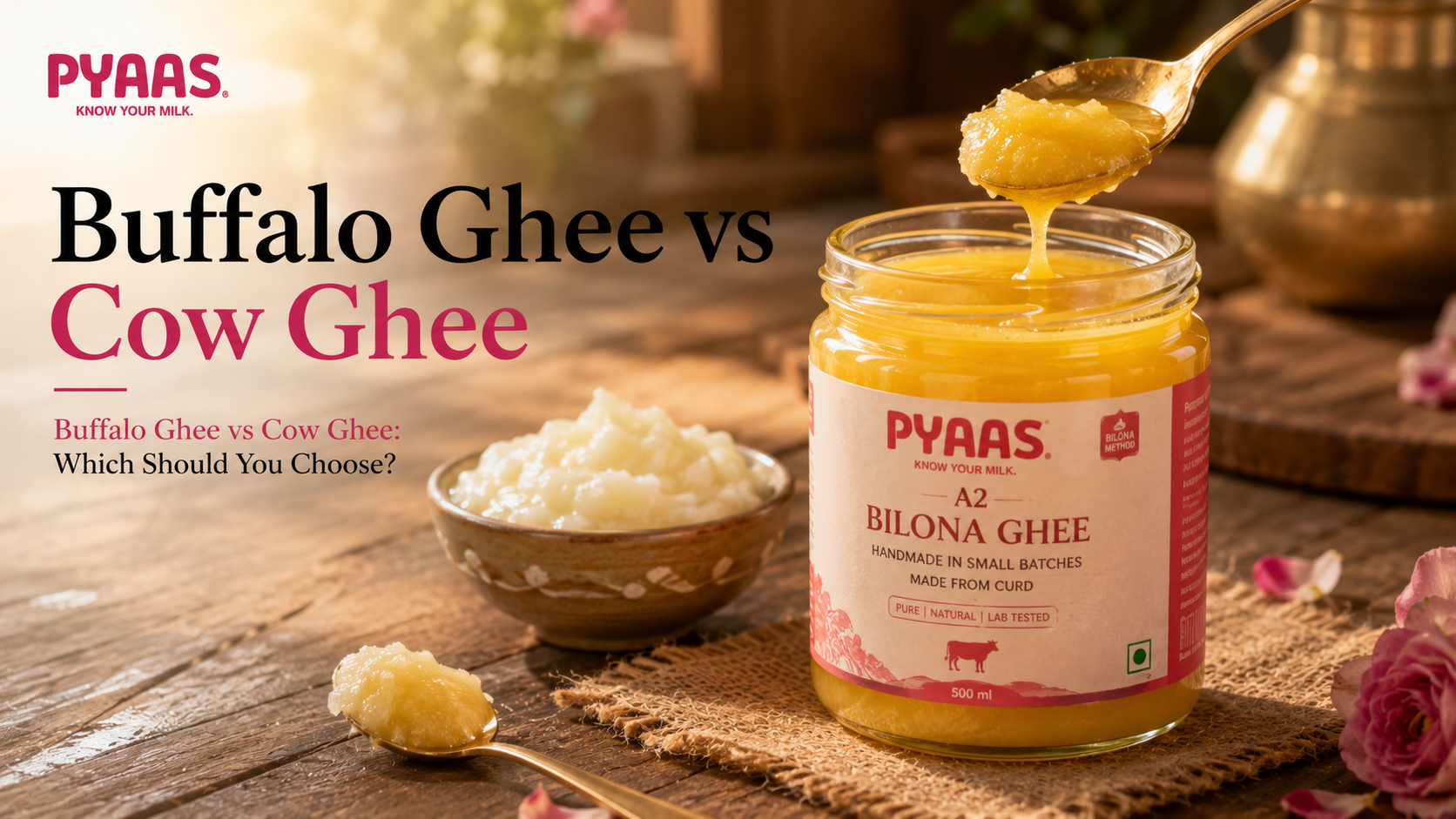
Buffalo Ghee vs Cow Ghee: Which Should You Choose?
Ask two families which ghee they swear by and you may get two different answers with equal conviction. One reaches for golden, fragrant cow ghee; the other for thick, white buffalo ghee. Both are traditional, both are loved, and neither is wrong. The buffalo ghee vs cow ghee question is less about which is superior and more about which suits your kitchen, your dishes and your taste. Let us lay out the real differences without the marketing gloss.
Colour: golden versus white
The first thing you notice is the colour. Cow ghee is a warm golden yellow, while buffalo ghee is noticeably whiter, almost ivory. This is not a quality trick or an added dye; it is nature. Cow's milk carries beta-carotene, a yellow pigment that comes from the green fodder cows eat, and that pigment travels into the ghee. Buffalo milk processes carotene differently, so its fat, and the ghee made from it, stays pale. If someone tells you white ghee is purer or yellow ghee is better, they are overselling. The colour simply reflects the animal.
Texture and body
Buffalo ghee tends to be denser and grainier when set, with a heavier, more substantial feel. Cow ghee is often softer and more delicate in texture. Buffalo milk is naturally higher in fat, which gives its ghee that rich, thick body some people love for sweets and rich gravies. Cow ghee's lighter texture makes it a favourite for drizzling and finishing, where you want aroma more than heaviness.
Taste and aroma
This is where cow ghee earns its devotees. It carries a lighter, nutty, distinctly aromatic flavour that lifts a bowl of dal, a hot roti or a spoon over khichdi. Buffalo ghee is richer and heavier on the palate, with a fuller mouthfeel that stands up well in decadent mithai. Neither is objectively tastier; it depends on whether you want fragrance and lightness or richness and body.
How they compare at a glance
- Colour: Cow ghee golden; buffalo ghee white to ivory.
- Texture: Cow ghee softer and finer; buffalo ghee denser and grainier.
- Taste: Cow ghee light, nutty, aromatic; buffalo ghee rich, heavy, full.
- Best for: Cow ghee for finishing, drizzling, everyday aroma; buffalo ghee for rich sweets and heavier dishes.
- Smoke point: Both are high and suit Indian frying and tempering.
What about A2 and how it is made?
Beyond the animal, how the ghee is made matters just as much. The traditional Bilona method, where curd is churned to butter and then slowly simmered into ghee, is prized for its aroma and character, and it is different from ghee made quickly by boiling cream directly. If you want to understand that distinction, our guide to Bilona ghee vs regular ghee explains it clearly.
There is also the A2 question. A2 refers to a type of protein in the milk, and it is a per-animal genetic trait, meaning A2 milk comes only from the specific A2 cows within a herd, identified cow by cow, not from a whole breed or tank. For the fuller story, see our overview of A2 ghee benefits.
A gentle note on health
Both cow and buffalo ghee are clarified butter, meaning most of the milk solids and water have been simmered off. Because of this, ghee is very low in lactose and casein, and many, though not all, lactose-intolerant people find they tolerate it well. Ghee is still a fat, though, and should be enjoyed in sensible amounts as part of a balanced diet. It is a wholesome traditional food, not a medicine, and nobody should treat it as a cure for anything. If you have specific health concerns, your doctor is the right person to guide you.
Where PYAAS stands
PYAAS makes A2 Bilona cow ghee, and it ships across India today in small batches. We chose cow ghee, and specifically the slow Bilona method, because we love its golden colour, its light nutty aroma, and the traditional character that comes from making it patiently rather than fast. That does not make buffalo ghee lesser; it is a wonderful product in its own right, especially for richer cooking. It simply is not what we make.
What we care about most is honesty about the source. Our ghee comes from milk drawn at named partner farms in Gonda, Uttar Pradesh, and A2 comes only from the A2 cows within those herds, identified individually. Every jar ties back to a real farm and a real farmer you can trace, part of our Know Your Milk promise. If you want the full picture of how we make it, read our complete guide to PYAAS A2 Bilona ghee.
The honest bottom line
In the buffalo ghee vs cow ghee debate, there is no single winner, only the right fit for you. Choose buffalo ghee when you want richness, density and a heavier body, especially in sweets. Choose cow ghee, as we do, when you love golden colour, lighter texture and that unmistakable aromatic finish. Whichever you pick, let the source be the deciding factor: a ghee you can trace back to a real farm will always beat one you simply have to take on faith.
Written by
Naina Sharma
PYAAS is an honest, traceable Indian dairy brand from Gonda, Uttar Pradesh.
More from Naina SharmaCommon questions.
What is the main difference between buffalo ghee and cow ghee?
The clearest differences are colour and taste. Cow ghee is golden and carries a lighter, aromatic, nutty flavour, while buffalo ghee is whiter and denser with a richer, heavier mouthfeel. In the buffalo ghee vs cow ghee comparison, cow ghee is prized for aroma and buffalo ghee for richness.
Why is cow ghee yellow and buffalo ghee white?
Cow's milk naturally contains beta-carotene, a yellow pigment from the grass and fodder the cows eat, which carries through into golden cow ghee. Buffalo milk converts that carotene differently, so its fat and the ghee made from it stay much whiter and denser.
Which ghee is better for everyday cooking?
Both work well and both have high smoke points suited to Indian cooking. Many families keep cow ghee for its aroma over dal, rotis and finishing dishes, and buffalo ghee where a richer, heavier body is wanted, such as certain sweets. The better choice is the one your family enjoys and trusts the source of.
Get the next one in your inbox.
The occasional note on milk, ghee, and how we work. Plain words, no hype, and you can leave any time.