How Technology Reaches the Village Dairy Farm
The first time I watched a farmer use a tool I had helped design, the sun was barely up. It was cold, the ground was wet, his hands were wet, and a cow was shifting her weight beside him. He was not thinking about my software. He was thinking about the animal, the milk, and the twenty things he had to do before the day got hot. That morning taught me more about building technology for dairy farms in India than any office ever could.
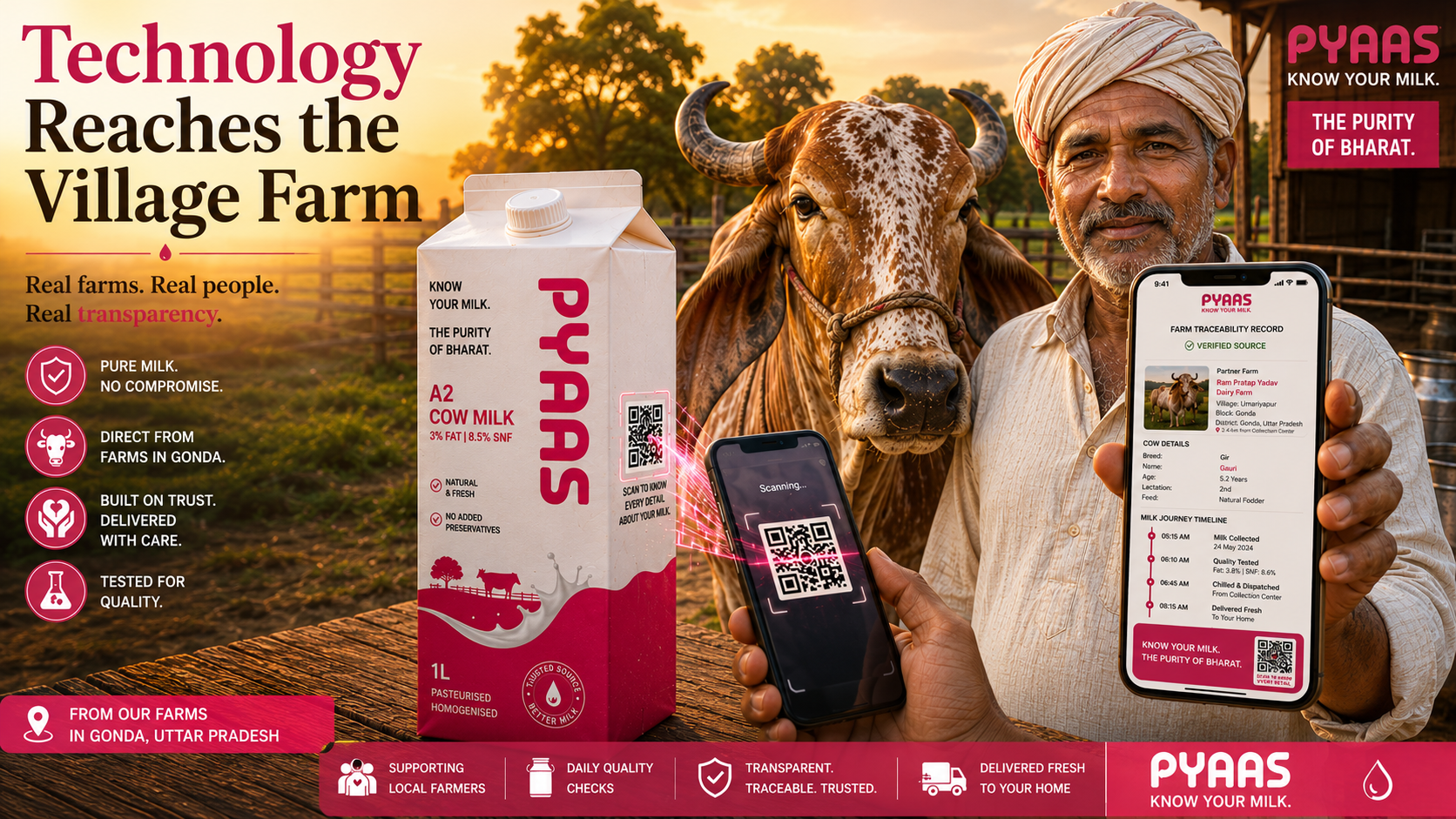
My name is Kushagra Shekhar Kaushik, and I am the Founder & CTO of PYAAS. My job is to make our traceability real: the system that lets you scan a QR code on a pack and see the farm, the farmer and that batch's quality record. But a QR code is the easy, visible end of the work. The hard end is at the farm gate, where the honest information has to be captured in the first place.
Why most farm technology dies at the office door
A lot of technology built for Indian agriculture is beautiful in a demo and useless in a field. It assumes a strong network connection. It assumes a clean, dry pair of hands and a spare few minutes. It assumes the user is looking for reasons to engage with a screen. None of that is true at 5 a.m. during a milking in a Gonda village.
When I design for PYAAS, I start from a blunt rule: if a tool needs a manual, a good signal, or ideal conditions, it has already failed. The farmer is not our user in the way an app-store customer is a user. He is a partner with a hard, physical job, and our technology has to earn its place by making that job no harder, ideally a little easier.
Design for the person, not the device
The most useful thing I have done as a CTO is spend time at the farms instead of at my desk. At Sri Radha Mohan Dairy Farm, where Ram tends a herd of 76 cows, you learn quickly which assumptions to throw away. You watch the actual sequence of a morning and you ask a simple question of every screen and every step: does this fit the rhythm of the work, or does it fight it?
That question changes the design completely. It pushes you toward fewer taps, bigger targets, and steps that can be done with one hand and half your attention. It pushes you toward capturing information at the moment it naturally exists, not asking someone to remember and re-enter it later. And it pushes you to build for the farmer you actually have, Harsh Singh at Gonard Dairy or Ranjeet Singh at his own farm, not the imaginary tech-savvy user in a pitch deck.
The QR code is the simplest thing we do
People often think the clever part of PYAAS is the QR code. It is not. Scanning a code is trivial. The real engineering is everything upstream of it: making sure the record behind that code is true.
- Capture at the source. The link between a batch of milk and its farm has to be created where the milk is, with as little friction as possible for the person creating it.
- Survive bad conditions. The capture step cannot fall apart when the network drops or the light is poor. It has to hold the information and reconcile later.
- Stay honest by design. The easiest path for the farmer should also be the accurate one, so that being truthful is never the extra effort.
If we get those three things right, the customer-facing QR code almost takes care of itself. Scan a PYAAS pack and you can see where it came from, who tends the herd, and how that batch was quality checked. That confidence rests entirely on work that happens far from any customer's phone.
What technology should never pretend to do
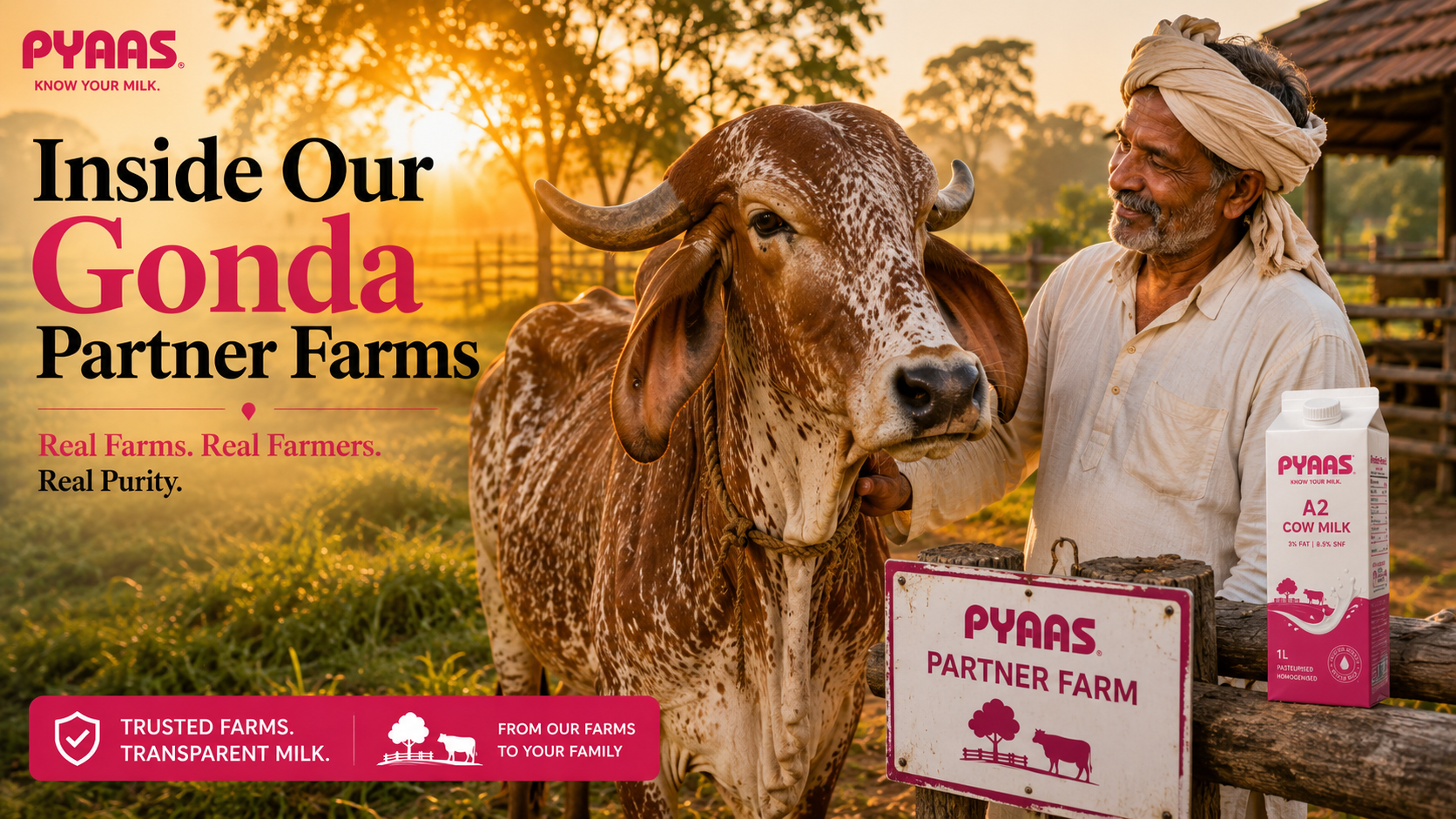
There is a temptation in my field to make software the hero of every story. On a dairy farm, that is exactly the wrong instinct. The hero is the animal and the person caring for it. Our partner farms in Gonda keep Holstein Friesian and Sahiwal cows, and the A2 milk comes from the A2 cows in the herd. No dashboard I build changes the quality of that milk. At best, technology makes what is already true visible and verifiable.
So I try to keep our tools humble. They should record reality, not decorate it. When PYAAS says Know Your Milk, the promise only means something because the technology is honest about what it does and does not do. Today that promise already backs our A2 Bilona cow ghee, which is shipping across India, and it is the same system we are readying for fresh A2 milk as we prepare to launch in Lucknow from August 2026 and expand across Uttar Pradesh.
Where this goes next
The farm gate is going to stay the hardest and most important place for our technology to work. As PYAAS grows across Uttar Pradesh, the number of farms, farmers and batches grows with it, and the system has to hold every one of those links without losing a single true detail. That is the problem I find genuinely exciting: not building something flashy, but building something quiet and reliable that a farmer barely notices and a customer can completely trust.
If we do our job well, you will never think about the technology at all. You will scan a code, see a real farm and a real person, and simply believe it. Getting a piece of software to disappear that gracefully into a 5 a.m. milking in a Gonda village is, to me, the whole point. You can meet the farms and farmers behind PYAAS for yourself, which is exactly how it should be.
Written by
Kushagra Shekhar Kaushik
Kushagra Shekhar Kaushik is the Founder & CTO of PYAAS, an independent, transparency-first dairy brand based in Gonda and Lucknow, Uttar Pradesh, building the technology that makes every pack traceable to its farm by QR.
More from Kushagra Shekhar KaushikCommon questions.
Why is technology on dairy farms in India so hard to get right?
Because most of it is designed for the office, not the farm. A dairy farm in a village like Gonda has patchy network, wet hands, early hours and a farmer who is rightly focused on the animals, not a screen. At PYAAS we treat the farm gate as the real design test: if a tool needs a manual, good signal or perfect conditions, it has already failed. Technology on dairy farms works only when it fits into the rhythm of the milking, not the other way round.
How does the PYAAS QR code actually work at the farm?
The QR code on a PYAAS pack links to that batch's record: the specific farm it came from, the farmer who tends the herd, and that batch's quality-checked details. The hard part is not the code you scan as a customer, it is capturing accurate information at the source with as little friction as possible for the farmer. We design the capture step to be simple and forgiving so the record stays honest.
Does PYAAS milk come from A2 cows?
Our partner farms in Gonda, Uttar Pradesh, keep Holstein Friesian and Sahiwal cows, and the A2 milk comes from the A2 cows in the herd. PYAAS A2 Bilona cow ghee is available and shipping across India today, while fresh A2 cow milk is launching in Lucknow from August 2026 and expanding across Uttar Pradesh.
Get the next one in your inbox.
The occasional note on milk, ghee, and how we work. Plain words, no hype, and you can leave any time.
Keep reading.
Red Sindhi & Rathi: Lesser-Known Indian Dairy Breeds
24 August 2026
What I Learned at Sri Radha Mohan Dairy Farm — Aryan Sharma
28 July 2026
The Farmer Economics Problem Indian Dairy Ignores
26 July 2026
Why PYAAS Partners With Farms Instead of Owning Them
26 July 2026