PYAAS A2 Ghee: What Makes It Different
I am Aryan, one of the two founders of PYAAS, and I want to be honest with you from the first line: the world does not need another ghee brand shouting the same claims as everyone else. "Pure." "100% natural." "Farm fresh." Those words have been worn so smooth they mean almost nothing now. So when people ask what makes pyaas a2 ghee different, I do not reach for adjectives. I reach for what we can actually prove.
Why we started with ghee
PYAAS began with a frustration my fellow founder Kushagra and I shared: as buyers, we could never really know where our dairy came from. Labels told us everything except the one thing that mattered, which was the actual source. We are two school friends from Amity who decided that instead of complaining, we would build the transparent dairy brand we wished existed. If you want the fuller story, we wrote it up in why we started PYAAS.
Ghee was the natural place to begin. It is shelf-stable, ships across India, and it is where the bilona tradition lives most vividly. It let us bring honest, traceable dairy to the whole country before our fresh milk was even ready.
The four things that actually make it different
When I say PYAAS A2 ghee is different, I mean these specific, checkable things, not vibes.
1. It is genuinely A2, cow by cow
A2 is about the protein in the milk, and it is a per-animal genetic trait. That means A2 milk comes only from the A2 cows within a herd, identified individually. I will not tell you an entire herd, breed, or tank is "all A2," because that is not how biology works and it would be a lie. Our herds are Holstein Friesian and Sahiwal, and we draw A2 milk specifically from the A2 cows within them. If you want the honest science, our overview of what A2 milk is lays out both the benefits and the myths.
2. It is made the bilona way, in small batches
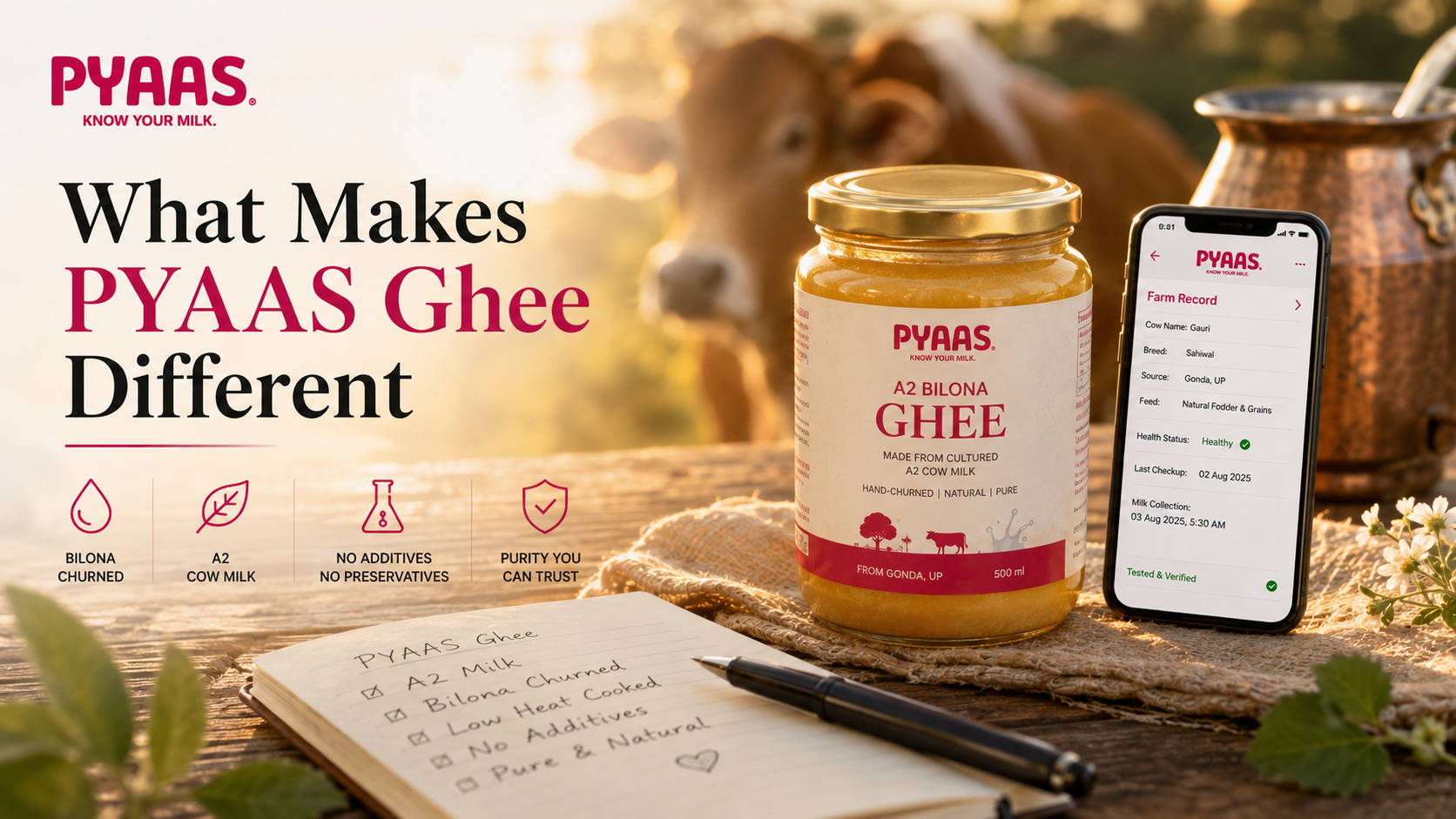
We do not shortcut the process. Milk is cultured into curd, the curd is churned into cultured butter, and only that butter is simmered into ghee. It is slower and gives us less ghee per litre, but it is the traditional method, and we think it is worth it. We make in small batches on purpose, so nothing sits around losing its character.
3. It comes from named farms, not a faceless supply chain
Our ghee traces to real, named partner farms in Gonda, Uttar Pradesh: Sri Radha Mohan Dairy Farm, where farmer Ram cares for a herd of around 76 cows; Gonard Dairy, run by Harsh Singh; and Ranjeet Singh Dairy Farm. We partner with these farms rather than owning cattle. You can meet some of them, like Ram at Sri Radha Mohan Dairy Farm, and see the people behind your jar.
4. Every jar proves itself with a QR code
This is the piece I am proudest of. Every pack carries a QR code. Scan it and you see the exact farm, the farmer, and that batch's quality-checked record. You do not have to trust my word. You can check it yourself. That is the whole idea behind Know Your Milk.
What I will not tell you
An honest review has to include what we deliberately do not claim:
- We do not invent certifications, awards, ratings, or customer counts.
- We do not print lab numbers we cannot stand behind.
- We do not claim our ghee cures, treats, or prevents any disease, because food is not medicine.
What I will say honestly is this: because clarified butter has most milk solids removed, A2 ghee is very low in lactose and casein, and many people who are sensitive to regular dairy find they tolerate it comfortably. Not everyone, and never as a cure, but many. That is the kind of measured claim I am willing to put my name to.
How it feels to actually use
Beyond the principles, ghee has to earn its place in your kitchen. A2 Bilona ghee carries a warm, nutty aroma that really comes alive when you use it raw over hot food, in a tadka, or folded into festival sweets. A little goes a long way. Store it cool and dry with a clean spoon, and it keeps beautifully.
- Drizzle it over dal, khichdi, or hot rice.
- Use it for tempering, where the aroma shines.
- Cook festival halwa and laddoo with it.
The honest bottom line
So, is pyaas a2 ghee different? I believe it genuinely is, but not because of anything I could paint onto a label. It is different because it is A2 cow by cow, bilona-made in small batches, sourced from named Gonda farms, and provable with a scan. In a category full of interchangeable promises, we decided the boldest thing we could do was simply tell the truth and let you check it. That is the brand Kushagra and I set out to build, and it is the one you hold in your hands every time you open a jar.
Written by
Naina Sharma
Aryan Sharma is the Founder & CEO of PYAAS, an honest, traceable Indian dairy brand.
More from Naina SharmaCommon questions.
What makes PYAAS A2 ghee different from other brands?
PYAAS A2 ghee is made in small batches using the traditional bilona method, from named partner farms in Gonda, and every jar carries a QR code you can scan to see the exact farm, farmer, and batch record. The difference is provable traceability, not marketing claims.
Does PYAAS own its own cows?
No. PYAAS partners with named farms in Gonda, Uttar Pradesh, rather than owning cattle. The A2 milk used for pyaas a2 ghee comes only from the A2 cows within those partner herds, identified cow by cow, because A2 is a per-animal genetic trait.
Does PYAAS claim any certifications or awards for its ghee?
No. We deliberately avoid invented certifications, awards, ratings, or lab numbers. Our claim is simpler and checkable: A2, bilona-made, small-batch ghee from named farms, traceable through a QR code on every pack.
Get the next one in your inbox.
The occasional note on milk, ghee, and how we work. Plain words, no hype, and you can leave any time.
Keep reading.
What to Expect From PYAAS Milk Subscription in Lucknow
23 August 2026
Where to Buy PYAAS A2 Milk and Ghee
24 August 2026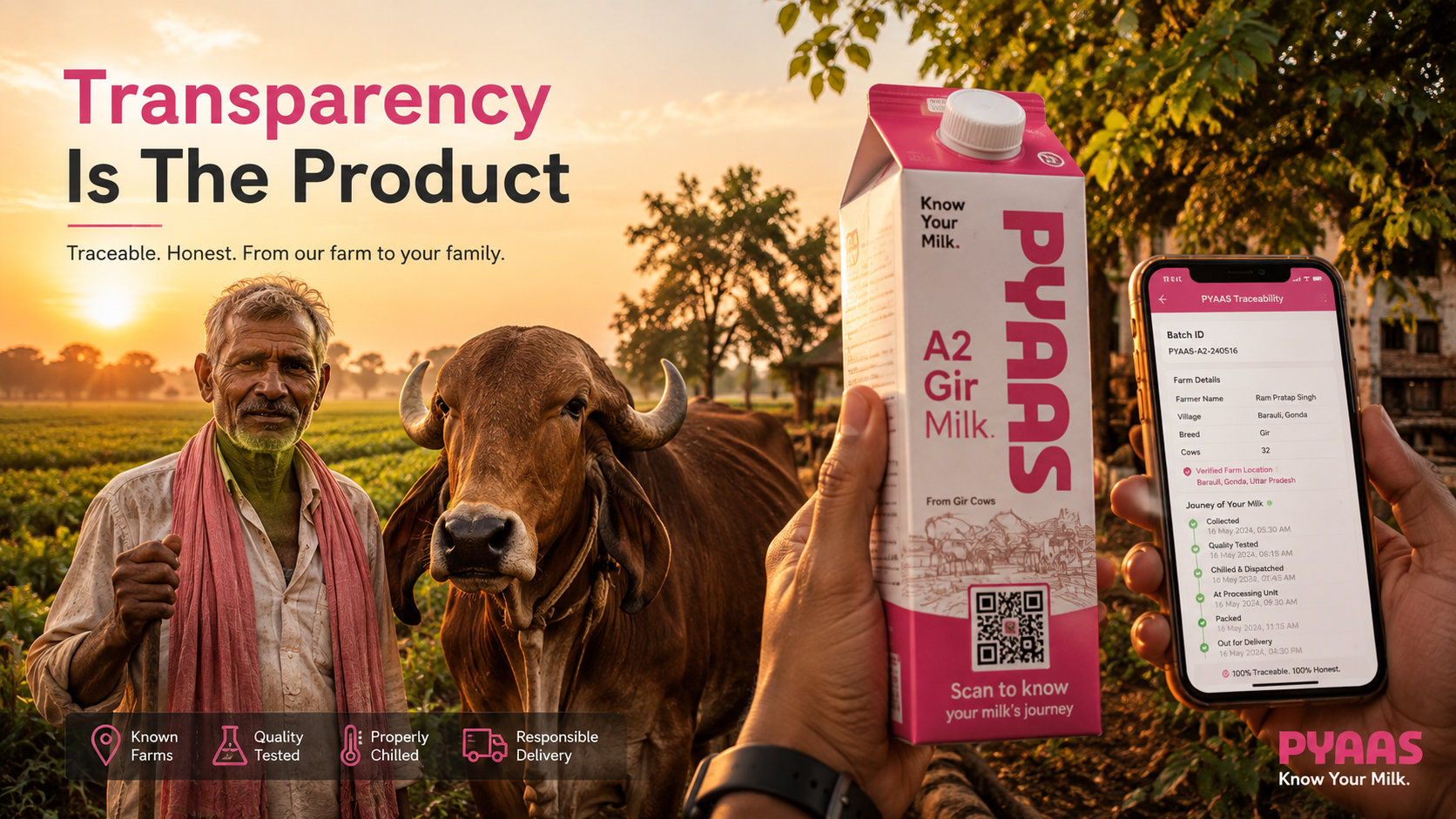
Transparency is not a feature. It is the product.
2 August 2026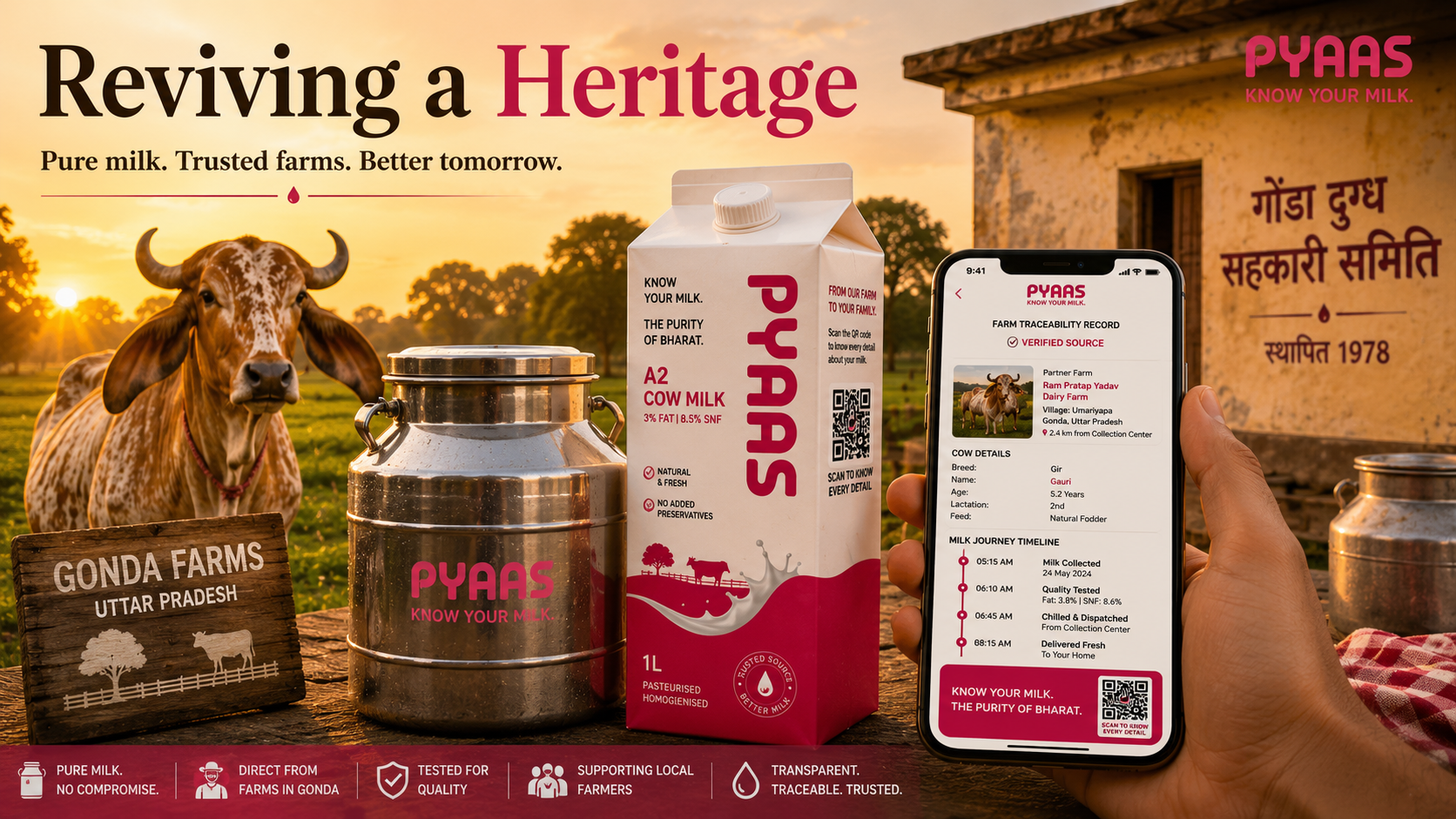
PYAAS and Parag: Bringing Know-Your-Milk Technology to a Heritage Dairy Brand — Aryan Sharma
31 July 2026