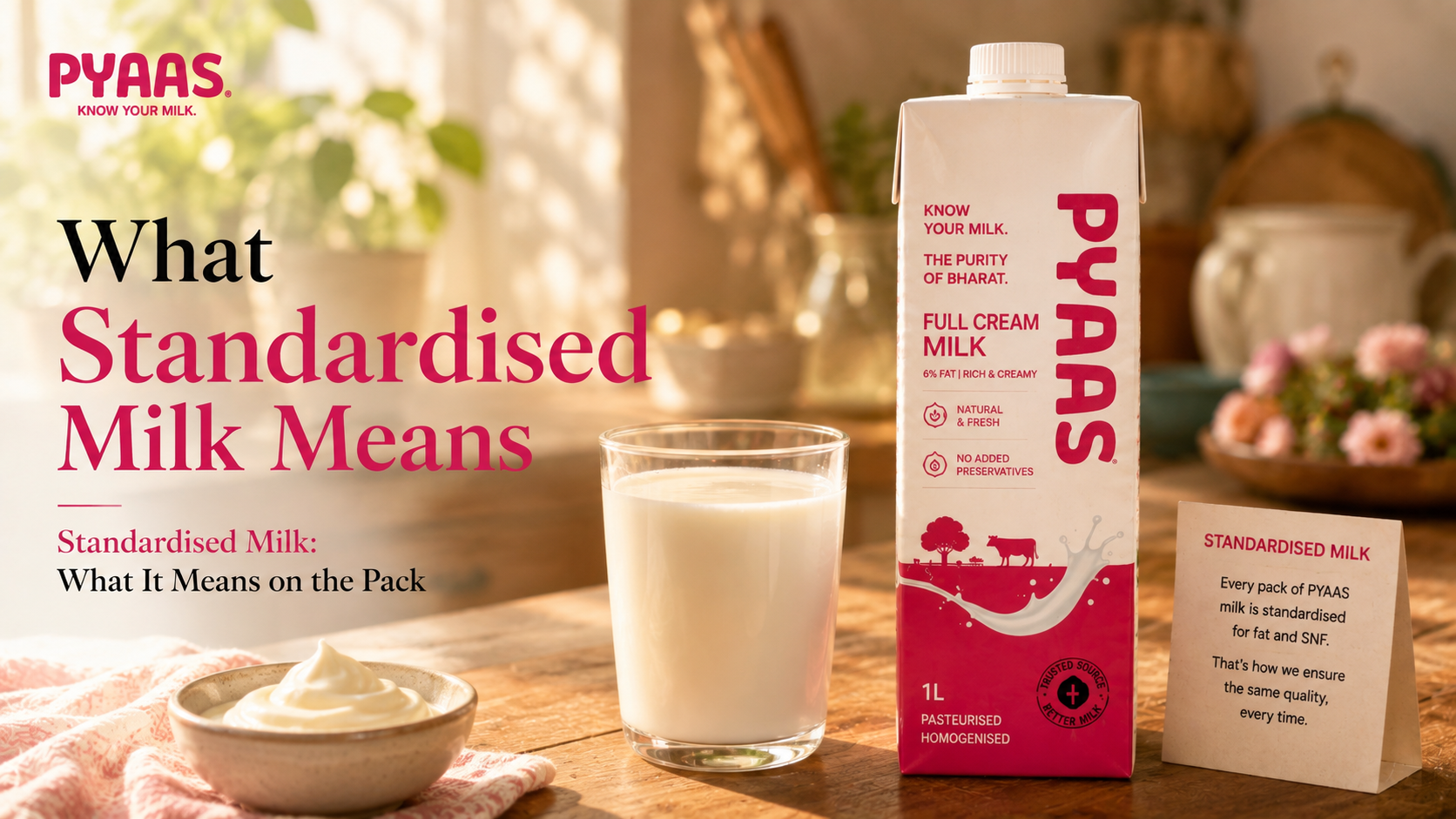
Standardised Milk: What It Means on the Pack
Pick up almost any tetra pack or pouch in India and you will spot one of a few words near the top: full cream, toned, double toned, or standardised milk. Most of us pour it into our tea without a second thought. But that single word is doing real work. It tells you exactly how much fat and how many solids are inside your glass, set to a legal standard rather than left to chance. Once you understand what standardised milk means on the pack, you will never read a carton the same way again.
What standardised milk actually means
Raw milk, straight from a cow, does not come with a fixed fat percentage. One animal's milk might be richer than another's, and the same cow's milk changes a little across the day and the season. Standardisation is the dairy's way of levelling that out. The milk is adjusted so its fat and solids-not-fat land on a declared, consistent number, so the pack you buy today tastes the same as the one you buy next month.
In simple terms, standardising means either removing a little cream to bring the fat down, or adding some back, until the milk hits its target. It is a physical adjustment, not a chemical one. Nothing foreign is mixed in.
Fat and SNF: the two numbers behind the label
Every conversation about milk grades comes down to two figures.
- Fat is the milk fat, the part that gives richness, mouthfeel and the cream layer.
- SNF (solids-not-fat) is everything solid that is not fat: the milk protein, lactose (milk sugar), and minerals like calcium. It is a quiet but important measure of how much real milk substance is in your glass.
Under FSSAI rules in India, standardised milk must carry a minimum of about 4.5% fat and 8.5% SNF. Full cream milk sits higher, near 6% fat and 9% SNF, which is why it feels creamier. Toned milk sits lower at roughly 3% fat, and double toned lower still. So the ladder, from richest to lightest, runs full cream, then standardised, then toned, then double toned.
Why dairies standardise in the first place
Consistency is the honest answer. A big brand collecting milk from thousands of animals cannot promise the same taste unless it sets the fat and SNF to a fixed point. Standardisation makes that possible at scale, and it lets the dairy offer clearly different products for different budgets and tastes.
There is nothing sneaky about it when it is done and declared properly. The problem only begins when milk is watered down or has cheap solids added and is still sold as though it were rich, whole milk. That is adulteration, not standardisation, and it is exactly the kind of thing traceability is meant to catch. If you want to understand why knowing your milk's origin matters as much as its grade, our piece on why India needs milk traceability goes deeper.
How to read a standardised milk pack like a pro
A well-labelled pack gives you more than a name. Look for these things.
- The type: standardised, toned, full cream, and so on.
- The declared minimum fat and SNF percentages, usually printed near the nutrition panel.
- Whether it is homogenised (the cream is broken up so it will not separate) or not.
- The pasteurisation statement, confirming it has been heat-treated for safety.
- A clear manufacturing and best-before date, and ideally a way to trace where the milk came from.
Standardised milk is homogenised in most packs, which is why you will not see a cream line rise to the top. That is a processing choice, not a quality signal, and it is different from the naturally cream-topped milk some smaller dairies sell.
Which grade should your family choose?
There is no single right answer, and anyone who tells you there is one perfect milk for everyone is overselling. Standardised milk is a genuinely sensible middle ground: richer and more satisfying than toned milk, but lighter than full cream. Families who want a balanced everyday glass, decent for tea, coffee and cooking without being heavy, often land here.
If you are watching fat intake, toned or double toned may suit you better. If you love thick, creamy milk and set curd, full cream is your friend. What matters is that the number on the pack is honest, and that the milk behind it is clean, safe and traceable. Grade tells you the composition; it cannot tell you the integrity of the source. For that, you need to know the farm.
Where PYAAS fits in
At PYAAS, our philosophy is that a label should never be the only thing you trust. Our fresh A2 cow milk, which launches in Lucknow from August 2026 and will expand across Uttar Pradesh, is built around a simple idea we call Know Your Milk: every pack carries a QR code you scan to see the exact partner farm in Gonda, the farmer who milked the herd, and that batch's quality-checked record. A2 milk, for the record, comes only from the A2 cows within a herd, identified animal by animal, not from a whole tank labelled A2.
Our A2 Bilona cow ghee, which already ships across India today in small batches, follows the same rule of radical honesty. If you would like the fuller picture of what that promise means beyond the label, read what Know Your Milk really means.
The honest bottom line
Standardised milk is not a lesser or a premium milk; it is simply milk set to a fixed, declared fat and SNF level so you get the same glass every time. Reading that word, and the fat and SNF numbers beside it, turns you from a passive buyer into an informed one. And once you are reading the label closely, the next natural question is the one PYAAS is built to answer: not just how much fat is in your milk, but exactly where it came from. That is the difference between knowing your grade and truly knowing your milk.
Written by
PYAAS
PYAAS is an honest, traceable Indian dairy brand from Gonda, Uttar Pradesh.
More from PYAASCommon questions.
What does standardised milk mean on a milk pack?
Standardised milk means the dairy has adjusted the milk so its fat and solids-not-fat (SNF) sit at a fixed, declared level. Under FSSAI norms, standardised milk carries a minimum of 4.5% fat and 8.5% SNF. It gives you a consistent glass every single time, batch after batch.
Is standardised milk the same as full cream milk?
No. Full cream milk usually has a higher minimum fat (around 6% fat and 9% SNF), so it tastes richer. Standardised milk sits a little lower at 4.5% fat, making it a balanced everyday option that is lighter than full cream but richer than toned milk.
Is standardised milk healthy or is something removed?
Standardisation is simply adjusting the fat level up or down to a set point; nothing harmful is added. It remains real milk with its protein, calcium and vitamins. Whether it suits you depends on how much fat you want in your daily diet, so choose based on your family's needs.
Get the next one in your inbox.
The occasional note on milk, ghee, and how we work. Plain words, no hype, and you can leave any time.