Sustainable Dairy Starts at the Farm
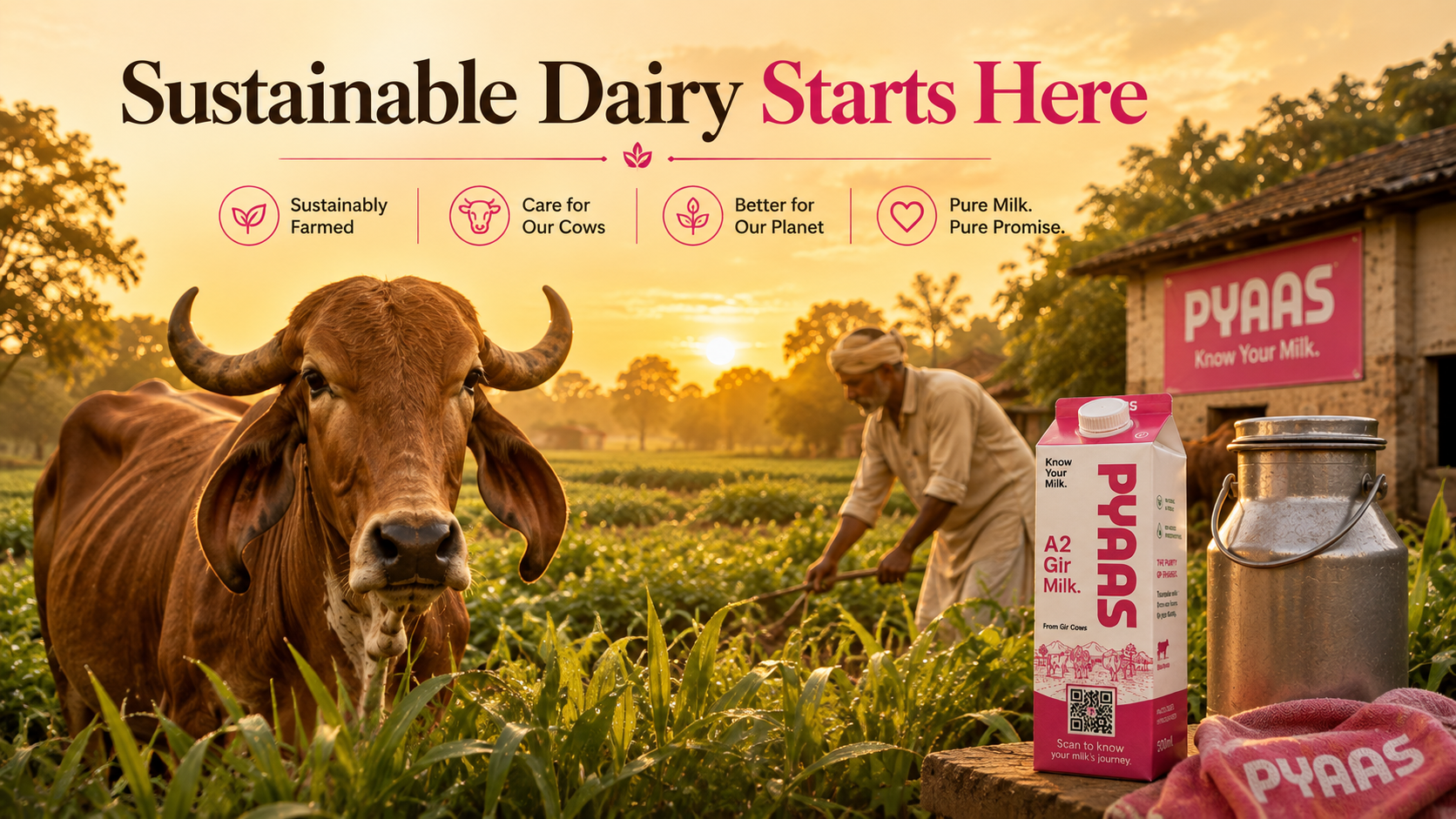
People ask me what sustainable dairy farming in India actually looks like, and they usually expect an answer about packaging or a carbon label. My honest answer is smaller and far less glamorous. It looks like a well-fed cow, a farmer who was paid fairly and on time, and soil that will still grow good fodder in twenty years. At PYAAS, I have come to believe that sustainability is not something you add to milk at the end. It is decided on the farm, long before a single carton is filled.
Sustainability is decided on the farm, not in the brochure
It is easy to make dairy sound sustainable. You can put a green leaf on the label, mention a recyclable carton, and call it a day. I understand the temptation, but I think it gets the order of things wrong. The largest footprint of a glass of milk is created on the farm — in how the cow is fed and kept, how the land is treated, and whether the family running that farm can afford to keep doing it well. If those things are wrong, no amount of clever packaging fixes them.
So when we talk about sustainable dairy farming in India at PYAAS, we start where the milk starts. Our milk comes from named farms in Gonda, Uttar Pradesh, and I would rather know three farms deeply than pool milk anonymously from three thousand. You cannot make a supply chain sustainable if you cannot even see it.
The farmer is the first sustainability metric
Before I count anything else, I look at the farmer. A dairy that squeezes its farmers is not sustainable — it is just borrowing against the future. When a farmer is underpaid or paid unpredictably, the first things to go are the things that matter most: good feed, veterinary care, rest for the animals, and the time to do the job properly. Cutting those corners looks efficient for a season and quietly ruins the farm over years.
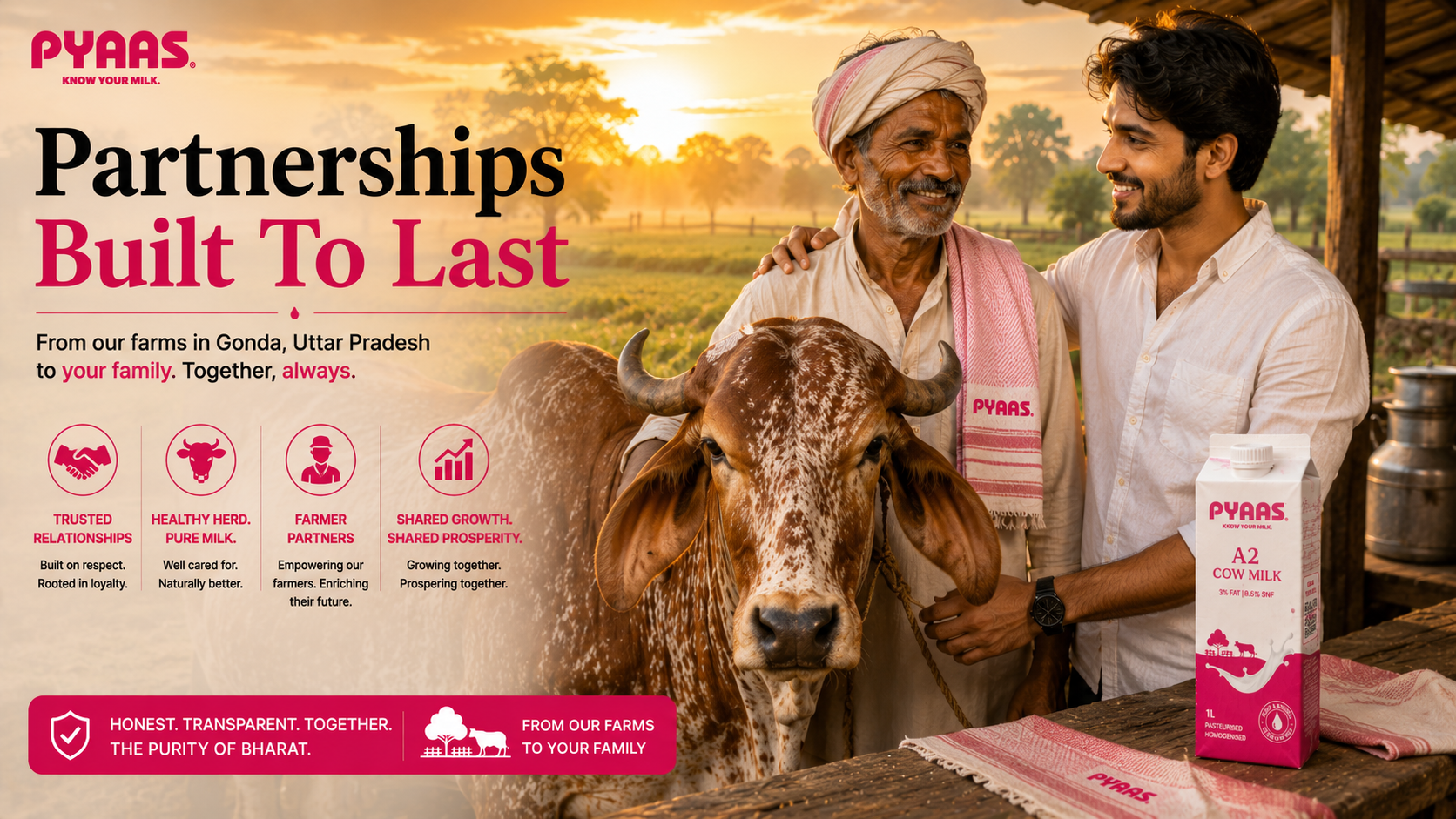
Farmers like Ram at Sri Radha Mohan Dairy Farm, Harsh Singh at Gonard Dairy, and Ranjeet Singh at Ranjeet Singh Dairy Farm are not anonymous suppliers to us; they are the reason the milk is what it is. Paying them fairly, on a rhythm they can plan their lives around, is the most basic form of sustainability I know. A farm healthy enough to hand to the next generation has already done more for the future than most marketing ever will.
What we actually watch on the farm
Sustainability on the ground is not one grand gesture. It is a hundred small, unglamorous habits done consistently. These are the ones I care about most:
- The comfort and health of the herd. A calm, well-fed, unstressed cow — whether Holstein Friesian or Sahiwal — stays healthy longer and needs less intervention. Animal welfare and sustainability are the same conversation.
- Feed and fodder grown close to home. Fodder grown near the farm rather than trucked across the country keeps both the cost and the footprint down.
- Water and waste that cycle back. On a well-run farm, dung and slurry return to the fields as manure instead of becoming something to dispose of. Little is wasted that can feed the next season's crop.
- Soil that has to last. The land that grows the fodder must still be productive decades from now, so it cannot be mined for one good year.
- A herd small enough to know. At Sri Radha Mohan Dairy Farm, with 76 cows, the farmer knows each animal. Scale has its place, but something real is lost when a cow becomes a number.
Traceability is what keeps it honest
Here is the uncomfortable part: anyone can claim all of this. The reason I trust our own version is that we built PYAAS to be checkable. Every pack is traceable by a QR code to the farm it came from, the farmer who runs it, and that batch's quality record. When we say the milk is single-origin and quality checked, you do not have to take my word for it — you can scan and see for yourself on our Know Your Milk page, and meet the farms behind every batch.
I think that is what most sustainability claims are missing. They ask for trust without offering evidence. We would rather show the source than describe it.
The long game we are playing
Our A2 Bilona cow ghee is made this way and ships across India today, and our fresh A2 cow milk launches in Lucknow from August 2026, before we expand across Uttar Pradesh. I am in no hurry to grow faster than we can grow honestly. We are building toward a ₹100 crore dairy brand, but that ambition would mean nothing to me if we reached it by treating farms as disposable.
Sustainable dairy farming in India will not be won on a label. It will be won farm by farm, farmer by farmer, season by season — and if we do this right at PYAAS, the proof will always be one QR scan away. That is the future I am building toward, and I would rather earn it slowly than fake it quickly. — Aryan Sharma
Written by
Aryan Sharma
Aryan Sharma is the Founder & CEO of PYAAS, an independent, transparency-first dairy brand based in Gonda and Lucknow, Uttar Pradesh. Every PYAAS pack is traceable to its farm by QR — Know Your Milk.
More from Aryan SharmaCommon questions.
What does sustainable dairy farming mean at PYAAS?
For us it means starting where the milk starts. Sustainable dairy at PYAAS is about how the cow is fed and kept, whether the soil that grows the fodder will still be productive in twenty years, and whether the farmer is paid fairly and on time. We source from named farms in Gonda, Uttar Pradesh, and make every pack traceable by QR to the farm, the farmer and that batch's quality record, so the claim can be checked rather than simply printed on a label.
Why does farmer welfare matter for sustainability?
Because an underpaid farm cannot be a sustainable one. When a farmer is squeezed or paid unpredictably, the first things cut are good feed, veterinary care and rest for the animals — the exact things that keep a farm healthy for the long run. Paying farmers like Ram, Harsh Singh and Ranjeet Singh fairly and on a rhythm they can plan around is, to us, the most basic form of sustainability there is.
Where does PYAAS milk come from, and when can I buy it?
PYAAS milk comes from named farms in Gonda, Uttar Pradesh — Sri Radha Mohan Dairy Farm, Gonard Dairy and Ranjeet Singh Dairy Farm — with herds of Holstein Friesian and Sahiwal cows. Our A2 Bilona cow ghee is made this way and ships across India today. Our fresh A2 cow milk launches in Lucknow from August 2026, before we expand across Uttar Pradesh.
Get the next one in your inbox.
The occasional note on milk, ghee, and how we work. Plain words, no hype, and you can leave any time.
Keep reading.
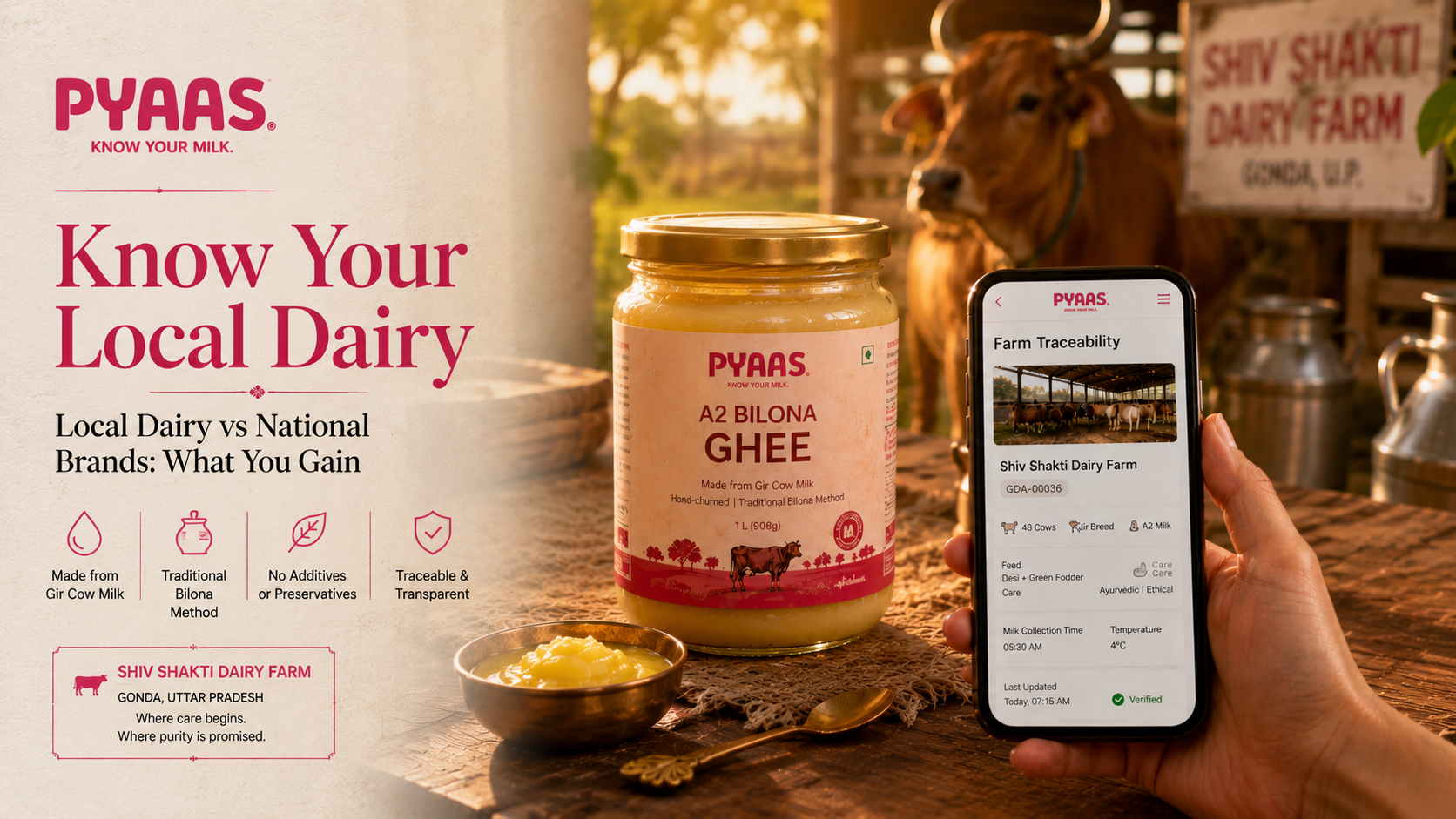
Local Dairy vs National Brands: What You Gain
23 August 2026
Saving India's Native Cow Breeds: Why It Matters
19 August 2026
Ethical Dairy: What Cow Welfare Really Means
19 August 2026
How Data Reduces Waste in the Dairy Supply Chain
26 July 2026