Local Dairy vs National Brands: What You Gain
Stand in front of a dairy shelf and the decision feels simple: a familiar national carton or a smaller local one. But the real story behind local dairy vs national brands is quieter and more interesting than the packaging suggests. It is about how far your milk travelled, how many hands touched it, and how much of your money ever reached the farmer who woke at dawn to milk the cow. None of that is printed on the front of the pack — so let us walk through it honestly, without pretending one side is a villain.
Freshness: the clock starts at milking
Milk is a living, perishable thing. The moment it leaves the cow, a clock starts ticking. A national brand often collects milk from thousands of farms across a wide region, pools it, pasteurises heavily, and ships it long distances to reach a national shelf. That system is genuinely impressive engineering — it keeps milk safe across huge geographies — but every extra kilometre and every extra day is a small cost to freshness and flavour.
A shorter, more local chain simply has fewer steps. Milk that travels a smaller distance from a named farm can reach you closer to when it was drawn. This is one of the clearest, most honest wins in the local dairy vs national brands debate: less time in transit, fewer pooling stops, a fresher glass.
The farmer's share: where your rupee actually goes
Here is a question worth asking of any brand you buy from: of the money I pay, how much reaches the person who owns the cows? In long national chains, value is split across collection agents, processors, distributors and retailers — each layer necessary, each taking a slice. Shorter chains remove some of those layers, which means more of your payment can land at the farm gate.
We will not pretend local automatically means fair. A local dealer can pay a farmer poorly too. The point is not the label "local" — it is transparency. At PYAAS we work directly with named partner farms in Gonda, Uttar Pradesh, and we would rather you judge us on whether the farmer is real and knowable than on a marketing claim. You can read about that approach on our farms page.
Traceability: can you actually see the source?
This is where the conversation gets sharper. Most people have never been able to answer a basic question about their milk: which farm did this come from? Big or small, most dairy hides that answer inside a blended tank.
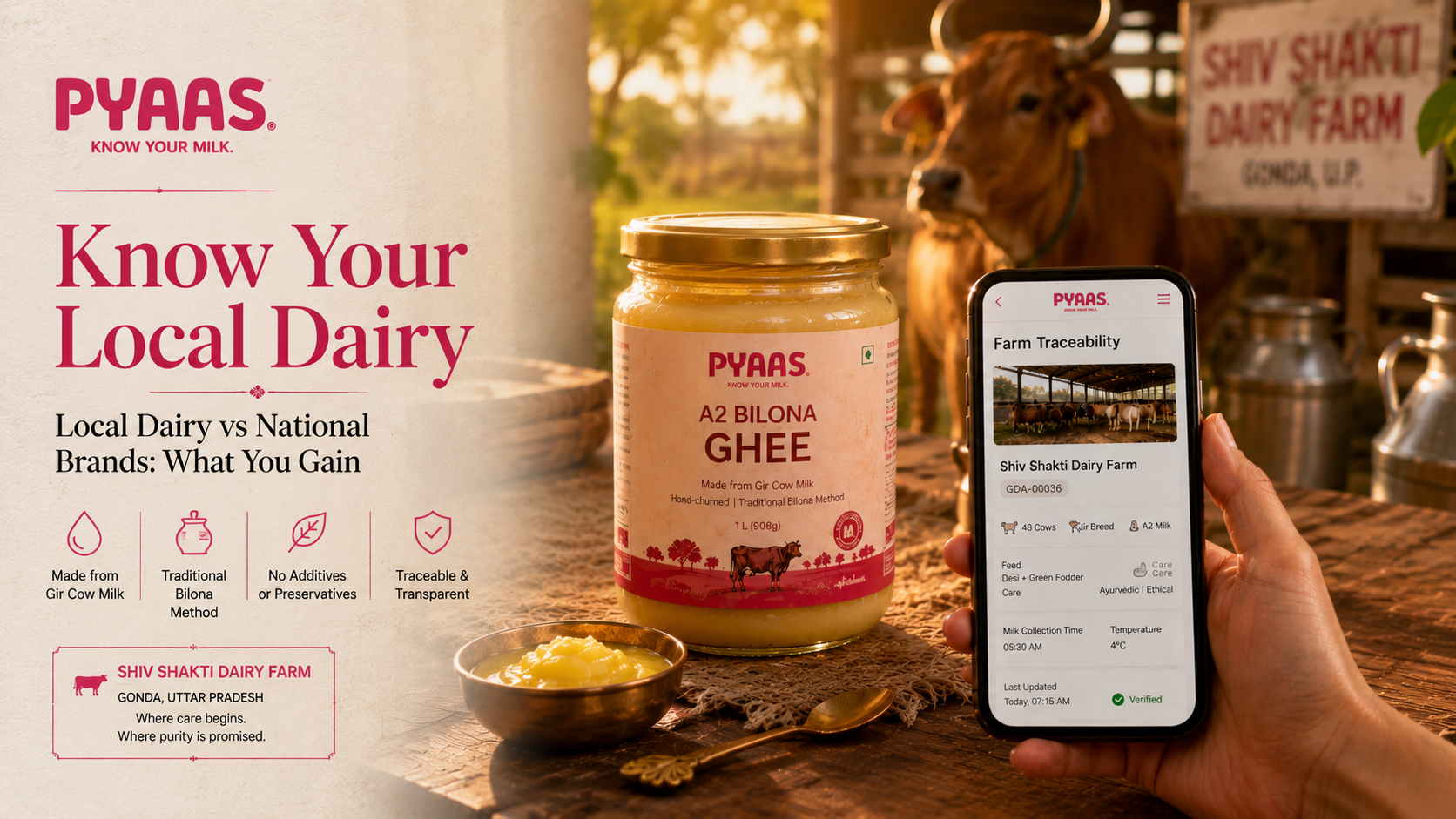
We think you deserve the answer. Every PYAAS pack carries a QR code you scan to see the exact farm, the farmer, and that batch's quality-checked record. That is the heart of what we call Know Your Milk. Size does not decide traceability — systems do. A national brand can absolutely build this, and some are starting to. The useful test is simple: pick up any carton and ask, "Can I see where this came from?"
What each side genuinely does well
An honest comparison has to give both sides their due:
- National brands often lead on consistency, wide availability, cold-chain reach and predictable pricing. When you need milk at 9pm in an unfamiliar city, they are dependable in a way small players cannot always match.
- Local and direct-from-farm dairy tends to win on freshness, a shorter journey, a bigger potential farmer share, and — when done right — the ability to name the exact farm behind your pack.
- Single-origin milk from one known farm carries a character that pooled milk cannot, because it has not been blended into anonymity. We explore this in why one farm beats a thousand.
Neither list makes the other side wrong. They describe different priorities.
Why traceability is the real deciding factor
If you strip the debate down, the question is not "local or national" but "known or unknown". A traceable supply chain lets you verify freshness claims, understand pricing, and see the farmer instead of imagining one. India's dairy sector has long relied on trust without proof, which is exactly why milk traceability matters more than the size of the logo on the carton.
When you can trace your milk, the local dairy vs national brands question answers itself for your household. You stop choosing between two guesses and start choosing based on what you can actually see.
A note on our own honesty
Since we are a dairy brand writing this, fairness demands we be plain about where we stand today. PYAAS A2 Bilona cow ghee is live and ships across India right now, made in small batches from our partner farms in Gonda. Our fresh A2 cow milk is not on sale yet — it launches in Lucknow from August 2026 and will expand across Uttar Pradesh after that. We would rather tell you exactly what you can and cannot buy than blur it.
How to decide for your own kitchen
Use a short checklist next time you compare options:
- Can I find out which farm or region this came from?
- How recently was it likely produced, given the chain length?
- Does the brand explain what I am paying for?
- Is there any way to verify the claims, like a scannable batch record?
Whatever you conclude, you will be deciding with your eyes open rather than on habit. That is the whole point. The best outcome of the local dairy vs national brands question is not that you switch — it is that you finally know what is in your glass. At PYAAS, that promise is the entire reason we exist: milk and ghee you can trace, from farms and farmers we are proud to name.
Written by
Naina Sharma
PYAAS is an honest, traceable Indian dairy brand from Gonda, Uttar Pradesh.
More from Naina SharmaCommon questions.
Is local dairy always better than a national brand?
Not automatically. A national brand often wins on consistency, cold-chain reach and availability. But in local dairy vs national brands, a good local supply chain usually gives you fresher milk, a shorter journey from cow to kitchen and a bigger share of your money reaching the farmer. The honest answer depends on how transparent each one is.
Does buying local dairy help farmers earn more?
Generally, yes. Shorter chains mean fewer middle layers between the farm and your kitchen, so more of what you pay can reach the person who milked the cow. It is not a guarantee, though — ask any brand, local or national, how much of the price reaches the farm.
Can national brands be traceable too?
They can, and some are improving. Traceability is about systems, not size. What matters is whether you can see the exact farm and batch behind your pack. PYAAS builds this in with a QR code on every jar so you can check the source yourself.
Get the next one in your inbox.
The occasional note on milk, ghee, and how we work. Plain words, no hype, and you can leave any time.
Keep reading.
Ethical Dairy: What Cow Welfare Really Means
19 August 2026
Saving India's Native Cow Breeds: Why It Matters
19 August 2026
Sustainable Dairy Starts at the Farm
2 August 2026
How Data Reduces Waste in the Dairy Supply Chain
26 July 2026