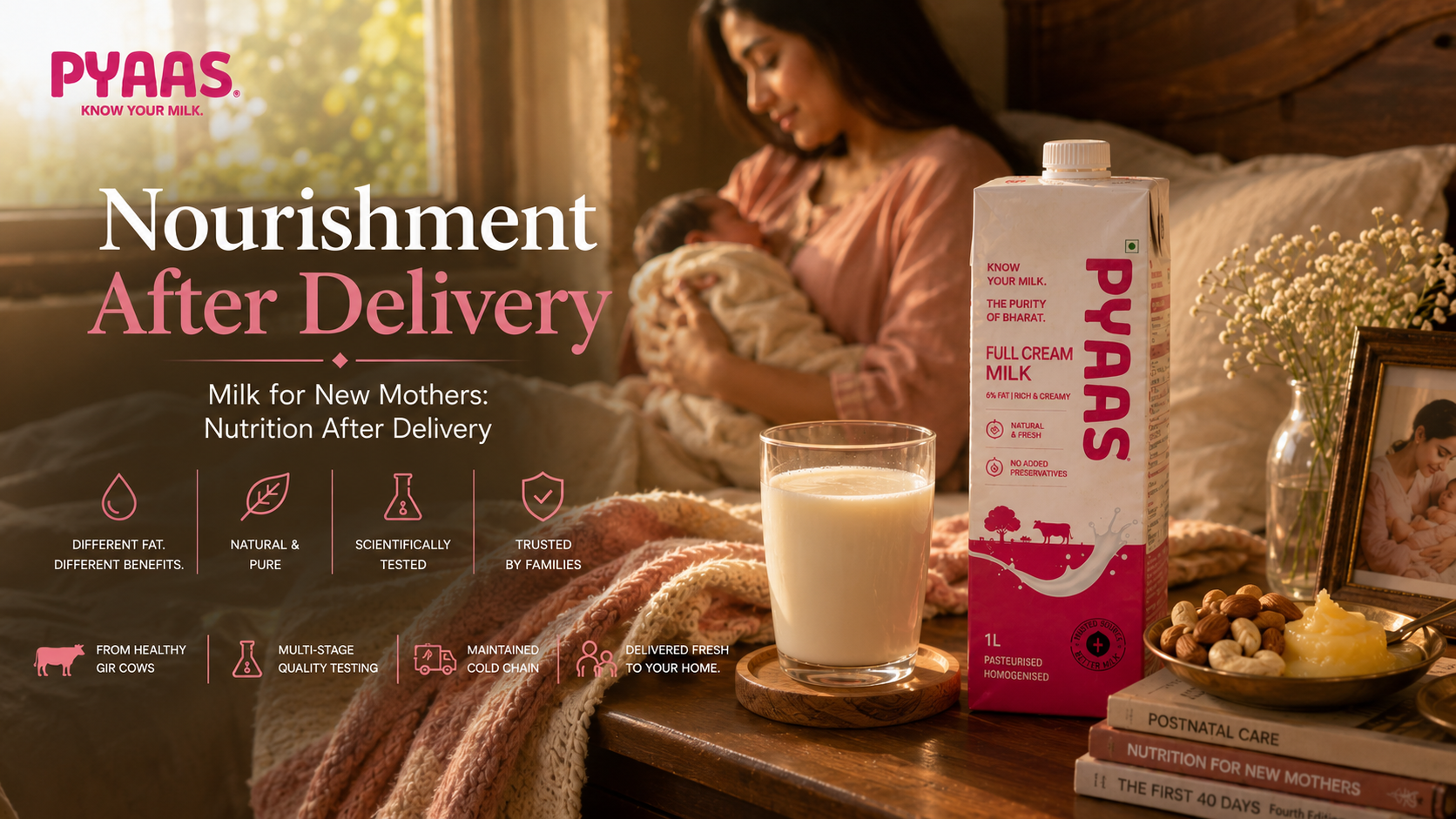
Milk for New Mothers: Nutrition After Delivery
The weeks after a baby arrives are tender and demanding in equal measure. A mother's body is healing, often feeding another human, and running on interrupted sleep. In Indian homes, care during this time usually arrives on a plate and in a glass, and warm milk has long been part of that tradition. This is a gentle, honest look at milk for new mothers, written with the firm reminder that a doctor's advice always outranks any article.
What a new mother's body is actually doing
Recovery after delivery is real physical work. Tissues are healing, blood volume is readjusting, and if a mother is breastfeeding, her body is producing milk around the clock. All of this raises the need for good nutrition: protein to rebuild, calcium to protect bone stores, iron to recover from blood loss, and plenty of fluids. The aim in this season is not restriction or trendy eating; it is steady, nourishing, easily digested food.
This is exactly the kind of moment where a familiar, wholesome food earns its place. Milk, for mothers who tolerate dairy, brings several of these needs together in one simple glass.
Where milk fits, honestly
Milk is not a magic postpartum food, and it would be dishonest to pretend otherwise. What it is, is a genuinely convenient source of a few things a recovering mother needs.
- Protein: a cup of milk carries around 7 to 8 grams of protein, both fast whey and slow casein, useful for tissue repair.
- Calcium: breastfeeding draws on a mother's calcium, so a well-absorbed source matters. Milk is one of the easiest, as we explain in our piece on milk and calcium absorption.
- Energy and comfort: warm milk is easy to digest and comforting during exhausting nights, which is part of why the tradition has lasted.
- Vitamin B12 and other nutrients: milk contributes small amounts of several nutrients that add up across a varied diet.
Traditional Indian postpartum foods often pair milk with ghee, dry fruits and gentle spices, in preparations meant to warm and nourish. There is real wisdom in that inheritance, as long as it is followed with balance and adapted to each mother's health, appetite and any conditions like gestational diabetes.
The myths worth setting aside
Two beliefs deserve a careful, honest correction. First, no single food or drink, milk included, has been shown to reliably increase breast milk supply. Supply is mostly driven by frequent, effective feeding and by the mother staying generally well nourished and hydrated. Milk supports the second half of that; it is not a tap you turn up.
Second, more milk is not automatically better. A mother who is uncomfortable with dairy, or who has been advised to limit it, gains nothing from forcing it down. Nutrition after delivery is about the whole plate: dals, vegetables, whole grains, fruit, good fats and adequate water, with milk as one helpful contributor rather than the centrepiece.
A note on comfort and digestion
Some mothers who felt fine with milk before pregnancy find their digestion more sensitive afterwards. If plain milk feels heavy, curd, chaas or paneer are gentler fermented options that still carry protein and calcium. A few families ask about A2 milk here, and some do find it easier on the stomach, though the science is still developing and A2 is about the beta-casein protein, not about lactose. We keep that clear in our honest guide to A2 milk. For a fuller picture of what milk provides, our milk nutrition facts article is a useful companion.
Why purity matters more than ever now
If there is one time to be careful about the quality of what you eat, it is while recovering and feeding a newborn. Adulterated or poorly handled milk is never acceptable, but in this window it matters especially. Milk that comes from a single, known farm, is quality-checked, and can be traced from that farm to the pack gives a family real peace of mind. Every PYAAS pack carries a QR code you can scan to see the exact farm, the farmer, and that batch's record, so a new mother knows precisely what she is drinking.
PYAAS A2 Bilona cow ghee, made in small batches and shipping across India today, is often part of traditional postpartum foods for the same reason: families want ingredients they can trust completely. Ghee is very low in lactose and casein because most milk solids are removed, which is one reason many people tolerate it comfortably.
The one rule above all others
Every mother, every delivery and every recovery is different. Someone may need to watch sugar, another may be advised more iron, another may have a dairy sensitivity. Nothing in this article replaces the guidance of the mother's own doctor, obstetrician, pediatrician or dietitian. Please treat professional advice as the final word, and use general information like this only as gentle context.
Care you can trust
The tradition of nourishing a new mother with warm, wholesome food carries genuine love and genuine sense. Milk, for those who tolerate it, is a convenient way to bring protein, calcium and comfort into a demanding season, sitting alongside a varied, balanced diet rather than replacing it. What matters most is that the food is genuinely good and genuinely what it claims to be. That is the quiet promise behind PYAAS: milk and ghee a family can trace, trust and know, at exactly the moments when trust matters most.
Written by
PYAAS
PYAAS is an honest, traceable Indian dairy brand from Gonda, Uttar Pradesh.
More from PYAASCommon questions.
Is milk good for new mothers after delivery?
For most mothers who tolerate dairy, milk can be a convenient source of protein, calcium and energy during recovery and breastfeeding. Traditionally, milk for new mothers has been part of Indian postpartum care. Individual needs differ, so a mother's doctor or dietitian should guide her specific diet.
Does drinking milk increase breast milk supply?
There is no strong evidence that any single food or drink reliably increases supply. Milk supply is mainly driven by frequent, effective feeding and staying well nourished and hydrated overall. Milk can support a mother's general nutrition, but it is not a guaranteed supply booster.
How much milk should a breastfeeding mother drink?
There is no fixed number; needs vary with body size, diet, activity and health. The goal is a balanced diet with enough protein, calcium, iron and fluids, of which milk can be one part. A doctor or registered dietitian can give personalised guidance.
Get the next one in your inbox.
The occasional note on milk, ghee, and how we work. Plain words, no hype, and you can leave any time.