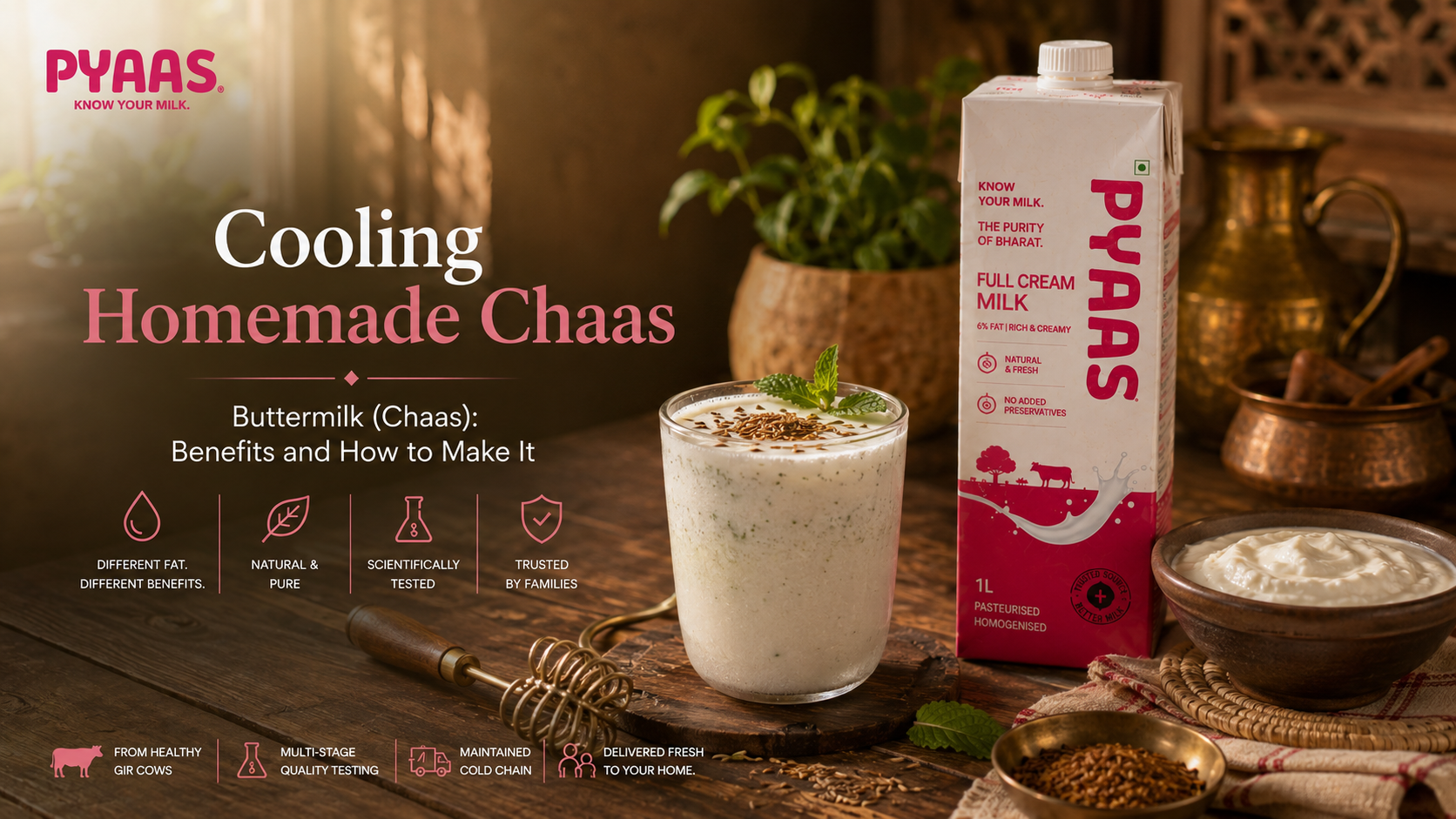
Buttermilk (Chaas): Benefits and How to Make It
Walk into almost any home across India after a big lunch and you will find the same quiet ritual: a tall, frothy glass of chaas, tempered with cumin and a pinch of salt, sipped slowly while everyone insists they could not possibly eat another bite. Chaas is not a trend. It is one of the oldest ways this country has kept its stomach happy, and the real buttermilk chaas benefits are worth understanding rather than exaggerating.
What buttermilk really is
There is some confusion here, so let us be precise. Traditional Indian buttermilk, or chaas, is what remains after curd is churned and the butter is removed, then thinned with water and seasoned. It is fundamentally a fermented dairy drink, light and tangy, quite different from the thick sweet lassi it often gets confused with. This churning connection is the same process that begins the journey toward ghee, which we trace in our piece on how ghee is made from fresh milk to golden ghee.
The honest benefits of chaas
Chaas has been celebrated for centuries, and modern understanding of fermented foods backs up a good part of the folk wisdom, even if some claims get stretched. Here is what stands on solid ground.
- Gentle on digestion: as a fermented drink, chaas carries friendly bacteria and mild acidity. Many people find it eases the heaviness after an oily or rich meal, which is exactly why it earns its place after lunch.
- Light and low in fat: because the butter has been removed and water added, chaas is far lighter than milk or lassi, making it an easy everyday drink rather than an indulgence.
- Cooling and hydrating: in an Indian summer, salted chaas with mint replaces fluids and feels genuinely refreshing, which is why it is a monsoon and heatwave staple.
- Easier on some sensitive stomachs: fermentation lowers part of the lactose, so a few people who feel bloated on plain milk manage chaas more comfortably. This varies a lot, so listen to your own body.
What chaas is not is a medicine. It will not cure a disease, melt fat, or fix a serious digestive condition, and anyone promising that is selling something. Its value is real but modest: a light, probiotic-rich, cooling drink that helps a meal sit well.
How to make proper chaas at home
Good chaas starts with good curd, and good curd starts with good milk. This is where the whole chain matters, because a drink this simple hides nothing. Fresh, clean, honestly produced milk sets into curd with a sweet, clean tang; tired or adulterated milk never quite gets there.
The basic recipe
For two glasses you need about half a cup of fresh curd, roughly one and a half cups of chilled water, and your seasoning.
- Whisk the curd until completely smooth, either by hand with a mathani or in a blender for a few seconds.
- Add the cold water gradually and whisk again until it turns light and frothy. Chaas should be pourable and thin, not thick.
- Season with roasted cumin powder, black salt or regular salt, and a little chopped coriander or mint.
- For a South Indian style, add grated ginger, a slit green chilli and curry leaves; for a plain everyday version, cumin and salt are enough.
- Serve immediately over ice, or chill briefly. Fresh is always best.
That is the entire method. The magic is in the ingredients, not the technique, which is why the quality of your curd and milk decides everything.
Why the milk behind your curd matters
Since chaas is really just curd, water and spice, there is nowhere for poor milk to hide. If the milk was watered down, over-processed or of unknown origin, the curd will be thin and the chaas flat. Milk from a single, known farm, fresh and properly cooled, sets into the kind of curd that makes chaas taste the way your grandmother's did.
This is one reason PYAAS cares so much about traceability. Every pack carries a QR code you can scan to see the exact farm, the farmer and that batch's quality-checked record, so the curd you set at home starts from milk you can actually name. When PYAAS fresh A2 cow milk launches in Lucknow from August 2026 and expands across Uttar Pradesh, that same traceable freshness is what will reach your kitchen for making curd and chaas.
A note on A2 and digestion
People often ask whether A2 milk makes even better chaas for sensitive stomachs. Some find A2 milk gentler to begin with, and fermenting it into curd may add to that comfort, but this is individual and the science is still developing. A2 is about the beta-casein protein, not about lactose, so it is not a fix for lactose intolerance. We keep that distinction clear in our honest guide to A2 milk. For the full nutritional context of dairy, our milk nutrition facts piece is a good companion.
An old habit worth keeping
There is something quietly reassuring about a food tradition that has survived for centuries without a health claim attached. Chaas asks for nothing exotic: some curd, cold water, cumin, salt. It cools you in summer, sits lightly after a heavy meal, and carries the gentle benefits of fermented dairy without pretending to be more than it is.
Make it at home, keep it fresh, and start from milk you can trust all the way back to the farm. That combination of an honest recipe and an honest source is exactly the kind of small, true thing PYAAS believes in when it asks you simply to know your milk.
Written by
PYAAS
PYAAS is an honest, traceable Indian dairy brand from Gonda, Uttar Pradesh.
More from PYAASCommon questions.
Is chaas good for digestion?
Many people find it is. Traditional chaas is made by churning curd, so it carries the friendly bacteria and mild acidity of fermented dairy, which some find settles a heavy stomach. One of the most cited buttermilk chaas benefits is comfort after a rich meal, though effects vary from person to person.
What is the difference between chaas and lassi?
Chaas is thinner, lighter and usually salty or spiced, made by churning curd with plenty of water. Lassi is thicker, creamier and often sweet. Chaas has less fat and calories, which is why it is the traditional after-meal drink rather than a dessert.
Can lactose-intolerant people drink buttermilk?
Some can tolerate it better than plain milk, because fermentation reduces part of the lactose and the drink is diluted with water. Tolerance is very individual, so start small. If you react to all dairy, check with your doctor before making it a habit.
Get the next one in your inbox.
The occasional note on milk, ghee, and how we work. Plain words, no hype, and you can leave any time.