Why Most Consumers Don't Know Their Milk
You know where your food delivery rider is at any given moment. You can track a parcel across the country in real time. You know how many steps you walked today and exactly how much battery your phone has left. Yet most people cannot answer one simple question about a product they pour into tea, cereal and a child's glass every single morning: where did today's milk actually come from? It is strange that the most consumed item in the Indian kitchen is also one of the most anonymous.
This is the quiet reason why most consumers don't know their milk. Not because they don't care, but because the dairy system was never built to tell them. The carton arrives, it gets used, and the story behind it stays invisible. At PYAAS we think that should change, and the good news is that it already is. This article explains how milk became anonymous, why that matters for your family, and what genuine milk traceability looks like when it is done right.
Why milk became anonymous in the first place
For most of modern history, milk was a face you knew. It came from a local farmer, often a neighbour, and trust was personal. As cities grew and demand exploded, dairy supply chains scaled up to keep pace. Milk from thousands of small farms began to be pooled, transported over long distances, processed in bulk and distributed at a scale that no single person could oversee.
Scale brought real benefits: more milk, lower costs and wider availability. But something was lost in the pooling. When milk from hundreds of sources is mixed into one tank, the link between a specific farm and the carton on your table disappears. You are no longer drinking one farmer's milk. You are drinking an average. That is efficient, but it is also why the answer to "whose milk is this?" became impossible to give. To understand this in more depth, read our breakdown of the hidden problem with India's milk supply chain.
What consumers usually know, and what they almost never do
Walk through what the average family can tell you about their milk, and a clear pattern appears. Consumers usually know:
- The brand name printed on the pack
- Whether it is labelled toned, full cream or double toned
- The price and the expiry date
- Roughly how to store it
But the same families rarely know any of the things that actually matter for trust:
- Which farm the milk came from, or the name of the farmer who milked the cow
- What breed of cow it came from, and whether it is A1 or A2 milk
- Whether that batch was tested, and what its SNF and FAT readings were
- When the milk left the farm and how long it travelled before reaching home
Notice that the things we know are about the product, and the things we don't know are about the source. Somehow the most important parts of the story, the people and the process, are exactly the parts that vanished. If you want a clear picture of what a complete milk journey involves, our guide on how milk reaches your home walks through every stage.
This is a trust problem, not a dairy problem
For decades the model was simple. A brand made a product, the product reached the consumer, and trust depended almost entirely on reputation and advertising. Questions were rarely asked because there was no easy way to ask them, and even fewer ways to get an honest answer. That worked for a long time, but expectations have shifted.
Today's consumers want more than a product. They want context. They want to know who grew it, how it was handled and whether anyone checked it. This is not a dairy quirk. It is happening everywhere. Banking shows you every transaction. Ride apps show you the driver and the route. Online stores show you reviews and shipment tracking. Food is simply the next industry to be asked the same question, and dairy sits right at the front of that line. We explore this wider shift in why consumers are demanding transparent food systems.
Why this matters more for milk than almost anything else
Milk is uniquely vulnerable. It is perishable, it is consumed daily, and it is given to the most sensitive members of the family: infants, growing children and elderly parents. When you cannot see the source, you also cannot rule out the things that worry families most, from adulteration to inconsistent quality. The lack of visibility is not a small inconvenience. It is the root of the unease many people feel without being able to name it. For practical context on those concerns, see our piece on milk adulteration in India.
What it looks like when you actually know your milk
Transparency creates a different kind of relationship with what you buy. Instead of asking you to trust blindly, it lets you understand. Information becomes visible, accountability becomes visible, and confidence follows naturally because it is supported by evidence rather than slogans.
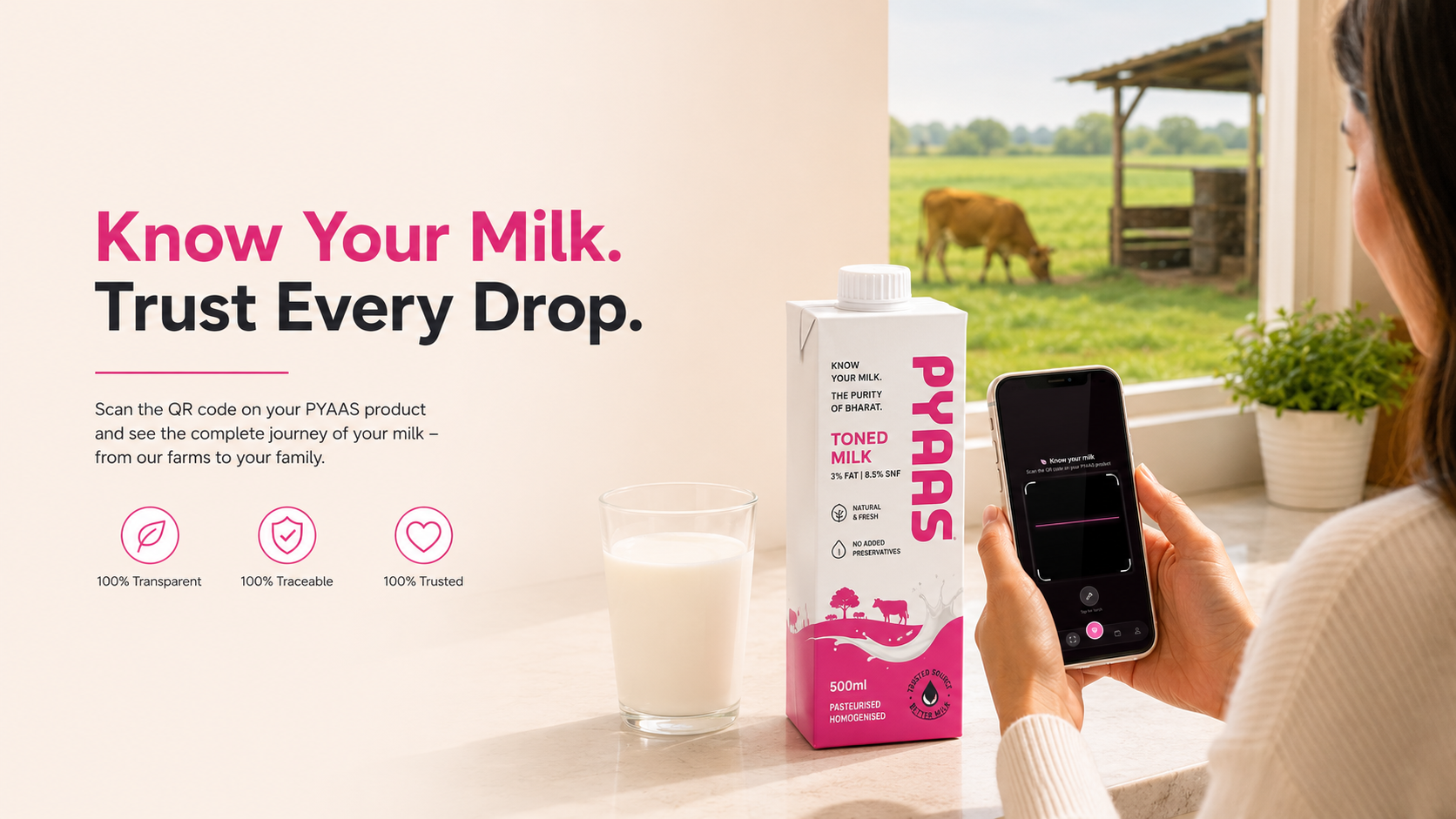
At PYAAS this is not a future promise. It is built into the pack. Scan the QR code on a PYAAS carton or pouch and you can see:
- The exact farm in Gonda, Uttar Pradesh, and the named farmer behind that batch
- That batch's lab test results, including SNF and FAT, so quality is shown and not just claimed
- The time the milk left the farm, so you understand its freshness
- That it is single-origin A2 cow milk, not an anonymous pooled average
This is what the phrase on our packs really means, and it is the whole idea behind Know Your Milk. We dig deeper into the meaning behind it in what "Know Your Milk" really means, and you can read the mechanics in how PYAAS tracks milk from farm to family. The same honesty extends to our small-batch A2 Bilona ghee, where the source story stays attached to the jar.
The future consumer is informed, not passive
The brands that answer these questions openly will build the strongest relationships over the next decade. A generation of buyers is growing up expecting to scan, check and verify, and they will not unlearn that habit when they reach the dairy aisle. Traceability is no longer a luxury feature. It is quickly becoming the baseline that families expect.
That is why we believe the future of dairy is not only about better milk. It is about better information delivered alongside it. To see where this is heading, read our view on why traceability matters in dairy, and meet the people doing the work through our founding family.
The bottom line
Most consumers don't know their milk because the system never gave them a reason to expect they could. That era is ending. You deserve more than a label, a logo and a leap of faith. You deserve to see the farm, the farmer, the test and the time, and to decide for yourself. If that idea matters to you, the simplest next step is to scan a pack and watch the story appear. That small moment of clarity is exactly why PYAAS exists, and it is the difference between buying milk and truly knowing it.
Written by
PYAAS Team
The PYAAS Team writes about milk traceability, A2 dairy and food transparency, drawing on the brand's farm-to-family work across Gonda, Delhi NCR, Lucknow and Ayodhya.
More from PYAAS TeamCommon questions.
Why don't most consumers know where their milk comes from?
As dairy scaled up to meet city demand, milk from thousands of farms began to be pooled, transported and processed in bulk. When milk is mixed into one tank, the link between a specific farm and your carton disappears. The system was built for efficiency, not for telling you the source.
What information should I be able to know about my milk?
Ideally you should know the farm it came from, the farmer behind it, the cow breed, whether it is A1 or A2, and that batch's quality test for SNF and FAT. You should also know when the milk left the farm so you can judge freshness. Most conventional milk cannot tell you any of this.
How does milk traceability actually work?
Traceability links every carton back to its source through digital records and a scannable QR code. With PYAAS, scanning the pack shows the exact farm in Gonda, the named farmer, the batch lab test and the time the milk left the farm. It turns trust from a claim into something you can verify yourself.
Why does not knowing your milk matter for families?
Milk is perishable, consumed daily and given to children, infants and elderly parents who are most sensitive to quality. When you cannot see the source, you also cannot rule out adulteration or inconsistent quality. Visibility is what lets a family choose with real confidence rather than blind faith.
What does PYAAS mean by Know Your Milk?
Know Your Milk means you can see the full story behind every pack instead of trusting a logo. PYAAS sells single-origin A2 cow milk, so scanning the QR code reveals the farm, farmer, batch test and freshness. The aim is to make the source visible, not hidden inside a pooled average.
Get the next one in your inbox.
The occasional note on milk, ghee, and how we work. Plain words, no hype, and you can leave any time.
Keep reading.
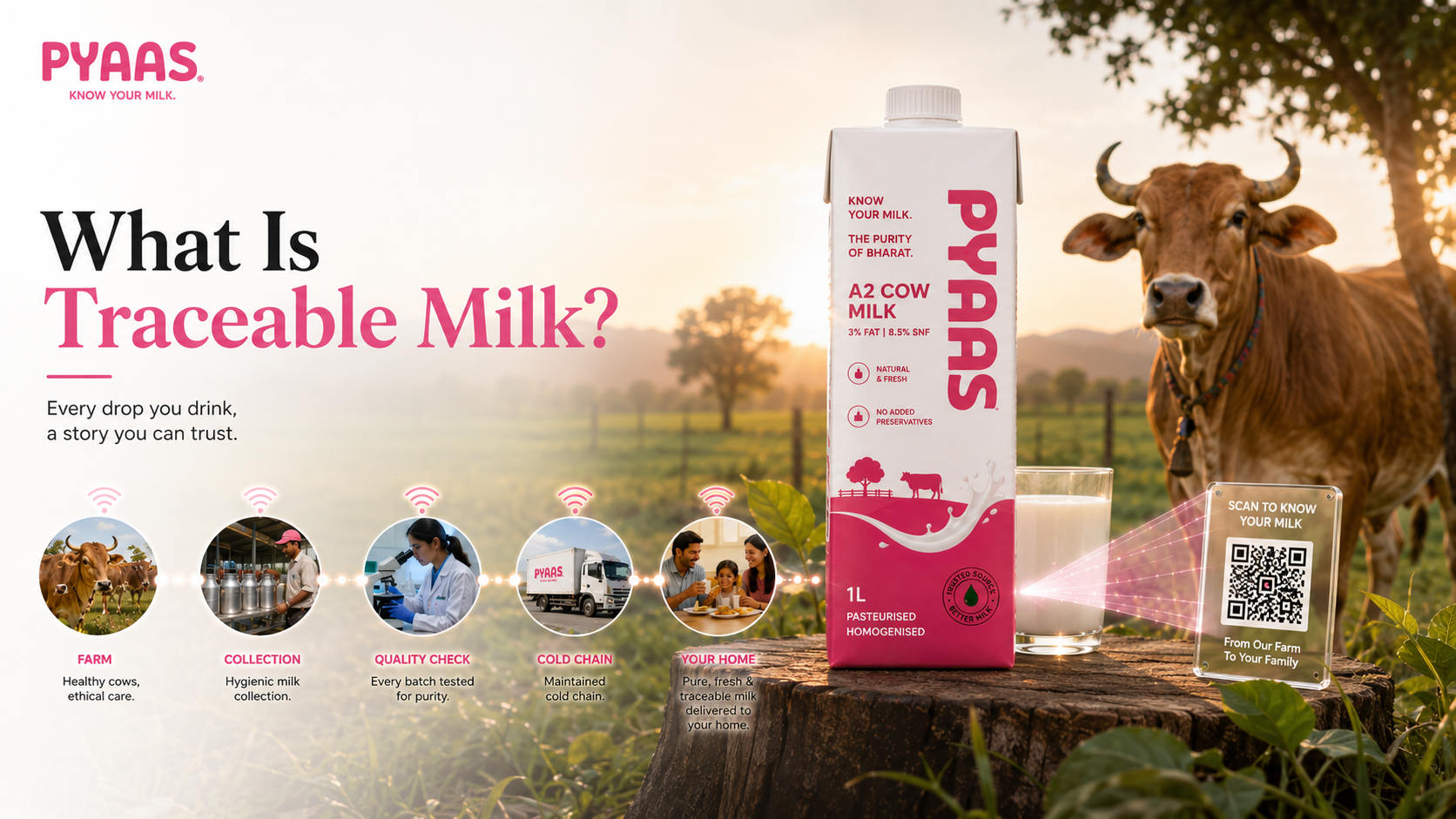
What Is Traceable Milk? Why Modern Consumers Want to Know Their Milk
5 July 2026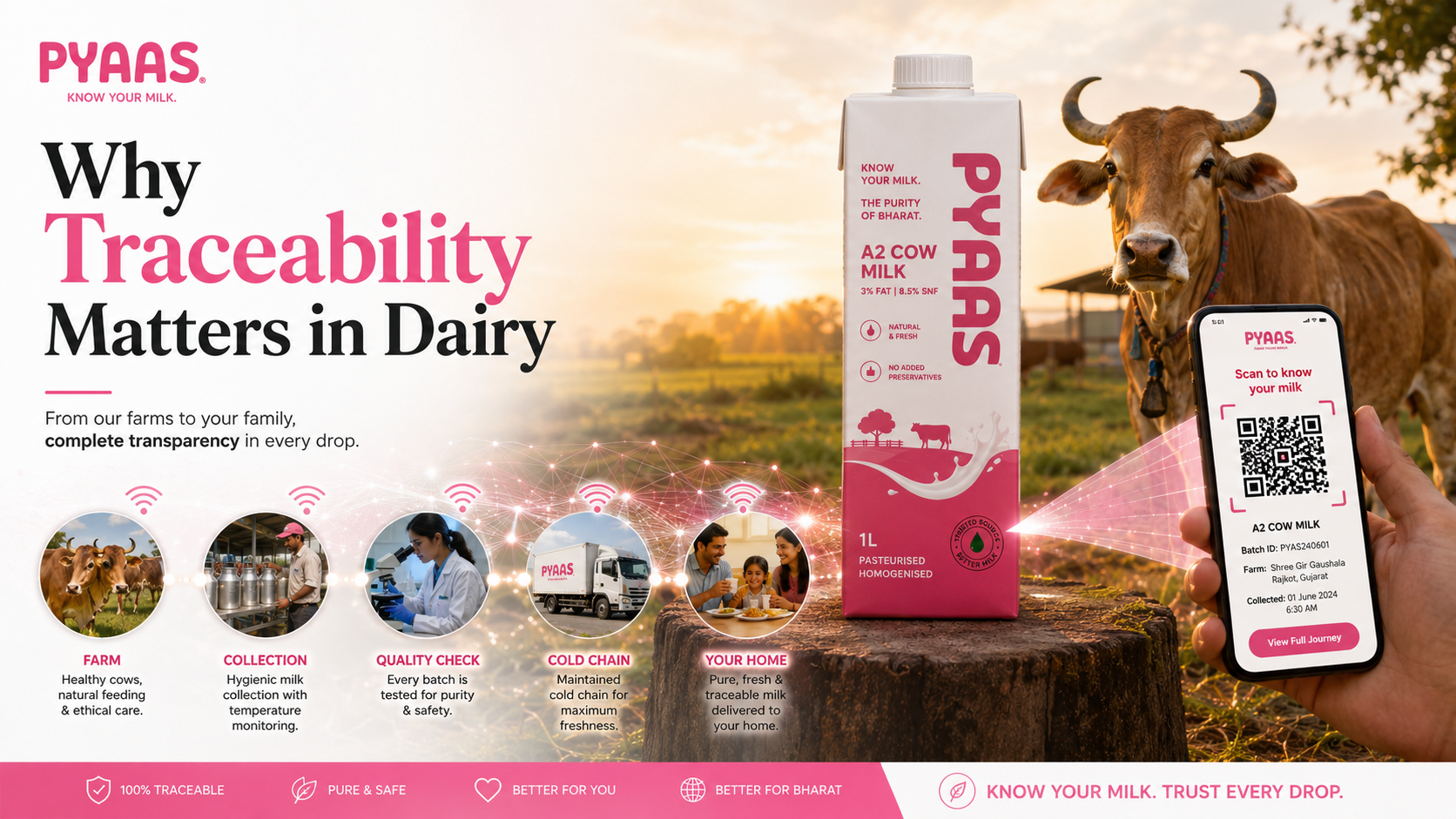
Why Traceability Matters in Dairy: The Future of Consumer Trust
5 July 2026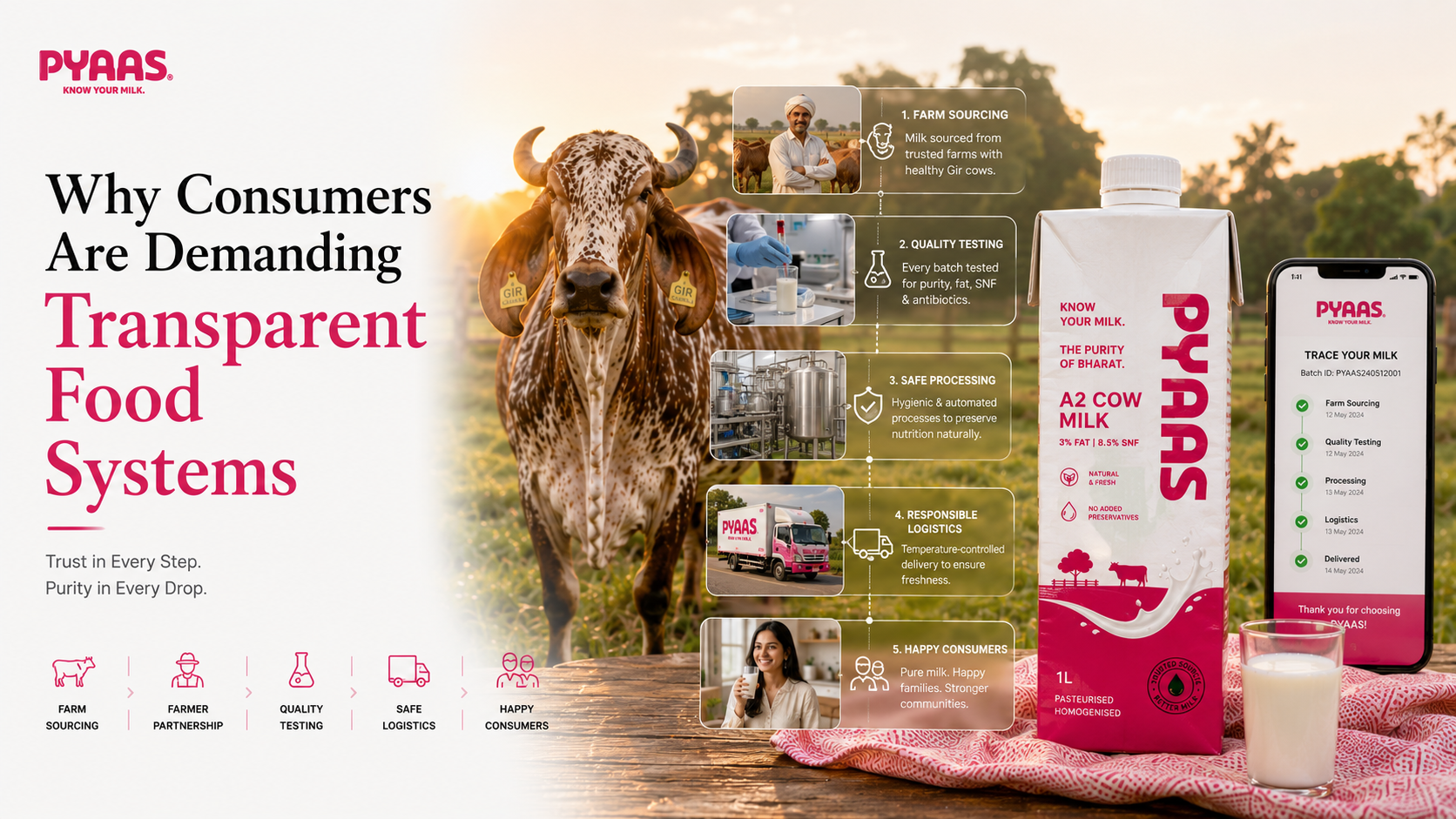
Why Consumers Are Demanding Transparent Food Systems
13 July 2026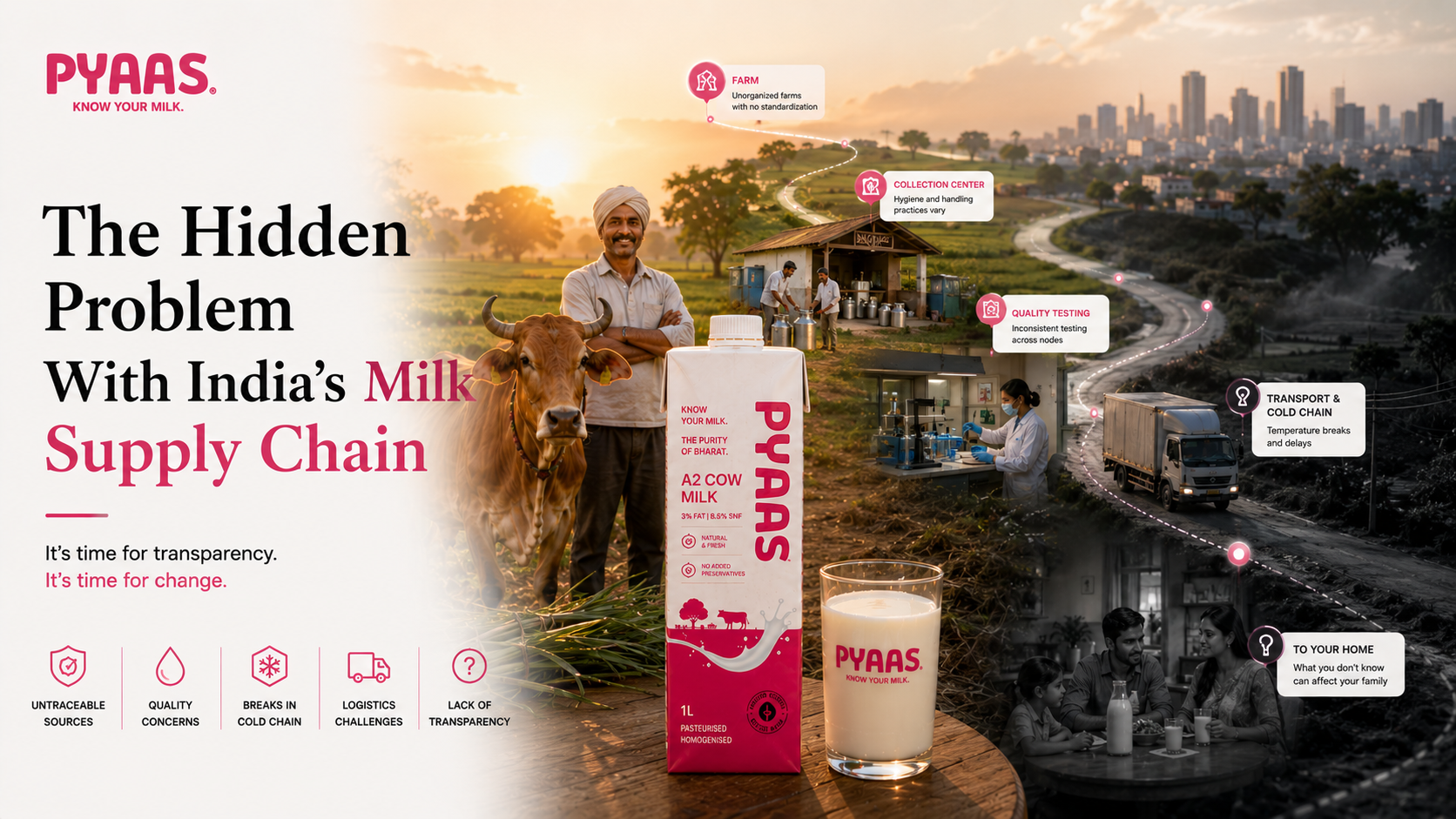
The Hidden Problem With India's Milk Supply Chain
7 July 2026