Why The Future Of Food Is Traceable
For most of human history, families knew exactly where their food came from. They knew the farmer by name, they knew the field, and they knew the journey from harvest to table. Industrialisation changed all of that. Food became cheaper, more abundant and far more convenient, but it also became anonymous. Today many of us pour a glass of milk or open a jar of ghee with almost no idea where it was produced, how it was handled, or whether the claims on the label are true. That information gap is exactly why the future of food is traceable.
The next wave of food innovation will not be defined only by better farming or smarter logistics. It will be defined by visibility: the ability to verify, not just assume. Across categories, shoppers are moving from trusting promises to demanding proof. In this guide we explain what food traceability actually means, why it is becoming the foundation of consumer trust, and what a fully traceable food system looks like for everyday Indian households, starting with the most frequently consumed product of all, milk.
What food traceability really means
Traceability is often dismissed as a technical feature, a barcode on a box. In reality it is much bigger than that. Traceability is the ability to follow a product's complete journey, from its origin to your home, and to verify that journey at any point. A genuinely traceable product can answer simple but powerful questions:
- Where exactly was this produced, and by whom?
- When was it made, processed and packed?
- What quality checks did it pass before reaching me?
- How long did it take to travel from source to shelf?
At its core, traceability is about accountability. When a company is willing to show the full story, it has to stand behind every step. That is a very different relationship from a brand that simply asks you to trust the words printed on the front of a pack. If you want a deeper definition, our explainer on what traceable milk is and why modern consumers want to know their milk breaks it down in plain language.
Why trust is becoming the real competitive advantage
For decades, food companies competed mostly on price, taste, convenience and distribution. Those factors still matter. But a new currency has entered the market, and it is trust. Consumers are increasingly willing to choose, and stay loyal to, brands that show them more rather than tell them more.
This shift is not unique to food. People already track parcels in real time, read verified reviews before buying, and check the source of almost everything online. Visibility has become the default expectation in most parts of modern life. Food is simply catching up. The brands that win the next decade will be the ones that treat transparency as a feature worth investing in, not a risk to be managed. We explore this cultural change in more detail in our piece on why consumers are demanding transparent food systems.
From hidden supply chains to open ones
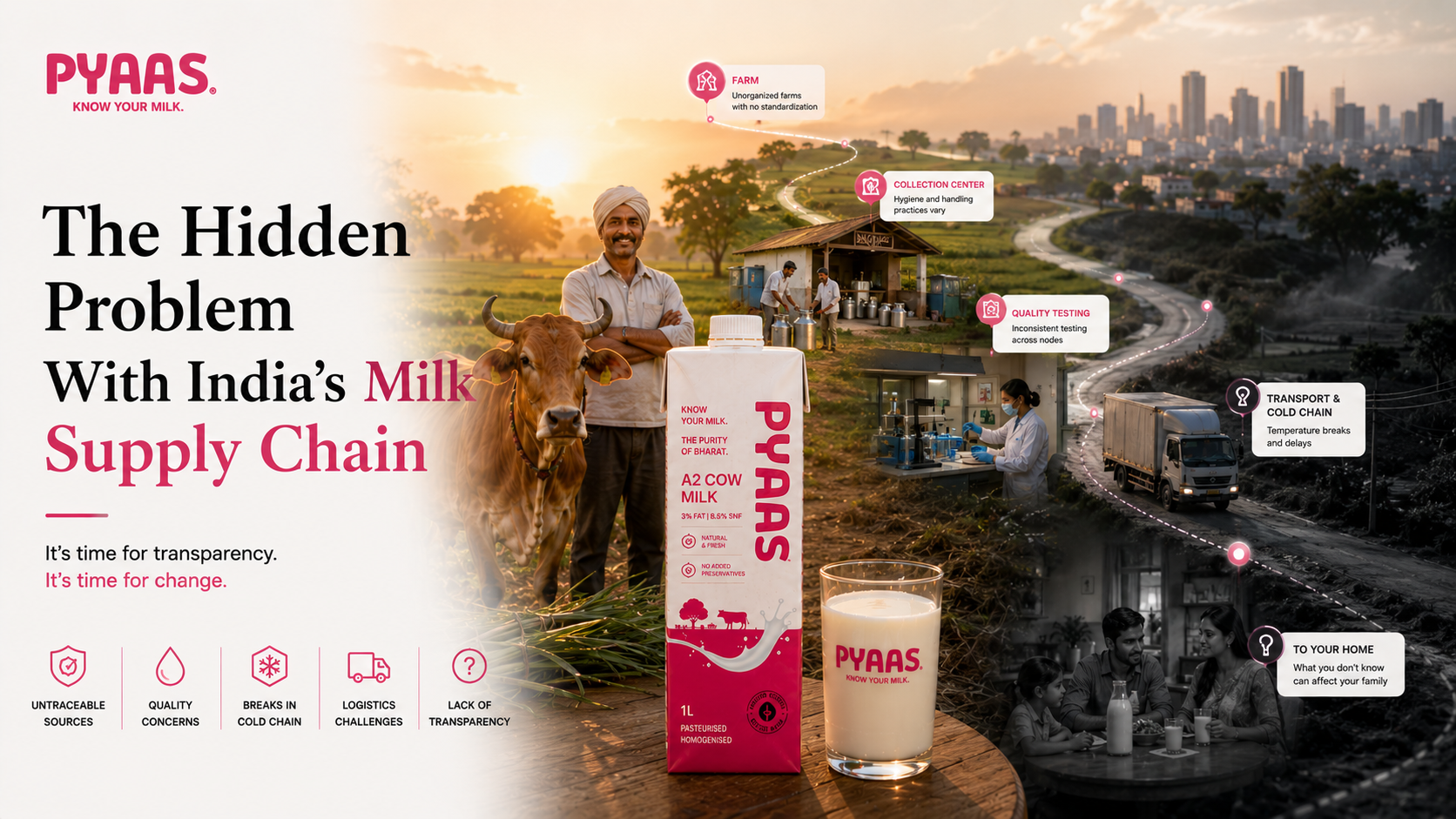
The biggest barrier to trust is the hidden supply chain. When milk passes through several unnamed middlemen before it reaches you, every handoff is a place where quality can slip and information can disappear. Opening up that chain, so that each step is recorded and verifiable, is how brands rebuild confidence. If you want to understand how fragile a typical supply chain can be, read about the hidden problem with India's milk supply chain.
Why milk is the perfect test case for traceable food
Few products enter our homes as often as milk, and few remain as opaque. We give it to children, to elders and to recovering patients, yet most of us cannot say which farm it came from or what was actually measured before it was packed. That combination of high trust and low visibility is exactly why milk is the perfect proving ground for the traceable future of food.
Indian families are increasingly asking sharper questions. Is this really A2 milk? Has it been diluted or adulterated? How fresh is it, truly? These questions are driving a new era of dairy transparency. Understanding the basics helps: our guide to A2 milk benefits, myths and how it differs from regular milk is a good place to start, and you can see the bigger picture in why traceability matters in dairy.
What a traceable carton actually shows you
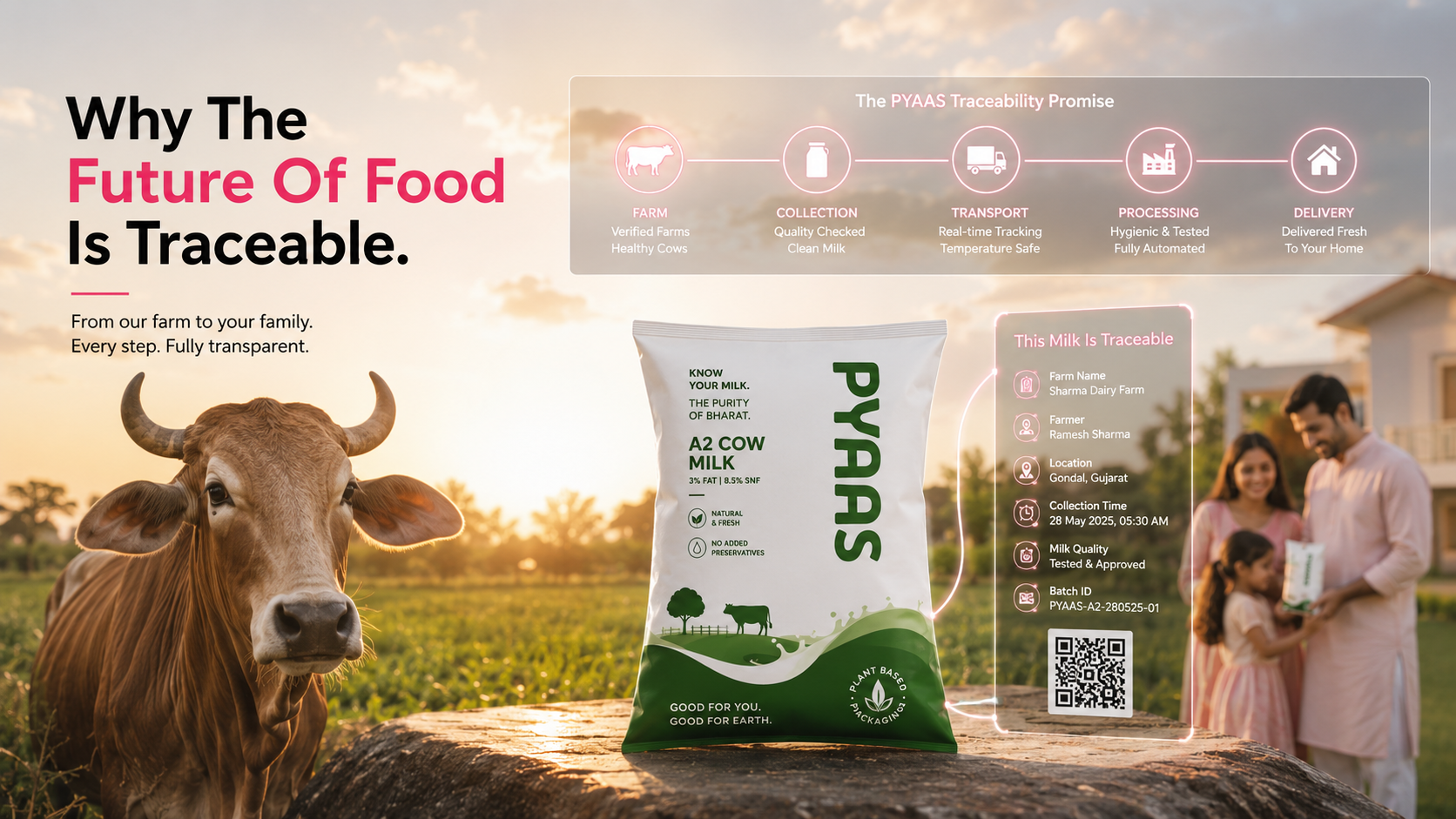
Imagine picking up a carton or pouch of milk and scanning a QR code on the pack. Instead of a generic marketing page, you instantly see:
- The named farm and named farmer who produced that specific batch.
- That batch's lab test results, including SNF and FAT values, so quality is shown rather than promised.
- The time the milk left the farm, so freshness is a fact you can read, not a hope.
This is precisely how PYAAS works. We source single-origin A2 cow milk from named farms in Gonda, Uttar Pradesh, and deliver it fresh across Delhi NCR, Lucknow and Ayodhya. You can follow the full route in our breakdown of how PYAAS tracks milk from farm to family. What feels innovative today will soon feel like the minimum a family should expect.
The technology and standards behind traceable food
Traceability is made possible by a combination of recordkeeping, lab testing and digital tools that connect the dots between farm and family. Modern dairies log each batch, test it, and tie those results to a code you can scan. Public food safety regulation, such as the standards set by the FSSAI in India, sets a baseline for what milk should contain, but traceability goes a step further by letting you verify a specific batch rather than trusting an industry average.
Technology is accelerating this shift. Better testing, digital records and connected logistics are turning what used to be invisible into something you can check in seconds. For a closer look at the systems at work, see how technology is transforming dairy farming in India. The point is not technology for its own sake. The point is that these tools finally make honesty practical at scale.
What a traceable future means for your family
In the years ahead, scanning a pack to read its full story will feel as normal as tracking a delivery does today. Traceability will move from a premium differentiator to a basic expectation, and that is a good thing for every household. It means fewer empty claims, less room for adulteration, and a direct line of accountability back to the people who grow and produce your food.
For families, the practical benefit is confidence. You will know your milk is genuinely A2, genuinely fresh and genuinely from where the brand says it is. You can carry the same mindset into other staples too, from choosing a real A2 Bilona ghee made the traditional way to picking the right milk for each member of your home. This is the heart of what we mean by Know Your Milk: information you can trust, presented openly, so you are never left guessing.
The future of food will not be defined only by what companies produce. It will be defined by what they are willing to reveal. At PYAAS, built by our founding family, we believe transparency should be the standard and not the exception. If that sounds like the way food should work, we would love for you to scan, read and decide for yourself. Know Your Milk.
Written by
PYAAS Team
The PYAAS Team writes about traceable, single-origin A2 dairy and the technology that lets families verify exactly where their milk and ghee come from.
More from PYAAS TeamCommon questions.
What does food traceability mean?
Food traceability is the ability to follow a product's complete journey from its origin to your home, and to verify that journey at any point. A traceable product can show where it was made, by whom, when it was processed, and what quality checks it passed. At its core, traceability is about accountability rather than promises.
Why is the future of food becoming more traceable?
Consumers now expect visibility in almost every part of life, from tracking parcels to reading verified reviews, and food is catching up. Shoppers increasingly want proof rather than promises about where their food comes from and how it was made. As a result, transparency is shifting from a premium feature to a basic expectation.
How does traceability work for milk?
Traceable milk ties each batch to records you can verify, often through a QR code on the pack. Scanning it can reveal the named farm and farmer, that batch's lab test results such as SNF and FAT, and the time the milk left the farm. This turns quality and freshness into facts you can check instead of claims you have to trust.
Is traceability the same as food safety regulation?
No, although they work together. Regulators like the FSSAI in India set baseline standards for what milk should contain. Traceability goes a step further by letting you verify a specific batch you are about to buy, rather than relying only on a general industry average.
How does PYAAS make its food traceable?
PYAAS sources single-origin A2 cow milk from named farms in Gonda, Uttar Pradesh, and delivers it fresh across Delhi NCR, Lucknow and Ayodhya. A QR code on the pack lets you see the exact farm, the named farmer, that batch's lab test and the time the milk left the farm. The same transparency-first approach applies to our small-batch A2 Bilona ghee.
Get the next one in your inbox.
The occasional note on milk, ghee, and how we work. Plain words, no hype, and you can leave any time.
Keep reading.
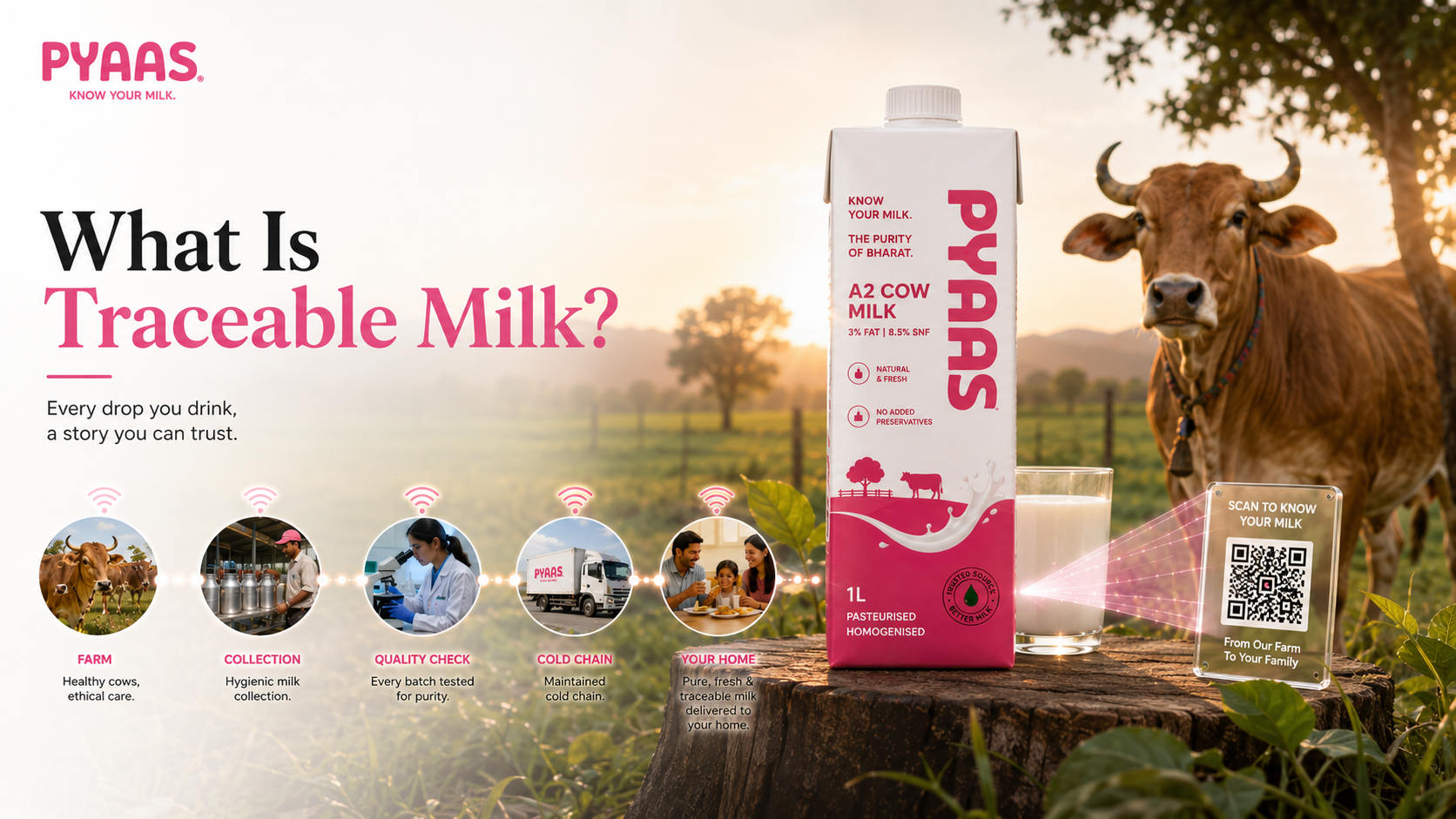
What Is Traceable Milk? Why Modern Consumers Want to Know Their Milk
5 July 2026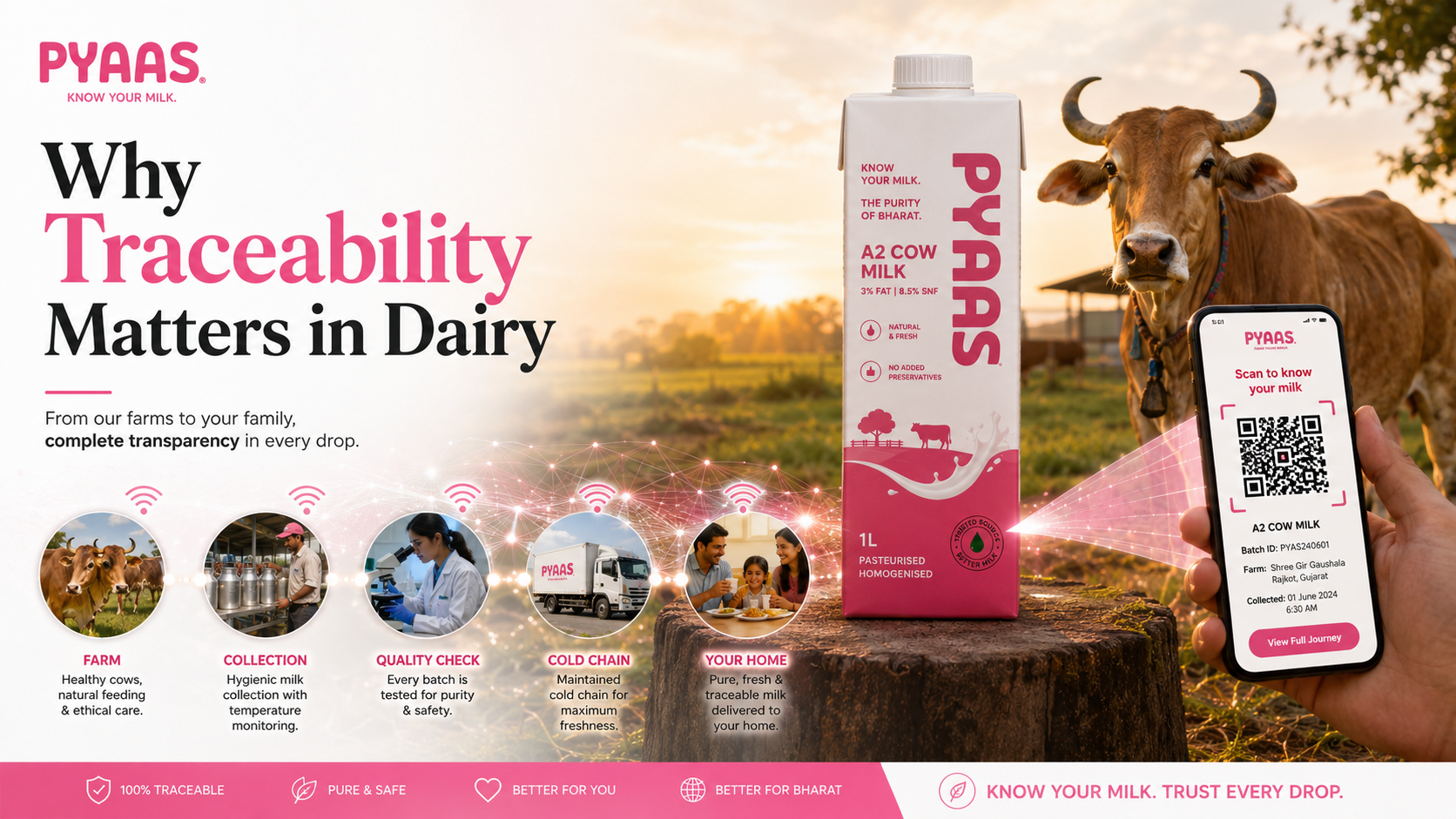
Why Traceability Matters in Dairy: The Future of Consumer Trust
5 July 2026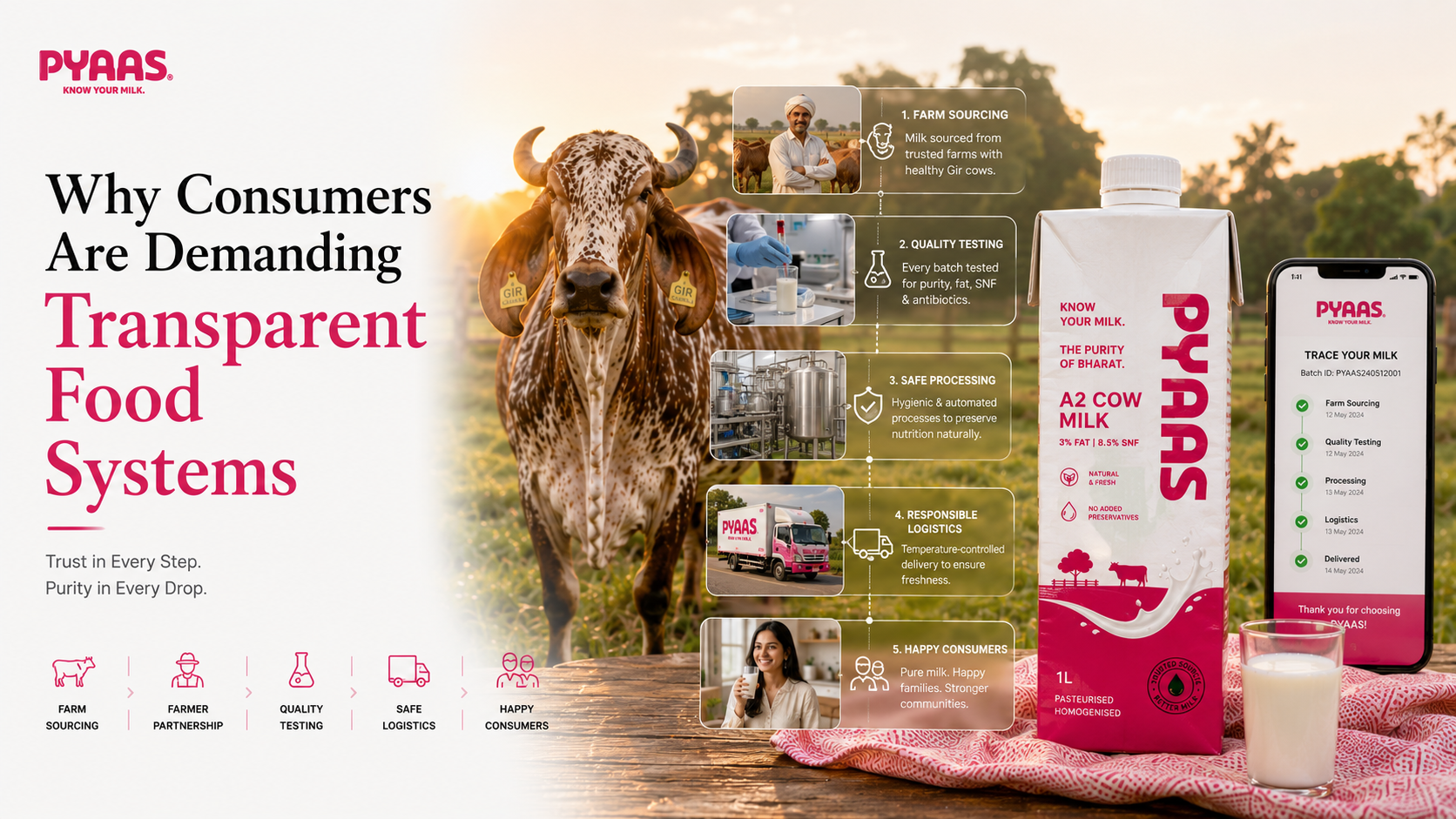
Why Consumers Are Demanding Transparent Food Systems
13 July 2026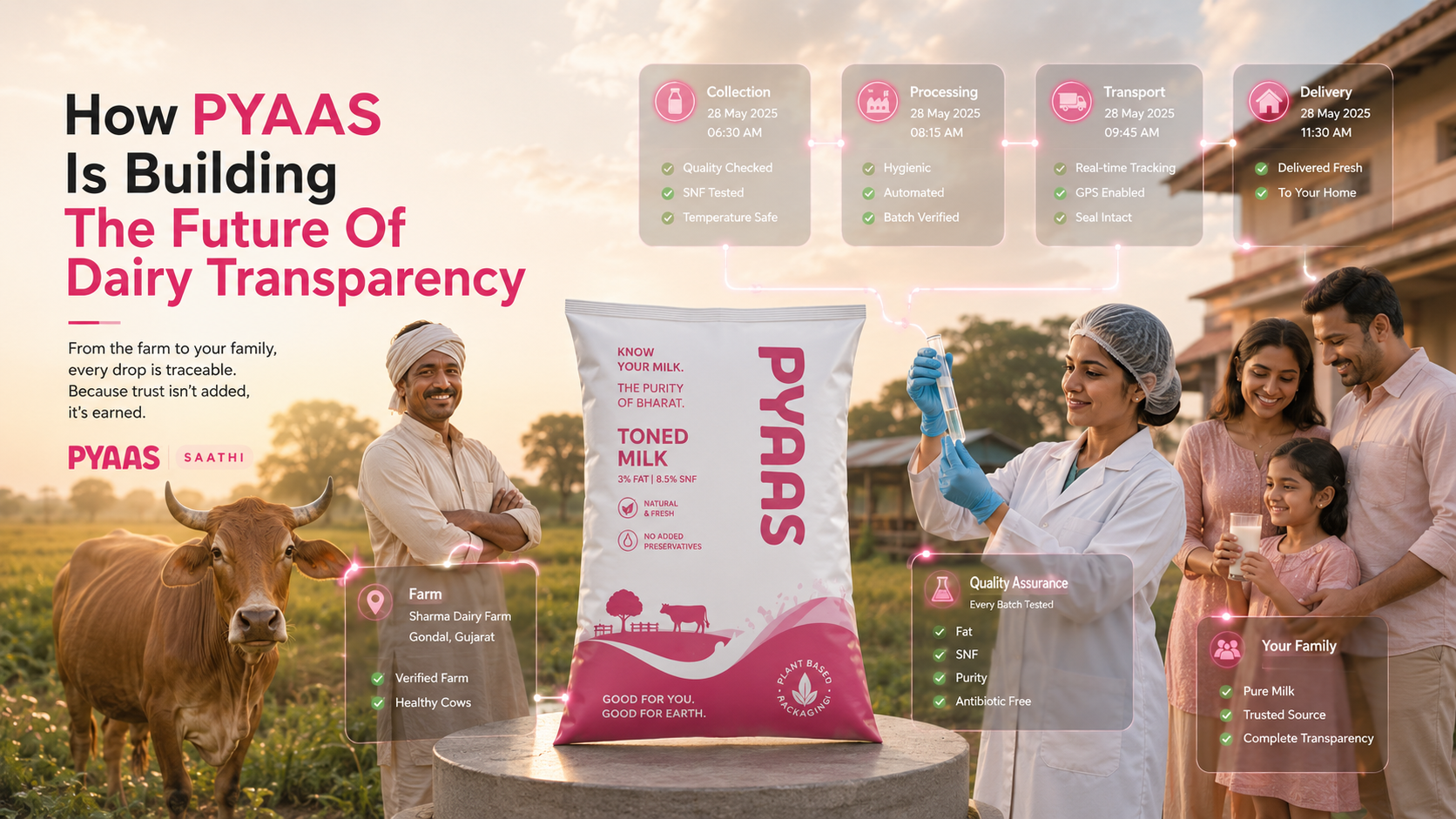
How PYAAS Is Building The Future Of Dairy Transparency
29 June 2026