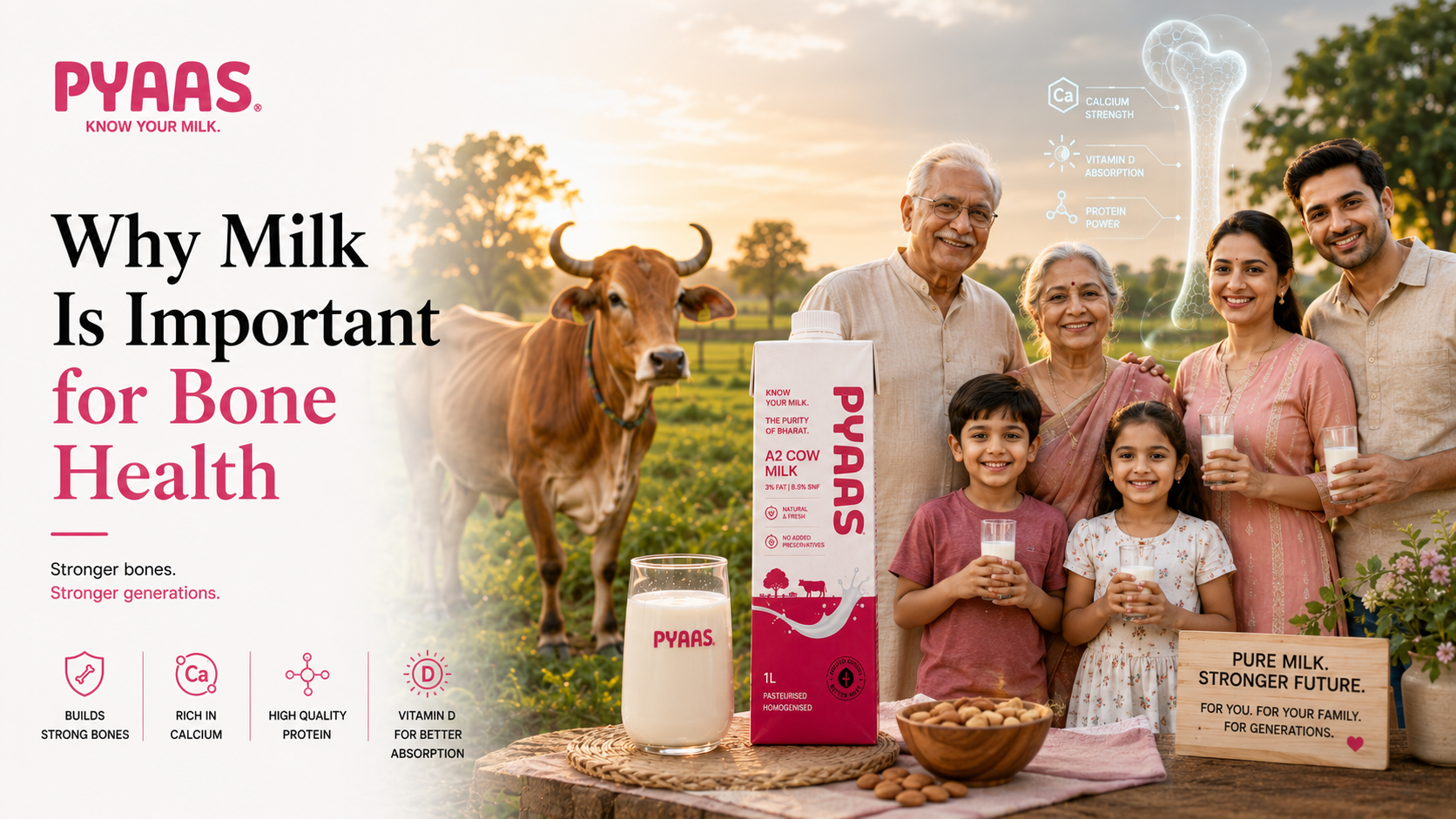
Why Milk Is Important for Bone Health: Understanding the Science
For generations, Indian families have grown up hearing the same gentle advice at the dinner table: drink your milk, it is good for your bones. That wisdom is not just a comforting tradition. There is real science behind why milk is important for bone health, and understanding it helps you make better choices for everyone at home, from a toddler taking first steps to a grandparent who wants to stay active and independent.
In this guide we explain how the nutrients in milk support strong, healthy bones across every stage of life, why the quality and source of your milk matter just as much as the glass itself, and how a transparent, traceable approach to dairy helps your family get the full benefit of what milk has to offer.
How Milk Supports Bone Health: The Science Made Simple
Your skeleton does far more than hold you upright. Bones provide structure, allow you to move, protect vital organs like the heart and lungs, and act as the body's main storehouse of minerals. Bone is living tissue that is constantly being broken down and rebuilt, and that lifelong renewal depends heavily on a steady supply of the right nutrients.
Milk happens to be one of the most nutrient-dense, naturally complete foods for this exact purpose. A single glass delivers a combination of bone-friendly nutrients that are difficult to match from any other single source. The most important of these include:
- Calcium: the primary mineral that gives bones their hardness and strength.
- Phosphorus: works alongside calcium to form the structural framework of bone.
- High-quality protein: forms the flexible collagen matrix that calcium binds to.
- Potassium and magnesium: support the body's mineral balance and bone metabolism.
- Vitamins: milk naturally contributes to a balanced diet that aids nutrient absorption.
Together these nutrients make milk a practical, affordable and familiar way to support normal bone development and maintenance. To understand the full nutritional picture, it helps to read our breakdown of milk nutrition facts and what is really inside your glass of milk.
Calcium and Protein: The Two Pillars of Strong Bones
Calcium is the nutrient most people associate with bone health, and for good reason. Roughly the vast majority of the body's calcium is stored in the bones and teeth. The body uses calcium not only to keep bones dense and strong, but also for muscle function, nerve signalling and blood clotting. Here is the catch: your body cannot produce calcium on its own. It must come from your diet, every single day, which is why a reliable food source like milk is so valuable.
Protein is the quieter partner in this story, and it is just as essential. Bone is not made of minerals alone. Calcium and phosphorus crystallise onto a scaffold built from collagen, a protein. Without enough good-quality protein, bones can become brittle even when calcium intake is adequate. Milk supplies both calcium and protein in one convenient package, which is part of why it has remained a dietary staple worldwide.
Why the Type of Milk Can Matter
Not all milk is the same. Many Indian families today are looking more closely at the kind of milk they buy, including the difference between A1 and A2 protein. If you are curious about this, our explainers on what A2 milk is, its benefits and myths and the deeper dive into A1 versus A2 milk and the real difference are good places to start. What matters for bone health is consistent intake of clean, nutrient-rich milk, and feeling confident about what is in your glass.
Bone Health Across Every Stage of Life
The role milk plays changes as we grow, but it stays important from childhood right through to the senior years.
- Children and adolescents: these are the bone-building years. The body lays down most of its peak bone mass before adulthood, so good nutrition early on sets up a stronger skeleton for life. Parents choosing milk for growing children may find our parent's guide to choosing quality milk for children helpful.
- Adults: the focus shifts from building bone to maintaining it. A balanced diet that includes calcium-rich foods helps preserve the bone strength built earlier in life.
- Seniors: as we age, bones naturally lose some density, and maintaining intake of calcium and protein becomes more important than ever for staying mobile and steady on your feet.
At every stage, milk works best as part of a broader healthy lifestyle that includes weight-bearing physical activity, sunlight for natural vitamin D, and an overall balanced diet.
Why Milk Quality and Source Matter for Bone Health
Here is something many people overlook: the bone benefits of milk depend on the milk actually being clean, fresh and genuine. Adulterated or poorly handled milk does not deliver the nutrition you are paying for, and in India this is a real concern. We encourage every family to understand milk adulteration in India and what consumers need to know so they can shop with confidence.
When you are choosing milk for your family's bone health, the questions worth asking go beyond calcium content:
- How fresh is it? Nutrients are best preserved in milk that reaches you quickly after milking.
- Is it tested? Lab testing for fat and solids-not-fat (SNF) confirms genuine, full-value milk.
- Where did it come from? Knowing the farm and the farmer builds real trust.
- Can you verify any of this? Transparency is what separates a claim from a promise.
This is exactly the gap PYAAS was built to close. Our single-origin A2 cow milk comes from named farms in Gonda, Uttar Pradesh, and every pack carries a QR code you can scan to see the exact farm, the farmer's name, that batch's lab test results and the time the milk left the farm. That is what we mean by Know Your Milk. If you want to understand why this kind of verification is becoming the standard, read what traceable milk is and why modern consumers want to know their milk.
Beyond Milk: Ghee in a Balanced Diet
Milk is also the source of one of India's most cherished foods. Traditional A2 Bilona ghee, made by hand-churning cultured curd, has long held a place in Indian kitchens and Ayurvedic tradition. While ghee is enjoyed for its flavour and culinary value rather than as a calcium source, it reflects the same principle we apply to milk: quality begins at the farm, and transparency lets you trust what you bring home.
The Bigger Picture: Milk Is One Piece of the Puzzle
It is important to be honest here. No single food guarantees strong bones, and milk is not a magic solution on its own. Lifelong bone health is built from a combination of factors working together:
- A balanced, varied diet rich in calcium, protein and key minerals.
- Regular weight-bearing exercise and physical activity.
- Adequate vitamin D, often from safe sun exposure.
- Healthy lifestyle habits maintained consistently over the years.
Within that bigger picture, milk plays a genuinely valuable role. It is one of the easiest and most enjoyable ways to deliver several bone-supporting nutrients in a single serving, which is why it has remained a daily ritual in homes across India for generations.
At PYAAS, we believe families deserve to understand not only the science of why milk supports their bones, but also exactly where that milk comes from and how it was tested. That belief is part of the story behind our founding family and everything we do. If you would like milk you can actually trace, glass after glass, we would love to help you know your milk, and feel good about every sip you pour for the people you love.
Written by
PYAAS Team
The PYAAS Team writes about dairy nutrition, milk quality and traceability to help Indian families make informed choices and truly know their milk.
More from PYAAS TeamCommon questions.
Why is milk good for bone health?
Milk naturally contains calcium, phosphorus and high-quality protein, the key nutrients bones need to stay strong. Calcium gives bones their hardness, while protein forms the collagen scaffold that calcium binds to. Together these nutrients support normal bone development and maintenance, which is why milk is a valuable part of a balanced diet.
Is calcium the only nutrient in milk that helps bones?
No. While calcium is the most well-known bone nutrient, milk also provides protein, phosphorus, potassium and magnesium, all of which play a role in building and maintaining healthy bones. Protein in particular is essential because it forms the flexible framework that calcium crystallises onto. Milk is valued precisely because it delivers several of these nutrients together.
How much milk should I drink for strong bones?
There is no single number that suits everyone, since needs vary by age, diet and overall health. The key is consistent intake of calcium-rich foods as part of a balanced diet, along with exercise and vitamin D. Milk is one convenient way to contribute to your daily calcium and protein, but it works best alongside other healthy habits.
Is milk only beneficial for children's bones?
Not at all. Children and adolescents build most of their peak bone mass early in life, but adults need calcium and protein to maintain that bone strength, and seniors need it to slow natural bone loss. Milk remains a nutrient-rich food that supports bone health for people of all ages.
Does the quality and source of milk affect its bone benefits?
Yes. The nutritional value of milk depends on it being genuine, fresh and clean, since adulterated or poorly handled milk does not deliver the nutrition you expect. Freshness, lab testing for fat and SNF, and trusted sourcing all matter. Traceable milk, where you can verify the farm and batch test, gives families confidence they are getting full-value milk.
Get the next one in your inbox.
The occasional note on milk, ghee, and how we work. Plain words, no hype, and you can leave any time.
Keep reading.
Milk Nutrition Facts: What Is Really Inside Your Glass of Milk?
12 July 2026
Best Milk for Children: A Parent's Guide to Choosing Quality Milk
9 July 2026
Best Milk for Seniors: What Older Adults Should Look For
7 July 2026
What Is A2 Milk? Benefits, Myths and How It Differs from Regular Milk
4 July 2026